Showing posts with label depression. Show all posts

Tuesday, September 8, 2009

"The Stonewalling of Peak Oil," By Dr. Robert Hirsch, ASPO-USA, September 7, 2009

Dr. Robert L. Hirsch is the lead author of a seminal report, "Peaking of World Oil Production: Impacts, Mitigation & Risk Management," written for the U.S. Department of Energy’s National Energy Technology Laboratory (DOE-NETL) and released in early 2005.

"When the report was done, management at NETL really didn’t know what to do with it because it was so shocking and the implications were so significant. Finally, the NETL director decided that she would sign off on it because she was retiring and couldn’t be hurt, or so I was told. The report didn’t get widely publicized. It somehow was picked up by a high school someplace in California; eventually NETL put it on their website. The problem for people at NETL—and these are really good people—was that they were under a good deal of pressure to not be the bearers of bad news -- pressure from people in the hierarchy of the DOE. This was true in both Republican and Democratic administrations. There is, I think, ample evidence, and some people in DOE have gone so far as to say it specifically, that people in the hierarchy of DOE, under both administrations, understood that there was a problem and suppressed work in the area. Under President Bush, we were not only able to do the first study but also a follow-on study that looked at mitigation economics. After that, visibility apparently got so high that NETL was told to stop any further work on peak oil.

Yes, that was terrible. And it was strictly politics and political appointees—I have no idea how far up in either administration (the current one and previous one) these issues went or now go. People in the Clinton administration had talked about peak oil, including President Clinton and Vice President Gore, and the same thing is true in the Bush administration, and the same is true, to the best of my knowledge, in the Obama administration.

The peak oil story is definitely a bad news story. There’s just no way to sugar-coat it, other than maybe to do what I’ve done on occasion and that is to say that by 2050 we’ll have it right and we will have come through the peak oil recession—quite probably a very deep recession. At some point we’ll come out of this because we’re human beings, and we just don’t give up. And I have faith in people ultimately. But it’s a bad news story and anybody’s who’s going to stand up and talk about the bad news story and is in a position of responsibility in the government needs to then follow immediately and say “here’s what we’re going to do about it,” and no one seems prepared to do that.

Peak oil is a bigger issue than health care, than federal budget deficits, and so forth. We’re talking about something that, to take a middle of the road position—not the Armageddon extreme and not the la-la optimism of some people—is going to be extremely damaging to the U.S. and world economies for a very long period of time. There are no quick fixes."

(VIEW FULL INTERVIEW)

Blog Comment: Dr. Hirsch says that "there’s just no way to sugar-coat [Peak Oil]," but that is what he does. There is no plan or technology for replacing oil, nor is there time or capital to do so. After listening to his speeches, it is clear that his beliefs in America, technology, and the human will distort his scientific analysis. Denial is way of avoiding the horror of the reality ahead.

Sunday, February 1, 2009

Peak Oil and the Global Economy

Recent news headlines reveal that the U.S. economy is deteriorating rapidly: “Be Prepared for More Cutbacks,” “Mass Layoffs Continue at Rapid Pace,” and “Economy’s Plunge is Worst in Quarter-Century.”

The Work Bank forecasts that the recession of 2008 will extend into 2009 and probably to 2010:

“A pronounced recession is believed to have begun in mid-2008 in Europe, Japan, and most recently, the United States. This recession is projected to extend into 2009. The possibility of a serious global recession cannot be ruled out. Even if the waves of panic that have inundated credit and equity markets across the world are soon brought under control, the crisis is likely to cause a sharp slowdown in activity stemming from the deleveraging in financial markets that has already occurred and that is expected to continue.”

The World Bank sees some signs of optimism for 2010, but concludes that “global recession is likely to be protracted” and “an even sharper recession is likely.”

A variety of analysts of The Wharton School, forecast a deep recession extending through 2010 and possibly beyond.

Gerald Celente, Editor and Publisher of "The Trends Journal," forecasts a global economic collapse beginning in 2009 (interview summary, not quoted directly):

The global economy will collapse in 2009, resulting in the worst recession in the post WW II period. The commercial real estate sector is highly leveraged and will collapse beginning in late February or early March as major retailers fail, leaving vacant rental space that will not be filled. This will lead to further failures in the finance and banking sectors and higher unemployment which is at 13% and growing.

Some two-thirds of the U.S. economy is based on consumerism, which is declining rapidly due to increasing unemployment. Declining personal income means a shrinking tax base and a need to raise state, local, and federal taxes and user fees.

This economic collapse, Celente believes, will lead to the "Greatest Depression," more corporate fraud, increased street crime, taxpayer revolts, rioting, and revolution. Survival is now a real concept as people lose investments and jobs. A return to frugality and self-sufficiency will characterize the economy in years to come.

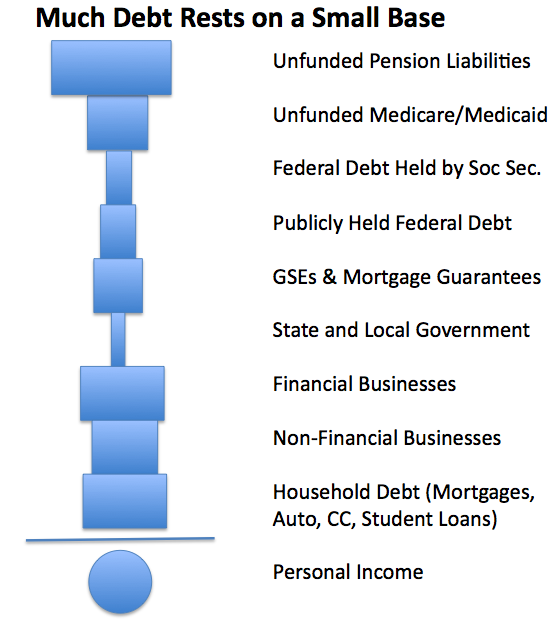
Financial analyst Gail Tverberg explains the economic crisis in terms of a “Tower of Debt.” Because most debt ultimately rests on personal income, as personal income declines most debts are at risk: unfunded pension liabilities, unfunded Medicare and Medicaid, Social Security debt, publicly held federal debt, government sponsored enterprises (such as Fannie Mae and Freddie Mac), state and local government debt, financial businesses, businesses, and household debt (mortgages, credit cards, and education loans). This supports Gerald Celente’s forecast. When personal income declines (due to increasing unemployment), consumerism declines, retails businesses fail, highly leveraged commercial centers fail and default on loans, causing banking and financial institutions to collapse.

ASPO-Ireland examines the economy in light of Peak Oil (excerpts from the ASPO Newsletter):

“Oil demand had begun to outpace supply around 2005, when the production of Regular Conventional Oil passed its peak. The shortfall was however relatively small and was partly met without undue difficulty by a modest reduction in consumption.

But as prices began to firm, oil traders and other speculative financial institutions began to take a position in the market, which had the effect of driving up the price. Gradually the process built momentum as huge notional profits were reaped from the appreciating asset. In a conventional market such movements would soon be countered by increased production, but in the case of oil, there was no spare capacity to release, and the speculative surge fed on itself leading to an extreme escalation in price which reached about $150 a barrel by July 2008. However as this peak [in prices] was approached, the traders began to conclude that a limit was close and began to buy future options at lower prices, which began to undermine the price in a self-fulfilling process. In parallel the high prices began to undermine many other aspects of the economy with for example airlines and automobile manufacturers facing difficulties. They themselves relied heavily on debt, which itself was traded between banks without adequate genuine collateral, and were forced to unload their speculative oil positions in order to try to shore up their failing businesses. Gradually the whole edifice collapsed, and oil prices fell to around $50 a barrel, although nothing particular had changed in the actual supply/demand relationship.

The flaw in the system was to treat a finite resource whose production was largely controlled by the immutable physics of the reservoir as if it were a normal commodity capable of responding to ordinary market pressures. If the price of potatoes increases, farmers can grow more and the market responds, but oil is different.

Governments responded to the crash by pouring yet more money, itself lacking genuine collateral, into the system in the mistaken belief that this would restore the position of assumed eternal growth, and quite possibly the stock market will respond positively as traders sense a new upward direction. They have no real interest in reality: their job being to try to reap rewards from short term movements.

But if there is an economic recovery, that would serve to increase the demand for oil, which is in a sense the lifeblood of the modern world, and oil prices would again begin to surge. Probably, it will take several such vicious circles before governments and, more important, people at large at last come to grasp the reality of the situation, which will likely prompt radical changes in the human condition.

Meanwhile, desperate efforts are being made around the world to shore up the crumbling financial system. For example, the Bank of England has radically reduced interest rates in a country facing a severe recession, effectively taking money from savers to give to spenders.

The Government has evidently failed to grasp the underlying causes of recession and hopes that pumping a bit of money into the system will restore it to its previous condition. That was premised on eternal economic growth, which is a somewhat unrealistic proposition for a Planet of finite dimensions, but Governments subject to re-election are by nature short-term in their thinking.

One is led to conclude that the entire Stock Market, including especially the oil market, has become a thoroughly debased speculative institution. In earlier years, investors clubbed together to build a specific project, such as a canal or railway, with the resulting dividend being the prime motivation. Things seemed to have gone wrong when such investments were traded on markets by financial institutions which naturally can have no serious knowledge of the underlying business or the true value to be placed upon it.”

Energy investment banker Matthew Simmons, like ASPO-Ireland, notes that today’s low oil prices and credit shortage will reduce investments needed for oil production, resulting in lower oil production in the future, followed by increasing oil prices as demand out strips supply, which will then cause another economic downturn in the future. Simmons also notes that the aging oil infrastructure of drilling rigs, rusting platforms, pipelines, and refineries must be renovated, requiring trillions of dollars in investments at a time when credit is tight..

Independent studies indicate that Peak Oil occurred between 2005 and 2008 and that global crude oil production will now decline from 74 million barrels per day to 60 million barrels per day by 2015. During the same time, demand will increase. Oil supplies will be even tighter for the U.S. As oil producing nations consume more and more oil domestically they will export less and less. Because demand is high in China, India, the Middle East, and other oil producing nations, once global oil production begins to decline, demand will always be higher than supply. And since the U.S. represents one fourth of global oil demand, whatever oil the U.S. conserves will be consumed elsewhere. Thus, conservation in the U.S. will not slow oil depletion rates significantly. More and more oil is expended in oil production and processing as lower grades of oil are extracted from an increasing number of smaller oil fields that are located in hard to access ocean depths. These factors will increase the oil production decline rate above the six percent that is forecasted in a few years

These Peak Oil factors suggest that there will be no economic recovery following the economic collapse of 2009 and that the recession will deteriorate into a permanent economic depression that will worsen over time.

In 2007, the U.S. General Accountability Office (advised by a panel of 13 scientists of the National Academy of Sciences) examined the potential of alternative energies for replacing liquid fuels (that are vital for transportation and food production):

“An imminent peak and sharp decline in oil production could have severe consequences. The technologies we examined [ethanol, biodiesel, biomass gas-to-liquid, coal gas-to-liquid, and hydrogen] currently supply the equivalent of only about 1% of U.S. annual consumption of petroleum products, and DOE [U.S. Department of Energy] projects that even under optimistic scenarios, these technologies could displace only the equivalent of about 4% of annual projected U.S. consumption by around 2015. If the decline in oil production exceeded the ability of alternative technologies to displace oil, energy consumption would be constricted, and as consumers competed for increasingly scarce oil resources, oil prices would sharply increase. In this respect, the consequences could initially resemble those of past oil supply shocks, which have been associated with significant economic damage. For example, disruptions in oil supply associated with the Arab oil embargo of 1973-74 and the Iranian Revolution of 1978-79 caused unprecedented increases in oil prices and were associated with worldwide recessions. In addition, a number of studies we reviewed indicate that most of the U.S. recessions in the post-World War II era were preceded by oil supply shocks and the associated sudden rise in oil prices. Ultimately, however, the consequences of a peak and permanent decline in oil production could be even more prolonged and severe than those of past oil supply shocks. Because the decline would be neither temporary nor reversible, the effects would continue until alternative transportation technologies to displace oil became available in sufficient quantities at comparable costs. Furthermore, because oil production could decline even more each year following a peak, the amount that would have to be replaced by alternatives could also increase year by year.”

There is no plan nor capital for a so-called electric economy. And most alternatives yield electric power, but we need liquid fuels for tractors/combines, 18 wheel trucks, trains, ships, and surface mining equipment.

The independent scientists of the Energy Watch Group conclude in a 2007 report titled: “Peak Oil Could Trigger Meltdown of Society:”

"By 2020, and even more by 2030, global oil supply will be dramatically lower. This will create a supply gap which can hardly be closed by growing contributions from other fossil, nuclear or alternative energy sources in this time frame."

With increasing costs for gasoline and diesel, along with declining taxes and declining gasoline tax revenues, states and local governments will eventually have to cut staff and curtail highway maintenance. Eventually, gasoline stations will close, and state and local highway workers won’t be able to get to work.

We are facing the collapse of the highways that depend on diesel and gasoline powered trucks for bridge maintenance, culvert cleaning to avoid road washouts, snow plowing, and roadbed and surface repair.

When the highways fail, so will the power grid, as highways carry the parts, large transformers, steel for pylons, and high tension cables from great distances.

With the highways out, there will be no food coming from far away, and without the power grid virtually nothing modern works, including home heating, pumping of gasoline and diesel, airports, communications, and automated building systems.

Governments, business and individuals should prepare for the impacts of Peak Oil.

Friday, January 23, 2009

Gerald Celente: Economic Trends for 2009

Gerald Celente is Editor and Publisher of "The Trends Journal"
Interivew MP3 January 17, 2009

Summary of the Interview: (not quotations)

The trend for 2008 was panic, a crashing stock market, some major retail store closings, and the loss of 2 million jobs in the last quarter of 2008.

The global economy will collapse in 2009, resulting in the worst recession in the post WW II period. The commercial real estate sector is highly leveraged and will collapse beginning in late February and March as major retailers and financial institutions fail, leaving vacant rental space that will not be filled. This will lead to further failures in the finance and banking sectors and higher unemployment.

Real unemployment is 13% and growing.

Some two-thirds of the economy is based on consumerism, which is declining rapidly due to increasing unemployment. Declining personal income means a shrinking tax base and a need to raise state, local, and federal taxes and user fees.

This will lead to the "Greatest Depression," increased street crime, more corporate fraud, taxpayer revolts, rioting, and "revolution." Survival is now a real concept as people lose investments and jobs. A return to frugality and self-sufficiency will characterize the economy in years to come.

Wednesday, January 21, 2009

The Wharton School: Global Economic Forecast for 2009

Knowledge@Wharton

January 7, 2009

After a year of financial shock and sharp economic loss, 2009 is likely to be extremely difficult for the global economy, with investors, business leaders and policymakers struggling to find signs of recovery, according to Wharton faculty and academic partners around the world.

"It's all pretty negative," says Wharton finance professor Franklin Allen. "The economy is going into a recession and my own view is that it will be deep and quite long-lasting. There doesn't seem to be anything on the horizon that is a bright spot."

In the wake of crumbling stock markets, mounting bad debt and rising unemployment, policymakers are scrambling to devise strategies to restore stability and lay the groundwork for new growth. "There's no country in the world that's doing well," Allen continues. "Everybody is doing badly, with large amounts of debt and heading toward deflation," plus "unemployment and a rush by companies to fire people."

The collapse in the United States is different than in other industrialized countries around the world because the problems began in the financial sector and spread out into the broader economy, says Wharton management professor Mauro Guillén. In the rest of the world, problems in the real economy -- created largely by trouble in the United States -- led to weakness in financial markets. "In the United States, the key in 2009 is, 'Can we clear up the mess in the financial sector?' Unfortunately, I'm not very optimistic," says Guillén.

Wharton finance professor Richard Marston says he is shocked by the impact of the crisis on U.S. financial firms and markets. "To see Wachovia, Wash Mutual, Citi all gravely wounded. It's extraordinary." Marston contends that while the banks have been shored up, they are unlikely to lend for a long time. On top of that, he adds, the inability to securitize will constrain credit more than if banks alone had cut back on lending. (Continued here)

Tuesday, January 20, 2009

Financial Forecast for 2009, by Gail Tverberg

Excerpts from Theoildrum.com, January 6, 2009 (the full article includes much data and is followed by a discussion).

We are due for a debt unwind, and with it a rapid decline in the US standard of living. Exactly what form it will take, and what the timing will be (for example, sudden one month from now or sudden three years from now, or gradual over a longer period), isn't certain. I would expect that many (or most) other economies in the world will be dragged along in this debt unwind and will experience a decline in their standards of living.

Many asset classes are correlated in time of stress, the tower of debt (Figure 1) has many feedback loops, and tends to magnify the economy's reaction to events, both favorable and unfavorable.


(FIGURE 1) (click on figure to read)

When consumer debt is rising it tends to make the economy look very, very good. When there are layoffs, the interrelationships tend to magnify the impact, making the economic impact much worse. One wonders whether there are tipping points, beyond which it is not really possible for the system to recover--particularly now that the US seems to be at the point of "peak energy" (Section 3), energy is required for growth (Section 3), and growth is required to allow debt to continue (Section 2).

The tower of debt is in some ways deceptive. It can make the economy look mostly OK to the casual observer, until all too quickly, things start to fall apart.

So far, the "fixes" that the US government has been attempting seem mostly counterproductive. Putting government guarantees behind more and more debt (thus stacking Figure 1 higher and higher, with a new TARP layer) just increases the likelihood that the US government will be drawn into the downward spiral. The financial services layer will be less and less needed in years ahead, as our need for debt-based products declines. Bailing it out does not help get additional income to ordinary workers (although it may temporarily protect them from losing their bank account balances).

All aspects of finances will be affected by the unwind of debt. A huge amount of debt will be defaulted on (or will be forgiven, so that an actual default does not need to occur). Regardless of whether the non-payment occurs because of default or forgiveness, the effect on financial institutions will be the same. Financial institutions such as banks, insurance companies, pension funds, and many hedge funds will find themselves in poor financial condition, because they were depending on the proceeds of this debt repayment to fund what they have promised--bank account balances; insurance policies; pension payments; or hedge fund returns. Institutions guaranteeing debt, such as monoline bond insurers will be particularly hard hit. The FDIC will likely be called on to rescue many failed banks, and will need to find funds from some source (printed money?) to do this.

As the year goes on, I expect each evaluation of where we are to be worse. Banks will report operating losses each quarter. Fannie and Freddie will need more funds than originally thought. TARP will need more funds than original planned. More and more businesses will enter bankruptcy, and more and more governments (states, cities, counties, and countries around the world) will find themselves unable to meet their obligations. There are a huge number of inter-relationships, and the bankruptcies and losses in one area will tend to cause more bankruptcies and losses in other areas, and act to destabilize the debt tower.

Debt of all forms will be very difficult to obtain, except through government sources. The interest rate the US government is currently paying is very low, mainly because of a "flight to quality". If the US government keeps issuing more and more debt, it seems likely that at some point this will change, because buyers will figure out that even if the US is the best of a bad lot, its risk of failure is significantly greater than 0%.

I do not expect a steep rise in the price of oil and natural gas in the next year, because the decline in demand is likely to outpace the decline in production in the short-term. If we look back at Figure 2, I expect that funds available to ordinary citizens will continue to decline in 2009, even considering any stimulus plan. This will happen because employee compensation will decline due to layoffs. Household debt outstanding will also decline (rather than just stay flat, as it has in the past year), because of the poor financial condition of lending institutions, and because with the poor economy, the risk of borrower default will be quite high, discouraging lending. A $300 billion stimulus program will be tiny in comparison to the boost the economy got in the past from increasing debt and greater refinancing (up to $2 trillion per year), as the prices of homes increased. With lower incomes, lower (actually net negative) cash flow from borrowing, and only a modest boost from a stimulus program, citizens will have less and less to spend on goods and services.

There is a distinct possibility that this could all end very badly. One possibility is that there will be more and more defaults, and the US government will not be able to prop up all of the institutions and will eventually default on its debt. While this seems to be the direction things are headed at the current time, the much more usual outcome is hyperinflation, caused by printing more and more money, wiping out the value of people's savings and pensions. Situations such as these are often accompanied by a new government (including a new constitution), and may even include different country boundaries (for example, Soviet Union after its fall).

Many people have started making preparation for the time when food needs to be produced locally and electricity is often not available. I would not discourage such preparations. While we do not know that the economy will collapse completely, I think such preparations are prudent, in the face of rising risk. Preparation for a major change takes many years, so starting earlier rather than later makes sense. Also, with the tower of debt (Figure 1) and the many feedback loops, the downward spiral can happen more quickly than our prior experience suggests is possible.

In conclusion, 2009 looks like a very challenging year for the new administration and for the world as a whole.