"Last week, the news was dominated by BP’s announcement on Wednesday that it had made a “giant” oil field discovery called Tiber, 35,000 feet beneath the surface of the Gulf of Mexico. BP did not announce the size of the find, but said it was comparable to other discoveries in the area, leading to press speculation that the Tiber find was on the order of 1-3 billion barrels. Initially the announcement that oil could be found so far below the surface was greeted with much enthusiasm with some stories suggesting that a new era of finding oil was at hand and that exploration in the Gulf would revive.
Within a day reality set in as reporters learned that it was likely to take ten years of difficult and expensive drilling before any oil could be produced and even then less than a third of the oil, and possibly as little as 5 to 15 percent, can be recovered. Given that production from existing fields in the Gulf is likely to start declining rapidly in the next few years, oil from the deep water discoveries is unlikely to be sufficient to increase production from the Gulf.
Production in the Gulf of Mexico accounts for about a quarter of total U.S. oil production, or about 1.2 million barrels a day. Gulf production peaked in 2003 at 1.56 million b/d. Most Gulf production wells tend to hit their peak within a year or two, and then begin to drop steeply several years later. Oil production in federal waters of the U.S. Gulf fell 9.8 percent last year, to the lowest since 1997, as new finds failed to keep pace with declining output from fields discovered in the 1970s and 1980s."
(VIEW FULL ARTICLE)
Showing posts with label oil depletion. Show all posts
Showing posts with label oil depletion. Show all posts
Tuesday, September 8, 2009


Monday, September 7, 2009
"Simmons vs Yergin, Lynch et al on Peak Oil," By Kate Mackenzie, Financial Times, September 7, 2009
Kate Makenzie at the Financial Times is trying to inform readers about Peak Oil. She counter poses William Simmons with Daniel Yergen, Michael Lynch, and Ed Morse. Readers are left with questions about who is right. Here is my my published comment :
Global oil production peaked in 2008 and is now in terminal decline. The evidence is clear. During the period 2004 to 2008, as oil prices climbed, all oil producers were pumping at maximum effort with historically high oil prices. During this period, oil production remained flat, peaked a bit in July 2008 and then began to decline while oil prices were very high and before the October global economic collapse, as documented here. And the depletion picture is far worse than Simmons indicated, as explained here.
Global oil production peaked in 2008 and is now in terminal decline. The evidence is clear. During the period 2004 to 2008, as oil prices climbed, all oil producers were pumping at maximum effort with historically high oil prices. During this period, oil production remained flat, peaked a bit in July 2008 and then began to decline while oil prices were very high and before the October global economic collapse, as documented here. And the depletion picture is far worse than Simmons indicated, as explained here.
Sunday, September 6, 2009
"What the IEA Doesn't Want You to Know About Peak Oil," By Lionel Badal, Seeking Alpha, September 6, 2009
"It is not in the interest of some IEA member states, in particular its most powerful member, namely the USA, that the agency provides an honest assessment of the situation. Admitting Peak Oil is real also means that you acknowledge our current way of life is about to (radically) change. And not everyone wants the public to know that. Irresponsible, dishonest? Absolutely."
(VIEW FULL ARTICLE)
Blog Comment: Mr. Birol, Chief Economist at the International Energy Agency has misinformed the public by indicating that global oil production will peak in the in the long term future.
The global oil production plateau from 2004 to 2008 is clear evidence of the peak. As oil prices climbed during this period, oil production leveled off. For more detail, see:
http://survivingpeakoil.blogspot.com/2008/12/top-story-of-year-global-oil-production.html
And the situation is more dire than Mr. Birol indicates:
http://survivingpeakoil.blogspot.com/2009/06/net-hubbert-curve-what-does-it-mean-by.html
(VIEW FULL ARTICLE)
Blog Comment: Mr. Birol, Chief Economist at the International Energy Agency has misinformed the public by indicating that global oil production will peak in the in the long term future.
The global oil production plateau from 2004 to 2008 is clear evidence of the peak. As oil prices climbed during this period, oil production leveled off. For more detail, see:
http://survivingpeakoil.blogspot.com/2008/12/top-story-of-year-global-oil-production.html
And the situation is more dire than Mr. Birol indicates:
http://survivingpeakoil.blogspot.com/2009/06/net-hubbert-curve-what-does-it-mean-by.html
Friday, September 4, 2009
"Oil Spin: Ignore the Optimsts, Peak Oil is Real," By Matthew R. Simmons, Foreign Policy, Sepetmeber 4, 2009
"Last week, four of the world's most outspoken oil aficionados waded into the controversy of peak oil, publishing articles packed with myth and distortion. This "Gang of Four" all claimed the issue was silly, moot, or simply a myth. The four pieces were Pulitzer Prize-winning author Daniel Yergin's seven-page article in Foreign Policy, energy analyst Michael Lynch's three column op-ed in the New York Times, analyst Edward Morse's essay in Foreign Affairs, and scholar Amy Jaffe's paper published by the Baker Institute at Rice University.
(VIEW FULL ARTICLE)
(VIEW FULL ARTICLE)
Sunday, August 2, 2009
"The Indendent" (London) Warns about Peak Oil
Peak Oil is now, not a decade away as "The Independent" indicates. According to most independent sources, global oil production peaked in 2008. "The Independent" relies on the optimistic IEA for forecasts. But the IEA is NOT an independent agency, as it tends to speaks for global oil and industrial interests. But the IEA indicates that "the oil crisis begins to grip after 2010."
What are your local, state, and federal governments planning for? Chief Economist Fatih Birol at the International Energy Agency warns that “many governments appeared oblivious to the fact that the oil on which modern civilisation depends is running out far faster than previously predicted...” Birol sees a supply crunch within the next few years that will jeopardize hopes of an economic recovery.
The IEA is one reason that governments are oblivious. The IEA has been downplaying Peak Oil for years, and still is in saying that Peak Oil is 10 years away.
Global oil production peaked in 2008 and depletion is steeper than the "The Independent" indicates.
Saturday, July 18, 2009
"Peak Oil: Myth or Reality -- A List of Countries Past Peak," By Praveen Ghanta, Theoildrum.com, July 18, 2009
Only 14 of the 54 oil producing nations in the world are still increasing their oil production. The era of cheap oil is definitively over, as shown below. Posted on Theoildrum.com with discussion HERE.
Is peak oil real? The BP Statistical Review of World Energy provides the data needed to answer this question. Using the 2009 edition, I have compiled a list of all oil producing countries and regions in the world, along with the production status of each, ordered by year of peak production. BP groups minor producers into categories like "Other Africa", and "Other Middle East", and that notation is used here. All production numbers are quoted in barrels/day.
| Country | Peak Prod. | 2008 Prod. | % Off Peak | Peak Year |
|---|---|---|---|---|
| United States | 11297 | 7337 | -35% | 1970 |
| Venezuela | 3754 | 2566 | -32% | 1970 |
| Libya | 3357 | 1846 | -45% | 1970 |
| Other Middle East | 79 | 33 | -58% | 1970 |
| Kuwait | 3339 | 2784 | -17% | 1972 |
| Iran | 6060 | 4325 | -29% | 1974 |
| Indonesia | 1685 | 1004 | -41% | 1977 |
| Romania | 313 | 99 | -68% | 1977 |
| Trinidad & Tobago | 230 | 149 | -35% | 1978 |
| Iraq | 3489 | 2423 | -31% | 1979 |
| Brunei | 261 | 175 | -33% | 1979 |
| Tunisia | 118 | 89 | -25% | 1980 |
| Peru | 196 | 120 | -39% | 1982 |
| Cameroon | 181 | 84 | -54% | 1985 |
| Other Europe & Eurasia | 762 | 427 | -44% | 1986 |
| Russian Federation | 11484 | 9886 | -14% | 1987* |
| Egypt | 941 | 722 | -23% | 1993 |
| Other Asia Pacific | 276 | 237 | -14% | 1993 |
| India | 774 | 766 | -1% | 1995* |
| Syria | 596 | 398 | -33% | 1995 |
| Gabon | 365 | 235 | -36% | 1996 |
| Argentina | 890 | 682 | -23% | 1998 |
| Colombia | 838 | 618 | -26% | 1999 |
| United Kingdom | 2909 | 1544 | -47% | 1999 |
| Rep. of Congo (Brazzaville) | 266 | 249 | -6% | 1999* |
| Uzbekistan | 191 | 111 | -42% | 1999 |
| Australia | 809 | 556 | -31% | 2000 |
| Norway | 3418 | 2455 | -28% | 2001 |
| Oman | 961 | 728 | -24% | 2001 |
| Yemen | 457 | 305 | -33% | 2002 |
| Other S. & Cent. America | 153 | 138 | -10% | 2003* |
| Mexico | 3824 | 3157 | -17% | 2004 |
| Malaysia | 793 | 754 | -5% | 2004* |
| Vietnam | 427 | 317 | -26% | 2004 |
| Denmark | 390 | 287 | -26% | 2004 |
| Other Africa | 75 | 54 | -28% | 2004* |
| Nigeria | 2580 | 2170 | -16% | 2005* |
| Chad | 173 | 127 | -27% | 2005* |
| Italy | 127 | 108 | -15% | 2005* |
| Ecuador | 545 | 514 | -6% | 2006* |
| Saudi Arabia | 11114 | 10846 | -2% | 2005 / Growing |
| Canada | 3320 | 3238 | -2% | 2007 / Growing |
| Algeria | 2016 | 1993 | -1% | 2007 / Growing |
| Equatorial Guinea | 368 | 361 | -2% | 2007 / Growing |
| China | 3795 | 3795 | - | Growing |
| United Arab Emirates | 2980 | 2980 | - | Growing |
| Brazil | 1899 | 1899 | - | Growing |
| Angola | 1875 | 1875 | - | Growing |
| Kazakhstan | 1554 | 1554 | - | Growing |
| Qatar | 1378 | 1378 | - | Growing |
| Azerbaijan | 914 | 914 | - | Growing |
| Sudan | 480 | 480 | - | Growing |
| Thailand | 325 | 325 | - | Growing |
| Turkmenistan | 205 | 205 | - | Growing |
| Peaked / Flat Countries Total | - | 49597 | - | 60.6% of world oil production |
| Growing Countries Total | - | 32223 | - | 39.4% of world oil production |
The evidence of the demise of the cheap oil era has become insurmountable. In the face of the highest oil prices on record, the great majority of the world's oil producers were incapable of taking advantage and producing more oil. Many nations including the US saw their oil production peak decades ago - there simply is no turning the clock back. This list shows that we are relying on a small number of countries to keep providing cheap oil. We need to move faster to alternatives and greater energy efficiency, before the last fourteen peak as well.
* More information on these countries:
- Russian Federation - Russia's oil production collapsed by the early 90's as the Soviet Union collapsed, but despite a decade of growth, Russia's own oil execs don't think the old peak can be surpassed.
- India's production appeared to plateau in 1995, and has stayed within a steady range since. The EIA forecasts Indian oil production to remain flat or decline slightly in the near future.
- Republic of Congo (Brazzaville) hit a production plateau in 1998, though current production is still very close to 1999 peak levels.
- Other Central & South America - The remaining countries of the Americas hit a production peak in 2003, though it's still too soon to know if this will be final peak.
- Malaysia has been on a production plateau since 1995, and the EIA projects flat or falling production.
- Other Africa - Oil production in much of Africa is potentially impacted by above-ground constraints, so it's definitely possible that production will rise here. It will rise from a low base of only 50,000 bpd however, and may not have much impact on total world production.
- Nigeria is impacted by domestic insurgencies in its oil-producing regions, and may be able to lift production if the political situation improves.
- Chad's oil production history is too short to definitively identify a peak in production, but the drop-off since 2005 has been dramatic.
- Italy has been on a production plateau for over 10 years, and it's unlikely that a mature economy is significantly under-exploiting its resource potential.
- Ecuador's production grew rapidly until 2004, but has leveled off and declined somewhat since then.
[1] To be considered past-peak, a producer's current (2008) production has to be at least 10% less than its best year, and the best year must have occurred prior to 2005. Some countries' production has been artificially constrained by political and other non-geological considerations. But in some of these cases, it will be difficult to pass an old peak because decades of depletion have occurred since that peak. Iraq peaked in 1979, making it all the more difficult to pass that now.
[2] While OPEC maintains formal production quotas, it is widely believed that only Saudi Arabia had true spare capacity in 2008, while all other OPEC nations were producing at capacity. The truth is unclear, since OPEC nations do not provide detailed reserve statistics for their oil fields.
Total has created its own short list of oil producers past peak, and Wikipedia has a list here.
Sunday, June 28, 2009
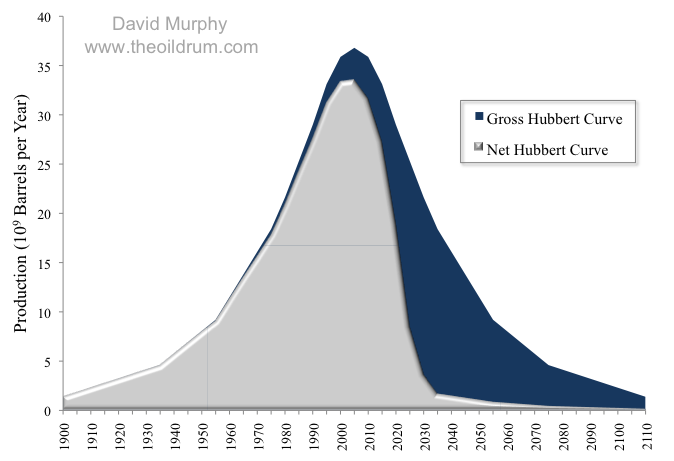
"The Net Hubbert Curve: What Does It Mean?" By David Murphy, The Oil Drum, June 22, 2009
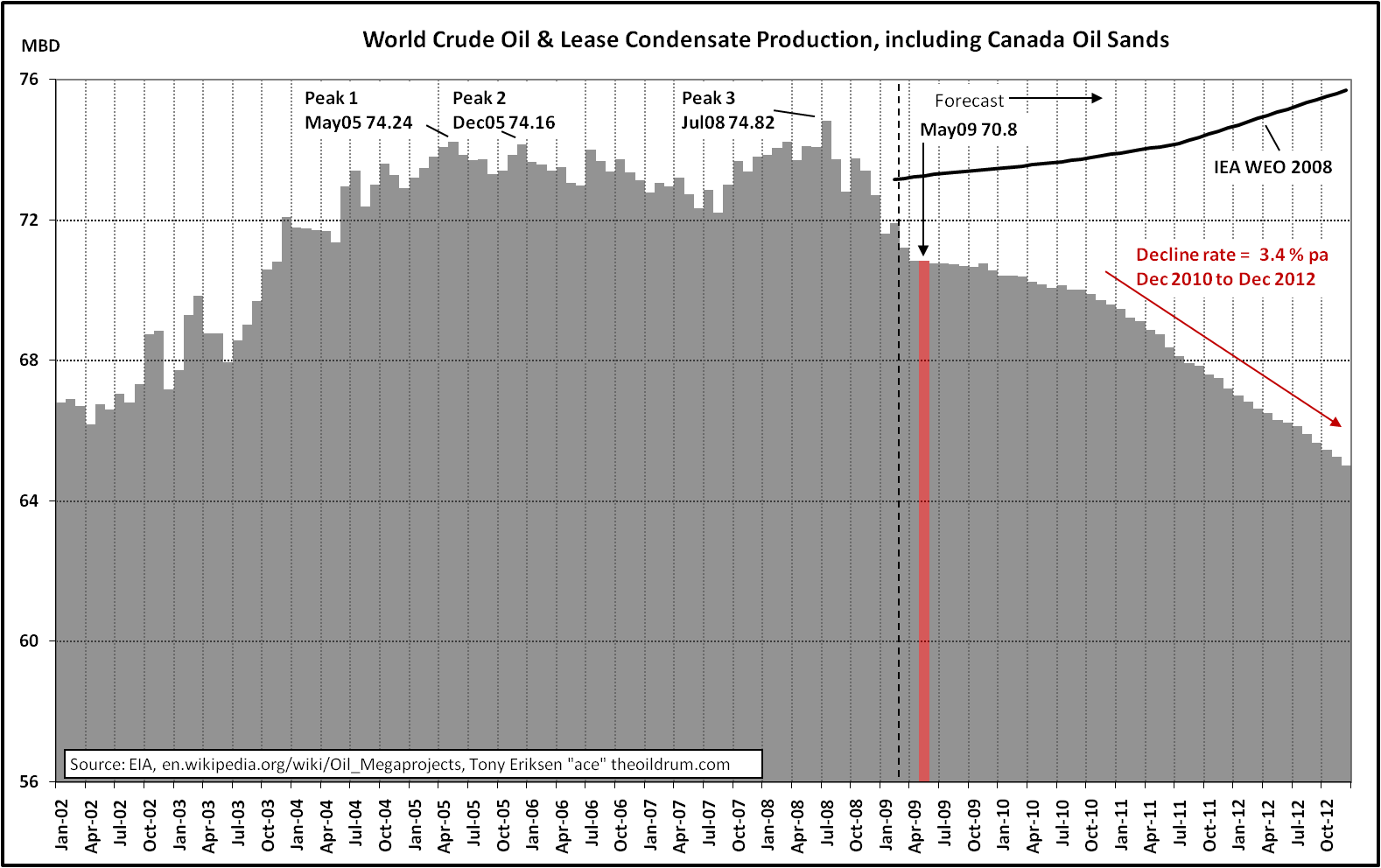
A recent post on this blog reviewed Tony Eriksen's study of declining oil production, which is summarized in this Figure. These data show a slow decline in global crude oil production currently and then accelerating after December 2010.
Because oil is used to produce oil, we should focus on net oil production, which is what we have left after oil is consumed to extract, refine, and deliver oil products to market. The rate of decline in net oil production is much steeper than for all oil produced, as shown in Murphy's Figure 3.
The drop in net oil production will probably be steeper than Murphy forecasts. Matthew Simmons estimates that 100 trillion dollars of investment is need to replace the globe's rusting infrastructure of pipelines, drilling rigs, platforms, and refineries. Much of this investment will consume oil to manufacture, transport, and assemble this infrastructure. And everyone who works on these 100 trillion dollars of projects will use their pay to buy products made out of oil or transported by oil. Currency is a ticket to buy oil. Thus less net oil will be produced than shown in Murhpy's Figure 3.
Also, as oil exporting nations consume more oil domestically they export less to the developed nations; hence, the oil supply available to developed countries will be considerably less than shown in Murphy's Figure 3.
This analysis indicates that oil supplies for the developed world will decline precipitously beginning in the next two years and the decline will accelerate over time.
This suggests that a rapid economic global collapse will occur in less than 10 years.
Because oil is used to produce oil, we should focus on net oil production, which is what we have left after oil is consumed to extract, refine, and deliver oil products to market. The rate of decline in net oil production is much steeper than for all oil produced, as shown in Murphy's Figure 3.
The drop in net oil production will probably be steeper than Murphy forecasts. Matthew Simmons estimates that 100 trillion dollars of investment is need to replace the globe's rusting infrastructure of pipelines, drilling rigs, platforms, and refineries. Much of this investment will consume oil to manufacture, transport, and assemble this infrastructure. And everyone who works on these 100 trillion dollars of projects will use their pay to buy products made out of oil or transported by oil. Currency is a ticket to buy oil. Thus less net oil will be produced than shown in Murhpy's Figure 3.
Also, as oil exporting nations consume more oil domestically they export less to the developed nations; hence, the oil supply available to developed countries will be considerably less than shown in Murphy's Figure 3.
This analysis indicates that oil supplies for the developed world will decline precipitously beginning in the next two years and the decline will accelerate over time.
This suggests that a rapid economic global collapse will occur in less than 10 years.
Sunday, February 1, 2009
Peak Oil and the Global Economy
Recent news headlines reveal that the U.S. economy is deteriorating rapidly: “Be Prepared for More Cutbacks,” “Mass Layoffs Continue at Rapid Pace,” and “Economy’s Plunge is Worst in Quarter-Century.”
The Work Bank forecasts that the recession of 2008 will extend into 2009 and probably to 2010:
“A pronounced recession is believed to have begun in mid-2008 in Europe, Japan, and most recently, the United States. This recession is projected to extend into 2009. The possibility of a serious global recession cannot be ruled out. Even if the waves of panic that have inundated credit and equity markets across the world are soon brought under control, the crisis is likely to cause a sharp slowdown in activity stemming from the deleveraging in financial markets that has already occurred and that is expected to continue.”
The World Bank sees some signs of optimism for 2010, but concludes that “global recession is likely to be protracted” and “an even sharper recession is likely.”
A variety of analysts of The Wharton School, forecast a deep recession extending through 2010 and possibly beyond.
Gerald Celente, Editor and Publisher of "The Trends Journal," forecasts a global economic collapse beginning in 2009 (interview summary, not quoted directly):
The global economy will collapse in 2009, resulting in the worst recession in the post WW II period. The commercial real estate sector is highly leveraged and will collapse beginning in late February or early March as major retailers fail, leaving vacant rental space that will not be filled. This will lead to further failures in the finance and banking sectors and higher unemployment which is at 13% and growing.
Some two-thirds of the U.S. economy is based on consumerism, which is declining rapidly due to increasing unemployment. Declining personal income means a shrinking tax base and a need to raise state, local, and federal taxes and user fees.
This economic collapse, Celente believes, will lead to the "Greatest Depression," more corporate fraud, increased street crime, taxpayer revolts, rioting, and revolution. Survival is now a real concept as people lose investments and jobs. A return to frugality and self-sufficiency will characterize the economy in years to come.
Financial analyst Gail Tverberg explains the economic crisis in terms of a “Tower of Debt.” Because most debt ultimately rests on personal income, as personal income declines most debts are at risk: unfunded pension liabilities, unfunded Medicare and Medicaid, Social Security debt, publicly held federal debt, government sponsored enterprises (such as Fannie Mae and Freddie Mac), state and local government debt, financial businesses, businesses, and household debt (mortgages, credit cards, and education loans). This supports Gerald Celente’s forecast. When personal income declines (due to increasing unemployment), consumerism declines, retails businesses fail, highly leveraged commercial centers fail and default on loans, causing banking and financial institutions to collapse.
ASPO-Ireland examines the economy in light of Peak Oil (excerpts from the ASPO Newsletter):
“Oil demand had begun to outpace supply around 2005, when the production of Regular Conventional Oil passed its peak. The shortfall was however relatively small and was partly met without undue difficulty by a modest reduction in consumption.
But as prices began to firm, oil traders and other speculative financial institutions began to take a position in the market, which had the effect of driving up the price. Gradually the process built momentum as huge notional profits were reaped from the appreciating asset. In a conventional market such movements would soon be countered by increased production, but in the case of oil, there was no spare capacity to release, and the speculative surge fed on itself leading to an extreme escalation in price which reached about $150 a barrel by July 2008. However as this peak [in prices] was approached, the traders began to conclude that a limit was close and began to buy future options at lower prices, which began to undermine the price in a self-fulfilling process. In parallel the high prices began to undermine many other aspects of the economy with for example airlines and automobile manufacturers facing difficulties. They themselves relied heavily on debt, which itself was traded between banks without adequate genuine collateral, and were forced to unload their speculative oil positions in order to try to shore up their failing businesses. Gradually the whole edifice collapsed, and oil prices fell to around $50 a barrel, although nothing particular had changed in the actual supply/demand relationship.
The flaw in the system was to treat a finite resource whose production was largely controlled by the immutable physics of the reservoir as if it were a normal commodity capable of responding to ordinary market pressures. If the price of potatoes increases, farmers can grow more and the market responds, but oil is different.
Governments responded to the crash by pouring yet more money, itself lacking genuine collateral, into the system in the mistaken belief that this would restore the position of assumed eternal growth, and quite possibly the stock market will respond positively as traders sense a new upward direction. They have no real interest in reality: their job being to try to reap rewards from short term movements.
But if there is an economic recovery, that would serve to increase the demand for oil, which is in a sense the lifeblood of the modern world, and oil prices would again begin to surge. Probably, it will take several such vicious circles before governments and, more important, people at large at last come to grasp the reality of the situation, which will likely prompt radical changes in the human condition.
Meanwhile, desperate efforts are being made around the world to shore up the crumbling financial system. For example, the Bank of England has radically reduced interest rates in a country facing a severe recession, effectively taking money from savers to give to spenders.
The Government has evidently failed to grasp the underlying causes of recession and hopes that pumping a bit of money into the system will restore it to its previous condition. That was premised on eternal economic growth, which is a somewhat unrealistic proposition for a Planet of finite dimensions, but Governments subject to re-election are by nature short-term in their thinking.
One is led to conclude that the entire Stock Market, including especially the oil market, has become a thoroughly debased speculative institution. In earlier years, investors clubbed together to build a specific project, such as a canal or railway, with the resulting dividend being the prime motivation. Things seemed to have gone wrong when such investments were traded on markets by financial institutions which naturally can have no serious knowledge of the underlying business or the true value to be placed upon it.”
Energy investment banker Matthew Simmons, like ASPO-Ireland, notes that today’s low oil prices and credit shortage will reduce investments needed for oil production, resulting in lower oil production in the future, followed by increasing oil prices as demand out strips supply, which will then cause another economic downturn in the future. Simmons also notes that the aging oil infrastructure of drilling rigs, rusting platforms, pipelines, and refineries must be renovated, requiring trillions of dollars in investments at a time when credit is tight..
Independent studies indicate that Peak Oil occurred between 2005 and 2008 and that global crude oil production will now decline from 74 million barrels per day to 60 million barrels per day by 2015. During the same time, demand will increase. Oil supplies will be even tighter for the U.S. As oil producing nations consume more and more oil domestically they will export less and less. Because demand is high in China, India, the Middle East, and other oil producing nations, once global oil production begins to decline, demand will always be higher than supply. And since the U.S. represents one fourth of global oil demand, whatever oil the U.S. conserves will be consumed elsewhere. Thus, conservation in the U.S. will not slow oil depletion rates significantly. More and more oil is expended in oil production and processing as lower grades of oil are extracted from an increasing number of smaller oil fields that are located in hard to access ocean depths. These factors will increase the oil production decline rate above the six percent that is forecasted in a few years
These Peak Oil factors suggest that there will be no economic recovery following the economic collapse of 2009 and that the recession will deteriorate into a permanent economic depression that will worsen over time.
In 2007, the U.S. General Accountability Office (advised by a panel of 13 scientists of the National Academy of Sciences) examined the potential of alternative energies for replacing liquid fuels (that are vital for transportation and food production):
“An imminent peak and sharp decline in oil production could have severe consequences. The technologies we examined [ethanol, biodiesel, biomass gas-to-liquid, coal gas-to-liquid, and hydrogen] currently supply the equivalent of only about 1% of U.S. annual consumption of petroleum products, and DOE [U.S. Department of Energy] projects that even under optimistic scenarios, these technologies could displace only the equivalent of about 4% of annual projected U.S. consumption by around 2015. If the decline in oil production exceeded the ability of alternative technologies to displace oil, energy consumption would be constricted, and as consumers competed for increasingly scarce oil resources, oil prices would sharply increase. In this respect, the consequences could initially resemble those of past oil supply shocks, which have been associated with significant economic damage. For example, disruptions in oil supply associated with the Arab oil embargo of 1973-74 and the Iranian Revolution of 1978-79 caused unprecedented increases in oil prices and were associated with worldwide recessions. In addition, a number of studies we reviewed indicate that most of the U.S. recessions in the post-World War II era were preceded by oil supply shocks and the associated sudden rise in oil prices. Ultimately, however, the consequences of a peak and permanent decline in oil production could be even more prolonged and severe than those of past oil supply shocks. Because the decline would be neither temporary nor reversible, the effects would continue until alternative transportation technologies to displace oil became available in sufficient quantities at comparable costs. Furthermore, because oil production could decline even more each year following a peak, the amount that would have to be replaced by alternatives could also increase year by year.”
There is no plan nor capital for a so-called electric economy. And most alternatives yield electric power, but we need liquid fuels for tractors/combines, 18 wheel trucks, trains, ships, and surface mining equipment.
The independent scientists of the Energy Watch Group conclude in a 2007 report titled: “Peak Oil Could Trigger Meltdown of Society:”
"By 2020, and even more by 2030, global oil supply will be dramatically lower. This will create a supply gap which can hardly be closed by growing contributions from other fossil, nuclear or alternative energy sources in this time frame."
With increasing costs for gasoline and diesel, along with declining taxes and declining gasoline tax revenues, states and local governments will eventually have to cut staff and curtail highway maintenance. Eventually, gasoline stations will close, and state and local highway workers won’t be able to get to work.
We are facing the collapse of the highways that depend on diesel and gasoline powered trucks for bridge maintenance, culvert cleaning to avoid road washouts, snow plowing, and roadbed and surface repair.
When the highways fail, so will the power grid, as highways carry the parts, large transformers, steel for pylons, and high tension cables from great distances.
With the highways out, there will be no food coming from far away, and without the power grid virtually nothing modern works, including home heating, pumping of gasoline and diesel, airports, communications, and automated building systems.
Governments, business and individuals should prepare for the impacts of Peak Oil.
The Work Bank forecasts that the recession of 2008 will extend into 2009 and probably to 2010:
“A pronounced recession is believed to have begun in mid-2008 in Europe, Japan, and most recently, the United States. This recession is projected to extend into 2009. The possibility of a serious global recession cannot be ruled out. Even if the waves of panic that have inundated credit and equity markets across the world are soon brought under control, the crisis is likely to cause a sharp slowdown in activity stemming from the deleveraging in financial markets that has already occurred and that is expected to continue.”
The World Bank sees some signs of optimism for 2010, but concludes that “global recession is likely to be protracted” and “an even sharper recession is likely.”
A variety of analysts of The Wharton School, forecast a deep recession extending through 2010 and possibly beyond.
Gerald Celente, Editor and Publisher of "The Trends Journal," forecasts a global economic collapse beginning in 2009 (interview summary, not quoted directly):
The global economy will collapse in 2009, resulting in the worst recession in the post WW II period. The commercial real estate sector is highly leveraged and will collapse beginning in late February or early March as major retailers fail, leaving vacant rental space that will not be filled. This will lead to further failures in the finance and banking sectors and higher unemployment which is at 13% and growing.
Some two-thirds of the U.S. economy is based on consumerism, which is declining rapidly due to increasing unemployment. Declining personal income means a shrinking tax base and a need to raise state, local, and federal taxes and user fees.
This economic collapse, Celente believes, will lead to the "Greatest Depression," more corporate fraud, increased street crime, taxpayer revolts, rioting, and revolution. Survival is now a real concept as people lose investments and jobs. A return to frugality and self-sufficiency will characterize the economy in years to come.
Financial analyst Gail Tverberg explains the economic crisis in terms of a “Tower of Debt.” Because most debt ultimately rests on personal income, as personal income declines most debts are at risk: unfunded pension liabilities, unfunded Medicare and Medicaid, Social Security debt, publicly held federal debt, government sponsored enterprises (such as Fannie Mae and Freddie Mac), state and local government debt, financial businesses, businesses, and household debt (mortgages, credit cards, and education loans). This supports Gerald Celente’s forecast. When personal income declines (due to increasing unemployment), consumerism declines, retails businesses fail, highly leveraged commercial centers fail and default on loans, causing banking and financial institutions to collapse.
ASPO-Ireland examines the economy in light of Peak Oil (excerpts from the ASPO Newsletter):
“Oil demand had begun to outpace supply around 2005, when the production of Regular Conventional Oil passed its peak. The shortfall was however relatively small and was partly met without undue difficulty by a modest reduction in consumption.
But as prices began to firm, oil traders and other speculative financial institutions began to take a position in the market, which had the effect of driving up the price. Gradually the process built momentum as huge notional profits were reaped from the appreciating asset. In a conventional market such movements would soon be countered by increased production, but in the case of oil, there was no spare capacity to release, and the speculative surge fed on itself leading to an extreme escalation in price which reached about $150 a barrel by July 2008. However as this peak [in prices] was approached, the traders began to conclude that a limit was close and began to buy future options at lower prices, which began to undermine the price in a self-fulfilling process. In parallel the high prices began to undermine many other aspects of the economy with for example airlines and automobile manufacturers facing difficulties. They themselves relied heavily on debt, which itself was traded between banks without adequate genuine collateral, and were forced to unload their speculative oil positions in order to try to shore up their failing businesses. Gradually the whole edifice collapsed, and oil prices fell to around $50 a barrel, although nothing particular had changed in the actual supply/demand relationship.
The flaw in the system was to treat a finite resource whose production was largely controlled by the immutable physics of the reservoir as if it were a normal commodity capable of responding to ordinary market pressures. If the price of potatoes increases, farmers can grow more and the market responds, but oil is different.
Governments responded to the crash by pouring yet more money, itself lacking genuine collateral, into the system in the mistaken belief that this would restore the position of assumed eternal growth, and quite possibly the stock market will respond positively as traders sense a new upward direction. They have no real interest in reality: their job being to try to reap rewards from short term movements.
But if there is an economic recovery, that would serve to increase the demand for oil, which is in a sense the lifeblood of the modern world, and oil prices would again begin to surge. Probably, it will take several such vicious circles before governments and, more important, people at large at last come to grasp the reality of the situation, which will likely prompt radical changes in the human condition.
Meanwhile, desperate efforts are being made around the world to shore up the crumbling financial system. For example, the Bank of England has radically reduced interest rates in a country facing a severe recession, effectively taking money from savers to give to spenders.
The Government has evidently failed to grasp the underlying causes of recession and hopes that pumping a bit of money into the system will restore it to its previous condition. That was premised on eternal economic growth, which is a somewhat unrealistic proposition for a Planet of finite dimensions, but Governments subject to re-election are by nature short-term in their thinking.
One is led to conclude that the entire Stock Market, including especially the oil market, has become a thoroughly debased speculative institution. In earlier years, investors clubbed together to build a specific project, such as a canal or railway, with the resulting dividend being the prime motivation. Things seemed to have gone wrong when such investments were traded on markets by financial institutions which naturally can have no serious knowledge of the underlying business or the true value to be placed upon it.”
Energy investment banker Matthew Simmons, like ASPO-Ireland, notes that today’s low oil prices and credit shortage will reduce investments needed for oil production, resulting in lower oil production in the future, followed by increasing oil prices as demand out strips supply, which will then cause another economic downturn in the future. Simmons also notes that the aging oil infrastructure of drilling rigs, rusting platforms, pipelines, and refineries must be renovated, requiring trillions of dollars in investments at a time when credit is tight..
Independent studies indicate that Peak Oil occurred between 2005 and 2008 and that global crude oil production will now decline from 74 million barrels per day to 60 million barrels per day by 2015. During the same time, demand will increase. Oil supplies will be even tighter for the U.S. As oil producing nations consume more and more oil domestically they will export less and less. Because demand is high in China, India, the Middle East, and other oil producing nations, once global oil production begins to decline, demand will always be higher than supply. And since the U.S. represents one fourth of global oil demand, whatever oil the U.S. conserves will be consumed elsewhere. Thus, conservation in the U.S. will not slow oil depletion rates significantly. More and more oil is expended in oil production and processing as lower grades of oil are extracted from an increasing number of smaller oil fields that are located in hard to access ocean depths. These factors will increase the oil production decline rate above the six percent that is forecasted in a few years
These Peak Oil factors suggest that there will be no economic recovery following the economic collapse of 2009 and that the recession will deteriorate into a permanent economic depression that will worsen over time.
In 2007, the U.S. General Accountability Office (advised by a panel of 13 scientists of the National Academy of Sciences) examined the potential of alternative energies for replacing liquid fuels (that are vital for transportation and food production):
“An imminent peak and sharp decline in oil production could have severe consequences. The technologies we examined [ethanol, biodiesel, biomass gas-to-liquid, coal gas-to-liquid, and hydrogen] currently supply the equivalent of only about 1% of U.S. annual consumption of petroleum products, and DOE [U.S. Department of Energy] projects that even under optimistic scenarios, these technologies could displace only the equivalent of about 4% of annual projected U.S. consumption by around 2015. If the decline in oil production exceeded the ability of alternative technologies to displace oil, energy consumption would be constricted, and as consumers competed for increasingly scarce oil resources, oil prices would sharply increase. In this respect, the consequences could initially resemble those of past oil supply shocks, which have been associated with significant economic damage. For example, disruptions in oil supply associated with the Arab oil embargo of 1973-74 and the Iranian Revolution of 1978-79 caused unprecedented increases in oil prices and were associated with worldwide recessions. In addition, a number of studies we reviewed indicate that most of the U.S. recessions in the post-World War II era were preceded by oil supply shocks and the associated sudden rise in oil prices. Ultimately, however, the consequences of a peak and permanent decline in oil production could be even more prolonged and severe than those of past oil supply shocks. Because the decline would be neither temporary nor reversible, the effects would continue until alternative transportation technologies to displace oil became available in sufficient quantities at comparable costs. Furthermore, because oil production could decline even more each year following a peak, the amount that would have to be replaced by alternatives could also increase year by year.”
There is no plan nor capital for a so-called electric economy. And most alternatives yield electric power, but we need liquid fuels for tractors/combines, 18 wheel trucks, trains, ships, and surface mining equipment.
The independent scientists of the Energy Watch Group conclude in a 2007 report titled: “Peak Oil Could Trigger Meltdown of Society:”
"By 2020, and even more by 2030, global oil supply will be dramatically lower. This will create a supply gap which can hardly be closed by growing contributions from other fossil, nuclear or alternative energy sources in this time frame."
With increasing costs for gasoline and diesel, along with declining taxes and declining gasoline tax revenues, states and local governments will eventually have to cut staff and curtail highway maintenance. Eventually, gasoline stations will close, and state and local highway workers won’t be able to get to work.
We are facing the collapse of the highways that depend on diesel and gasoline powered trucks for bridge maintenance, culvert cleaning to avoid road washouts, snow plowing, and roadbed and surface repair.
When the highways fail, so will the power grid, as highways carry the parts, large transformers, steel for pylons, and high tension cables from great distances.
With the highways out, there will be no food coming from far away, and without the power grid virtually nothing modern works, including home heating, pumping of gasoline and diesel, airports, communications, and automated building systems.
Governments, business and individuals should prepare for the impacts of Peak Oil.
Tuesday, December 30, 2008
Top Story of the Year: Global Oil Production Peaked in 2008
The top story of the year is that global crude oil production peaked in 2008.
The media, governments, world leaders, and public should focus on this issue.
Global crude oil production had been rising briskly until 2004, then plateaued for four years. Because oil producers were extracting at maximum effort to profit from high oil prices, this plateau is a clear indication of Peak Oil.
Then in July and August of 2008 while oil prices were still very high, global crude oil production fell nearly one million barrels per day, clear evidence of Peak Oil (See Rembrandt Koppelaar, Editor of "Oil Watch Monthly," page 1). Peak Oil is now.
Credit for accurate Peak Oil predictions (within a few years) goes to the following (projected year for peak given in parentheses):
* Association for the Study of Peak Oil (2007)
* Rembrandt Koppelaar, Editor of “Oil Watch Monthly” (2008)
* Tony Eriksen, Oil stock analyst and Samuel Foucher, oil analyst (2008)
* Matthew Simmons, Energy investment banker, (2007)
* T. Boone Pickens, Oil and gas investor (2007)
* U.S. Army Corps of Engineers (2005)
* Kenneth S. Deffeyes, Princeton professor and retired shell geologist (2005)
* Sam Sam Bakhtiari, Retired Iranian National Oil Company geologist (2005)
* Chris Skrebowski, Editor of “Petroleum Review” (2010)
* Sadad Al Husseini, former head of production and exploration, Saudi Aramco (2008)
* Energy Watch Group in Germany (2006)
* Fredrik Robelius, Oil analyst and author of "Giant Oil Fields" (2008 to 2018)
Oil production will now begin to decline terminally.
Within a year or two, it is likely that oil prices will skyrocket as supply falls below demand. OPEC cuts could exacerbate the gap between supply and demand and drive prices even higher.
Independent studies indicate that global crude oil production will now decline from 74 million barrels per day to 60 million barrels per day by 2015. During the same time, demand will increase. Oil supplies will be even tighter for the U.S. As oil producing nations consume more and more oil domestically they will export less and less. Because demand is high in China, India, the Middle East, and other oil producing nations, once global oil production begins to decline, demand will always be higher than supply. And since the U.S. represents one fourth of global oil demand, whatever oil we conserve will be consumed elsewhere. Thus, conservation in the U.S. will not slow oil depletion rates significantly.
Alternatives will not even begin to fill the gap. There is no plan nor capital for a so-called electric economy. And most alternatives yield electric power, but we need liquid fuels for tractors/combines, 18 wheel trucks, trains, ships, and mining equipment. The independent scientists of the Energy Watch Group conclude in a 2007 report titled: “Peak Oil Could Trigger Meltdown of Society:”
"By 2020, and even more by 2030, global oil supply will be dramatically lower. This will create a supply gap which can hardly be closed by growing contributions from other fossil, nuclear or alternative energy sources in this time frame."
With increasing costs for gasoline and diesel, along with declining taxes and declining gasoline tax revenues, states and local governments will eventually have to cut staff and curtail highway maintenance. Eventually, gasoline stations will close, and state and local highway workers won’t be able to get to work. We are facing the collapse of the highways that depend on diesel and gasoline powered trucks for bridge maintenance, culvert cleaning to avoid road washouts, snow plowing, and roadbed and surface repair. When the highways fail, so will the power grid, as highways carry the parts, large transformers, steel for pylons, and high tension cables from great distances. With the highways out, there will be no food coming from far away, and without the power grid virtually nothing modern works, including home heating, pumping of gasoline and diesel, airports, communications, and automated building systems.
It is time to focus on Peak Oil preparation and surviving Peak Oil.
The media, governments, world leaders, and public should focus on this issue.
Global crude oil production had been rising briskly until 2004, then plateaued for four years. Because oil producers were extracting at maximum effort to profit from high oil prices, this plateau is a clear indication of Peak Oil.
Then in July and August of 2008 while oil prices were still very high, global crude oil production fell nearly one million barrels per day, clear evidence of Peak Oil (See Rembrandt Koppelaar, Editor of "Oil Watch Monthly," page 1). Peak Oil is now.
Credit for accurate Peak Oil predictions (within a few years) goes to the following (projected year for peak given in parentheses):
* Association for the Study of Peak Oil (2007)
* Rembrandt Koppelaar, Editor of “Oil Watch Monthly” (2008)
* Tony Eriksen, Oil stock analyst and Samuel Foucher, oil analyst (2008)
* Matthew Simmons, Energy investment banker, (2007)
* T. Boone Pickens, Oil and gas investor (2007)
* U.S. Army Corps of Engineers (2005)
* Kenneth S. Deffeyes, Princeton professor and retired shell geologist (2005)
* Sam Sam Bakhtiari, Retired Iranian National Oil Company geologist (2005)
* Chris Skrebowski, Editor of “Petroleum Review” (2010)
* Sadad Al Husseini, former head of production and exploration, Saudi Aramco (2008)
* Energy Watch Group in Germany (2006)
* Fredrik Robelius, Oil analyst and author of "Giant Oil Fields" (2008 to 2018)
Oil production will now begin to decline terminally.
Within a year or two, it is likely that oil prices will skyrocket as supply falls below demand. OPEC cuts could exacerbate the gap between supply and demand and drive prices even higher.
Independent studies indicate that global crude oil production will now decline from 74 million barrels per day to 60 million barrels per day by 2015. During the same time, demand will increase. Oil supplies will be even tighter for the U.S. As oil producing nations consume more and more oil domestically they will export less and less. Because demand is high in China, India, the Middle East, and other oil producing nations, once global oil production begins to decline, demand will always be higher than supply. And since the U.S. represents one fourth of global oil demand, whatever oil we conserve will be consumed elsewhere. Thus, conservation in the U.S. will not slow oil depletion rates significantly.
Alternatives will not even begin to fill the gap. There is no plan nor capital for a so-called electric economy. And most alternatives yield electric power, but we need liquid fuels for tractors/combines, 18 wheel trucks, trains, ships, and mining equipment. The independent scientists of the Energy Watch Group conclude in a 2007 report titled: “Peak Oil Could Trigger Meltdown of Society:”
"By 2020, and even more by 2030, global oil supply will be dramatically lower. This will create a supply gap which can hardly be closed by growing contributions from other fossil, nuclear or alternative energy sources in this time frame."
With increasing costs for gasoline and diesel, along with declining taxes and declining gasoline tax revenues, states and local governments will eventually have to cut staff and curtail highway maintenance. Eventually, gasoline stations will close, and state and local highway workers won’t be able to get to work. We are facing the collapse of the highways that depend on diesel and gasoline powered trucks for bridge maintenance, culvert cleaning to avoid road washouts, snow plowing, and roadbed and surface repair. When the highways fail, so will the power grid, as highways carry the parts, large transformers, steel for pylons, and high tension cables from great distances. With the highways out, there will be no food coming from far away, and without the power grid virtually nothing modern works, including home heating, pumping of gasoline and diesel, airports, communications, and automated building systems.
It is time to focus on Peak Oil preparation and surviving Peak Oil.
Subscribe to:
Posts (Atom)


 Posts
Posts