Showing posts with label economic collapse. Show all posts

Thursday, July 16, 2009

"Nine Reasons the Economy is Not Getting Better," By Mortimer B. Zuckerman, US New & World Report, July 15, 2009

"We are now looking at unemployment numbers that undermine any confidence that we might be nearing the bottom of the recession. The appropriate metaphor is not the green shoots of new growth. A better image is to look at the true total of jobless people as a prudent navigator looks at an iceberg.

What we see on the surface is disconcerting enough. The estimate from the Bureau of Labor Statistics of job losses for June is 467,000. That increases by 7.2 million the number of unemployed since the start of the recession. The cumulative job losses over the past six months have been greater than for any other half-year period since World War II, including demobilization. What's more, the job losses are now equal to the net job gains over the previous nine years, making this the only recession since the Great Depression to wipe out all employment growth from the previous business cycle.

Next year, state budgets will have depleted their initial rescue dollars. Absent another rescue plan, they will have no choice but to slash spending or raise taxes, or both. The complete state and local government sector, which makes up about 15 percent of the economy, is beginning the worst contraction in postwar history in the face of a deficit gap of $166 billion for fiscal year 2010, according to the Center on Budget and Policy Priorities, and a cumulative gap of $350 billion in fiscal year 2011.

That's bad enough. But here are nine reasons we are in even more trouble than the 9.5 percent unemployment rate indicates."

(CONTINUED HERE)

Blog Comment: Peak Oil is the reason for continued economic malaise. Eventually state and local governments will lack the resources to maintain the highways -- which support maintenance for the power grid. Federal assistance to states will decline as federal revenues decline. Some 70% of federal revenues come from income taxes. Read more HERE and HERE.

Sunday, July 12, 2009

"Economic Fragility Underestimated - Collapse May Be Imminent ," By Arbitrary Vote, Seeking Alpha, July 2, 2009

"The mainstream media and government are communicating that the economy is on a positive track toward recovery while downplaying the likelihood of another economic catastrophe similar or worse than that experienced in the fourth quarter of 2008 and first quarter of 2009. In actuality, there is a significant chance that the U.S. will experience a severe economic collapse, beyond what has already been experienced, either this year or within the next few years. If there is a perceived, sustainable economic rebound before this happens, do not be fooled - the underlying economic problems still exist and will likely eventually surface in economic collapse.

This following analysis further explores this warning by describing:

  1. The 4 key reasons an economic collapse is likely imminent
  2. Why these 4 reasons make the economy vulnerable
  3. Warning signs and triggers to monitor to foresee a collapse before it happens
  4. What can result from an economic collapse
  5. Ideas for preparation"
(CONTINUED HERE)

Thursday, July 9, 2009

"California in not such a golden state," By Robert Shrimsley, Financial Times (London), July 9, 2009

"The scale of California's debt crisis - the state is having to issue IOUs as it grapples with a $26bn deficit - has raised some uncomfortable questions for the US.

Is California too big to fail? If so, might the federal government be forced to nationalise it? There are those who believe California should be allowed to fail as a warning to the others. Many ordinary voters are unhappy at bailing out wealthy Californians who enjoyed a luxury lifestyle of sun and sand while their state was sinking."

(CONTINUED HERE)

BLOG COMMENT: For someone who has taught state politics for 30 years, this article is surealistic. Can I really be reading this in a mainstream publication? Am I dreaming? No, tis not a dream, rather it is Peak Oil reality. We are beginning to wake up from a dream, the Age of Oil.

Saturday, July 4, 2009

"States set to ring in Independence Day sans budget," By Andrew Welsh-Huggins, Associated Press, July 3, 2009

"Several states are facing the prospect of government shutdowns and program cuts as they enter the first weekend of the fiscal year and July Fourth holiday without a budget in place.

'This downturn, even more so than previous downturns, really is affecting every state right now,' said Brian Sigritz, a staff associate with the National Association of State Budget Officers.

'Numerous things look worse than some past recessions,' said Bert Waisanen, a fiscal analyst with the Denver-based National Conference of State Legislatures. 'The housing market is worse. Industrial production is worse. Wages are nearly worse.'

'The sputtering economy has created an across-the-board drop in tax collections. Taxes ranging from sales to personal income to property are all down,' Sigritz said."

(CONTINUED HERE)

Blog Comment: Highway maintenance is the Achilles's heel for modern society. Without expensive and energy intensive maintenance, the highways will fail from bridge collapes, washouts from a lack of culvert maintenance, and land slides. The power grid depends on the highways for replacements of huge transformers and pylons. Each winter, ice storms damage the power grid, and thousands of power company crews on trucks repair the damage. State governments maintain the highways. The Peak Oil economic depression is just beginning to cut into state revenues. As unemployment increases, states will have less revenues from sales and income taxes. As oil supplies dwindle, the price of diesel and highway maintenance will increase. Eventually states will not have enough resources to subsidize home heating and highway maintenance. Without the highways and power grid, virtually nothing will come in from "the outside." The federal government will try come to the rescue, but 70% of federal revenues come from individual income taxes.

Sunday, June 28, 2009

"The Net Hubbert Curve: What Does It Mean?" By David Murphy, The Oil Drum, June 22, 2009

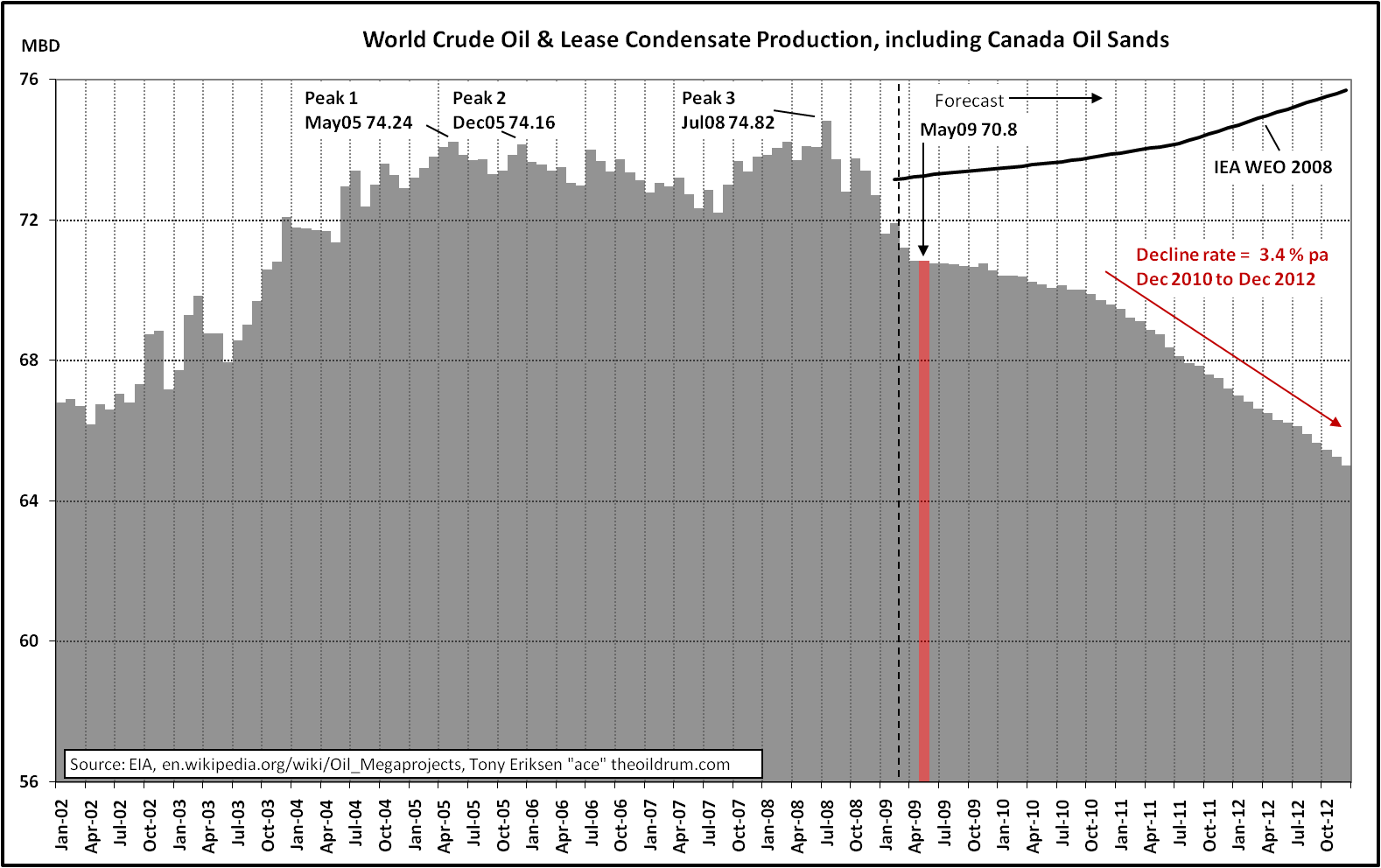
A recent post on this blog reviewed Tony Eriksen's study of declining oil production, which is summarized in this Figure. These data show a slow decline in global crude oil production currently and then accelerating after December 2010.

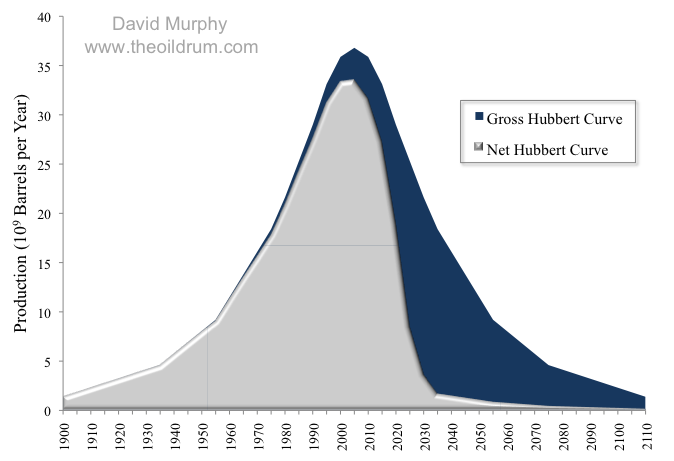
Because oil is used to produce oil, we should focus on net oil production, which is what we have left after oil is consumed to extract, refine, and deliver oil products to market. The rate of decline in net oil production is much steeper than for all oil produced, as shown in Murphy's Figure 3.

The drop in net oil production will probably be steeper than Murphy forecasts. Matthew Simmons estimates that 100 trillion dollars of investment is need to replace the globe's rusting infrastructure of pipelines, drilling rigs, platforms, and refineries. Much of this investment will consume oil to manufacture, transport, and assemble this infrastructure. And everyone who works on these 100 trillion dollars of projects will use their pay to buy products made out of oil or transported by oil. Currency is a ticket to buy oil. Thus less net oil will be produced than shown in Murhpy's Figure 3.

Also, as oil exporting nations consume more oil domestically they export less to the developed nations; hence, the oil supply available to developed countries will be considerably less than shown in Murphy's Figure 3.

This analysis indicates that oil supplies for the developed world will decline precipitously beginning in the next two years and the decline will accelerate over time.

This suggests that a rapid economic global collapse will occur in less than 10 years.

Friday, June 19, 2009

"Adventures In Post-Oil Paradise," By Peter Goodchild, Countercurrents, April 27, 2009

In this article, Peter Goodchild covers seven years when he and his wife worked to become self-sufficient on four acres in a rural area near Ontario, Canada. Although he concludes that "we learned that it is possible to live with some independence from modern civilization," they depended on modern civilization for much, including a chain saw, bow saw, wood stove, building materials, wire fencing, seeds, and clothing.

After the last power blackout, such things will become unavailable, as he notes himself in another article.

Thursday, June 11, 2009

"California nears financial 'meltdown' as revenues tumble," By Jim Christie, Reuters, June 11, 2009

"California's government risks a financial 'meltdown' within 50 days in light of its weakening May revenues unless Governor Arnold Schwarzenegger and lawmakers quickly plug a $24.3 billion budget gap, the state's controller said on Wednesday.

California's revenues have been on a dramatic slide as a result of recession, rising unemployment and its lengthy housing downturn.

The state's revenues from personal income taxes tumbled by 39.3 percent in May from a year earlier while revenues from corporate taxes fell by 52.1 percent and revenues from sales taxes sagged by 7.6 percent, according to a report released by Chiang's office." (CONTINUED HERE).

Tuesday, June 9, 2009

"Why Home Prices May Keep Falling ," By Robert J. Shiller, The New York Times, June 8, 2009

"Home prices in the United States have been falling for nearly three years, and the decline may well continue for some time.

Even the federal government has projected price decreases through 2010. As a baseline, the stress tests recently performed on big banks included a total fall in housing prices of 41 percent from 2006 through 2010. Their 'more adverse' forecast projected a drop of 48 percent — suggesting that important housing ratios, like price to rent, and price to construction cost — would fall to their lowest levels in 20 years.

Such long, steady housing price declines seem to defy both common sense and the traditional laws of economics, which assume that people act rationally and that markets are efficient. Why would a sensible person watch the value of his home fall for years, only to sell for a big loss? Why not sell early in the cycle? If people acted as the efficient-market theory says they should, prices would come down right away, not gradually over years, and these cycles would be much shorter."

(CONTINUED HERE).

Wednesday, May 27, 2009

"Job Losses Push Safer Mortgages to Foreclosure ," by Peter S. Goodman and Jack Healy, The New York Times, May 24, 2009

"As job losses rise, growing numbers of American homeowners with once solid credit are falling behind on their mortgages, amplifying a wave of foreclosures.

In the latest phase of the nation’s real estate disaster, the locus of trouble has shifted from subprime loans — those extended to home buyers with troubled credit — to the far more numerous prime loans issued to those with decent financial histories.

With many economists anticipating that the unemployment rate will rise into the double digits from its current 8.9 percent, foreclosures are expected to accelerate. That could exacerbate bank losses, adding pressure to the financial system and the broader economy."

(CONTINUED HERE).

Friday, April 17, 2009

The Great (Peak Oil) Recession, Who's to Blame, and How People Adjust, TIME/CNN, April 17, 2009

Here you find lots on: who is to blame for the financial crisis; how some people in the U.S. are adjusting to the "Great Recession;" photos of failed retail stores; and a poll on attitudes; and how people are handling the "recession."

But there is not a photo display of how this impacts poor Americans or those in the economically less developed countries.

Missing on the blame list are those who issued fairy tales about future oil production and future oil prices -- the Energy Information Agency (EIA), International Energy Agency (IEA), U.S. Geological Survey (USGS), Cambridge Energy Research Associates, and private and national oil companies.

There is no mention of Peak Oil or high oil prices. No mention that last year economists quoted in "The Wall Street Journal" said that if oil goes above $125 per barrel we will go into recession. No mention that Dr. Colin Campbell, ASPO Ireland, ASPO International, Congressman Roscoe Bartlett, the U.S. General Accountability Office, the Hirsch report, Jim Puplava, James Kunstler, Chris Shaw, Gail the Actuary, Matt Savinar, Peter Goodchild, Kathy McMahon, me, and many others warned about a looming Peak Oil recession. And no mention that many voices now warn that the recession will grow into an ever worsening economic depression.

Thursday, April 16, 2009

Peak Oil Financial Crisis: "General Growth files largest U.S. real estate bankruptcy," By Ilaina Jonas and Emily Chasan, Reuters, April 16, 2009

NEW YORK (Reuters) - "General Growth Properties Inc, the second-largest U.S. mall owner, declared bankruptcy on Thursday in the biggest real estate failure in U.S. history.

Ending months of speculation, General Growth, along with 158 of its 200-plus U.S. malls, filed Chapter 11 while it tries to refinance its debts.

But the ongoing global financial crisis made it impossible for General Growth to restructure outside of bankruptcy and could signal further troubles for other financial institutions who are General Growth creditors."

(Continued here.)