Showing posts with label peak oil. Show all posts

Saturday, September 26, 2009

"Peak Oil: Not enough oil for the G20 package," By Kjell Aleklett, Aleklett Energy Mix, Apil 3, 2009

The world’s wealthiest nations, the G20 group, have decided to light a fire but have forgotten a very important detail – to check whether there is sufficient fuel to enable the fire to burn. Historically we have never had global economic growth without a simultaneous increase in the use of energy. This means, primarily, an increase in the use of fossil fuels. For a few nations – China, USA, Russia, India, Australia and South Africa – coal is a very important fuel. However, the most important fuel for the world economy is oil. All nations of the world use oil.

When the economies of different nations are compared, one usually compares their GDP(PPP), Gross Domestic Product (Purchasing Power Parity) per capita. If one furthermore compares how much oil nations use one can see that, since the Second World War, all nations have had to increase their oil use to get economic growth. If we compare how much oil is needed per 1000 dollar GDP (PPP) per person we get a suitable figure for comparison. The amount of oil different nations use varies. In 1980 Sweden, together with the USA, was the worst in the world since we needed the most oil. Nuclear energy and increased use of biofuels have helped us in Sweden to improve but we are still not as good as, for example, France, Germany and the United Kingdom.

During the last 20 years we have had global economic growth of approximately 3% per annum. Fuel use in the form of oil has increased, on average, by half of this rate, i.e. 1.5% per annum. In the future prognoses made by the International Energy Agency, IEA, they believe that we can increase our efficiency of fuel use but we will still need more oil. The documents that resulted from the G20 meeting assume that this fuel will exist to allow future global growth.

To get an appreciation of the scale of the task we can examine the economic growth that the world experienced from 2003 until 2007. In 2003 oil consumption was 77 million barrels per day and in 2007 it was around 85 million barrels per day, i.e. an increase of 10 percent. At the moment consumption is around 84 million barrels per day. If the stimulus package that the G20 group decided on is to generate the same amount of growth as seen in the 2003 to 2007 period then we will need an increase of 8 to 9 million barrels per day during the next 5 years. Such an increase is not possible.

The Global Energy Systems group at Uppsala University has just published an article in the scientific journal Energy Policy (see article) in which we show that oil production from those fields that are currently in production will decrease by 6 percent per year during the next 5 years. This means a decrease in the rate of production by 18 million barrels per day after 5 years. The G20 nations want to increase oil use but the forces of Nature say that there will be a decrease. For the G20 nations to get what they want the world’s oil industry would need to bring online new production of 25 million barrels per day over the next 5 years.

The USA-based company CERA has studied all the projects that the oil industry currently plans to bring online in the coming years. Last summer they arrived at an optimistic estimate that saw 14 million barrels per day of new production. One week ago they revised this increase downwards by 7.6 million barrels per day since companies are now postponing projects.

The same nations that now require increased oil consumption will meet in December with the world’s other nations in Copenhagen. They will then discuss what measures they can take to reduce oil consumption. They do not discuss what volumes of renewable energy will be needed but we have made an initial preliminary estimate and we find that 30 million barrels of oil per day must be replaced with renewable fuels and electricity by 2030 to keep a GDP(PPP) growth rate of 3 percent. What the G20 group should discuss is what investments will be required for this transformation of the energy system to become reality.


Kjell Aleklett, Professor of Physics
Global Energy Systems, Uppsala University, www.fysast.uu.se/ges
President of ASPO International, the International Association for the Study of Peak Oil & Gas, www.peakoil.net
Mobile: +70 425 0604
Email: kjell.aleklett@fysast.uu.se

~~~~~~~~~~~~~~~~~~~~~~~~~~~~~~~~~~~~~~~~~~~~~~
Original article available here

Tuesday, September 8, 2009

"The Stonewalling of Peak Oil," By Dr. Robert Hirsch, ASPO-USA, September 7, 2009

Dr. Robert L. Hirsch is the lead author of a seminal report, "Peaking of World Oil Production: Impacts, Mitigation & Risk Management," written for the U.S. Department of Energy’s National Energy Technology Laboratory (DOE-NETL) and released in early 2005.

"When the report was done, management at NETL really didn’t know what to do with it because it was so shocking and the implications were so significant. Finally, the NETL director decided that she would sign off on it because she was retiring and couldn’t be hurt, or so I was told. The report didn’t get widely publicized. It somehow was picked up by a high school someplace in California; eventually NETL put it on their website. The problem for people at NETL—and these are really good people—was that they were under a good deal of pressure to not be the bearers of bad news -- pressure from people in the hierarchy of the DOE. This was true in both Republican and Democratic administrations. There is, I think, ample evidence, and some people in DOE have gone so far as to say it specifically, that people in the hierarchy of DOE, under both administrations, understood that there was a problem and suppressed work in the area. Under President Bush, we were not only able to do the first study but also a follow-on study that looked at mitigation economics. After that, visibility apparently got so high that NETL was told to stop any further work on peak oil.

Yes, that was terrible. And it was strictly politics and political appointees—I have no idea how far up in either administration (the current one and previous one) these issues went or now go. People in the Clinton administration had talked about peak oil, including President Clinton and Vice President Gore, and the same thing is true in the Bush administration, and the same is true, to the best of my knowledge, in the Obama administration.

The peak oil story is definitely a bad news story. There’s just no way to sugar-coat it, other than maybe to do what I’ve done on occasion and that is to say that by 2050 we’ll have it right and we will have come through the peak oil recession—quite probably a very deep recession. At some point we’ll come out of this because we’re human beings, and we just don’t give up. And I have faith in people ultimately. But it’s a bad news story and anybody’s who’s going to stand up and talk about the bad news story and is in a position of responsibility in the government needs to then follow immediately and say “here’s what we’re going to do about it,” and no one seems prepared to do that.

Peak oil is a bigger issue than health care, than federal budget deficits, and so forth. We’re talking about something that, to take a middle of the road position—not the Armageddon extreme and not the la-la optimism of some people—is going to be extremely damaging to the U.S. and world economies for a very long period of time. There are no quick fixes."

(VIEW FULL INTERVIEW)

Blog Comment: Dr. Hirsch says that "there’s just no way to sugar-coat [Peak Oil]," but that is what he does. There is no plan or technology for replacing oil, nor is there time or capital to do so. After listening to his speeches, it is clear that his beliefs in America, technology, and the human will distort his scientific analysis. Denial is way of avoiding the horror of the reality ahead.

Monday, September 7, 2009

"Simmons vs Yergin, Lynch et al on Peak Oil," By Kate Mackenzie, Financial Times, September 7, 2009

Kate Makenzie at the Financial Times is trying to inform readers about Peak Oil. She counter poses William Simmons with Daniel Yergen, Michael Lynch, and Ed Morse. Readers are left with questions about who is right. Here is my my published comment :

Global oil production peaked in 2008 and is now in terminal decline. The evidence is clear. During the period 2004 to 2008, as oil prices climbed, all oil producers were pumping at maximum effort with historically high oil prices. During this period, oil production remained flat, peaked a bit in July 2008 and then began to decline while oil prices were very high and before the October global economic collapse, as documented here. And the depletion picture is far worse than Simmons indicated, as explained here.

Sunday, September 6, 2009

"What the IEA Doesn't Want You to Know About Peak Oil," By Lionel Badal, Seeking Alpha, September 6, 2009

"It is not in the interest of some IEA member states, in particular its most powerful member, namely the USA, that the agency provides an honest assessment of the situation. Admitting Peak Oil is real also means that you acknowledge our current way of life is about to (radically) change. And not everyone wants the public to know that. Irresponsible, dishonest? Absolutely."

(VIEW FULL ARTICLE)

Blog Comment: Mr. Birol, Chief Economist at the International Energy Agency has misinformed the public by indicating that global oil production will peak in the in the long term future.

The global oil production plateau from 2004 to 2008 is clear evidence of the peak. As oil prices climbed during this period, oil production leveled off. For more detail, see:

http://survivingpeakoil.blogspot.com/2008/12/top-story-of-year-global-oil-production.html

And the situation is more dire than Mr. Birol indicates:

http://survivingpeakoil.blogspot.com/2009/06/net-hubbert-curve-what-does-it-mean-by.html

Friday, September 4, 2009

"Oil Spin: Ignore the Optimsts, Peak Oil is Real," By Matthew R. Simmons, Foreign Policy, Sepetmeber 4, 2009

"Last week, four of the world's most outspoken oil aficionados waded into the controversy of peak oil, publishing articles packed with myth and distortion. This "Gang of Four" all claimed the issue was silly, moot, or simply a myth. The four pieces were Pulitzer Prize-winning author Daniel Yergin's seven-page article in Foreign Policy, energy analyst Michael Lynch's three column op-ed in the New York Times, analyst Edward Morse's essay in Foreign Affairs, and scholar Amy Jaffe's paper published by the Baker Institute at Rice University.

(VIEW FULL ARTICLE)

Sunday, August 2, 2009

"The Indendent" (London) Warns about Peak Oil

Peak Oil is now, not a decade away as "The Independent" indicates. According to most independent sources, global oil production peaked in 2008. "The Independent" relies on the optimistic IEA for forecasts. But the IEA is NOT an independent agency, as it tends to speaks for global oil and industrial interests. But the IEA indicates that "the oil crisis begins to grip after 2010."

What are your local, state, and federal governments planning for? Chief Economist Fatih Birol at the International Energy Agency warns that “many governments appeared oblivious to the fact that the oil on which modern civilisation depends is running out far faster than previously predicted...” Birol sees a supply crunch within the next few years that will jeopardize hopes of an economic recovery.

The IEA is one reason that governments are oblivious. The IEA has been downplaying Peak Oil for years, and still is in saying that Peak Oil is 10 years away.

Global oil production peaked in 2008 and depletion is steeper than the "The Independent" indicates.

Monday, April 20, 2009

Peak Oil Interview with Dr. Colin J. Campbell, Interviewed by Neil Jackson, Posted by Chris Vernon on The Oil Drum, April 20, 2009

Photojournalist Neil Jackson has recently conducted an interview with Dr. Colin J. Campbell, retired -- Texaco, British Petroleum, Amoco and founder and Honorary Chairman of the Association for the Study of Peak Oil and Gas (ASPO). The interview is reproduced here in full.

Blog comments follow the interview.

Neil Jackson: Why is peak oil important?

Colin Campbell: Peak Oil is a turning point for mankind. It is a big subject.

In short, the population only doubled over the first 17 centuries of the last millennium. But then came coal followed by oil and gas, and the population increased six-fold. These new energy sources, especially oil, the easiest, allowed the rapid expansion of industry, transport, trade and agriculture allowing the economy to expand greatly. It was accompanied by the growth of financial capital as banks lent more than they had on deposit, confident that Tomorrow's Expansion was collateral for Today's Debt.

But now we face the dawn of the Second Half of the Age of Oil when supply declines from natural depletion, meaning that debt goes bad (as is already happening) and the economy contracts. Today's oil supply support 6.7 billion people, but by 2050 the supply will be enough to support no more than about 2.5 billion in their present way of life. So the challenges of using less and finding other energy sources is great.

The transition threatens to be a time of great tension : there are already tribal wars in Africa, disturbances in many places including rioting in Greece. Urban conditions will become especially difficult.


Looming lifestyle changes, derelict housing. Ibrox, Glasgow, UK

NJ: What has been your personal reaction to peak oil?

CC: I happened to have worked in the oil industry and I was not alone in being fully aware of depletion for a long time. But geologists are passive people, given to describing rather than changing things. We can describe the Cretaceous but not change it.

NJ: How are you or your family preparing?

CC: I am too old to do much, but live modestly in an Irish village. My wife however is actively trying to introduce allotments here by which people can feed themselves. We do have a solar panel on the roof, providing hot water from about May to October. If the sun doesn't shine I don't wash.

NJ: Do you think the media are playing the issue down? Has there been much coverage of the issue in the mainstream media? Any ideas as to why?

CC: The media is now taking a serious interest : a trail of journalists and TV crews have been here over the past few years. The BBC and no less than Korean TV was here recently. There are of course vested interests (BP for example) keen to suppress Peak Oil but I think the word is out.

NJ: How about governments? Are they playing the issue down, and if so, what examples can you give? Do you think any governments are approaching Peak Oil correctly? Who?

CC: The position of governments is changing. They are heavily influenced by classical economics and badly advised by such practitioners for whom finding oil is just a matter of investment.

The International Energy Agency is the OECD watchdog, although in practice more of a consumers lobby (not wanting OPEC to know its strength). Ten years ago internally it recognised that peak oil would arrive around 2010, but issued no more than a coded message. Now as Peak Oil arrives it changes its tune, for fear of losing credibility, and begins to admit to it under the slogan let's leave oil before it leaves us.

I happen to know the Irish Minister, who understands the position perfectly and is trying to prepare, but he tells me that the political obstacles are very great. It is promising that Obama has renewables high on his agenda and seems to recognise that the attempted conquest of Iraq's oil failed. Oil discovery in Britain peaked in the 1970s and should have alerted the government that the inevitable corresponding peak of production would follow, but Mrs Thatcher believed in the free market, and exploited the resources as fast as possible, which accelerated depletion.

Britain exported its surplus at low prices but now faces rising imports at high prices. Russia now seems to be aware of its power by controlling Europe's gas supply, and will likely try to conserve what is left for its own use rather than export, which makes sense. It is a big subject, and does not exactly give one much confidence in government.

NJ: It is sometimes said that there are billions of barrels of oil reserves locked up in Canada’s tar sands. Can you say anything about these reserves with respect to peak oil? What are the challenges faced when bringing this oil to market?

CC: The resource in the ground of tarsand in Canada and elsewhere is huge, but extraction is slow and costly, yielding a low or even negative net energy return. My guess is that oil prices in the future will range in the $50-100 range as higher prices would dampen demand by economic recession. If so this is a constraint on developing tarsands (some projects are said to be viable only at $90+) ... and indeed restrain the development of renewable energy).


Poverty and the end of suburbia. Benchill, Manchester, UK

NJ: The discovery of oil peaked some 40 years ago – how much oil are we discovering now and what potential is there for further discoveries--new, significant discoveries? Does the Arctic represent another Saudi Arabia? How about the Antarctic?

CC: It is difficult to get good information on recent discovery, but my best estimate is that it is running in the 5-10 billion barrel a year range. The accessible world has now been thoroughly explored, such that all the major productive provinces and large fields within them have been found.

Attention now turns to the deepwater and Polar regions. I think that the main deepwater areas have also already been found : they depend on very exceptional geological conditions as most of the oceans are definitely non-prospective. I do not entertain great hopes for the Polar regions because I think they are generally deficient in effective source rock, and that seal integrity has been impaired by vertical movements of the crust due to the weight of fluctuating ice caps.

There are a few freak occurrences, such as Prudhoe Bay in Alaska, but generally Polar seems to be a gas-prone domain, with sniffs of encouragement that eventually disappoint. It is unlikely to have any material impact on Peak Oil.

NJ: How familiar do you think the senior staff of Western oil majors are with the concept of peak oil? Do they see it as a serious problem either for their business or the wider global economy?

CC: In earlier years, major oil companies did tend to be run by people with exploration experience, for whom peak oil has long been evident (Harry Warman once Exploration Manager of BP was one of the first to publish on it), but now most are run by financiers and engineers, who lack the deeper resource insights. But generally I think they understand.

The Seven major companies are now reduced to four by merger, which is a sign of contraction, and they are selling off subsidiary refineries and marketing chains, evidently recognising that falling supply will give downstream over-capacity.

But remember that the job of managers is to sing to the Stock Market to protect their shareholders' interests under the present system whereby the merits of a firm dividend have surrendered to speculative movements on the Market, which is largely a public relations exercise, as these brokers can have little real understanding of the businesses in which that take positions ("investment" is hardly the word). It is simply not the job of oil company managers to concern themselves with global issues. But that said they do begin to hint and half admit to the obvious truth : Total and Chevron are probably the most forthright, with BP being the least.

NJ: How does oil form, when did it form, where does it form - what does this tell us about the likelihood of finding significant new oil in the middle of the Atlantic... or in the Arctic?

CC: The bulk of the world's oil was formed under special conditions of global warming 90 and 150 million years ago.

Algae proliferated in warm sunlit tropical waters, and the hot surface water prevented normal circulation such that stagnant anoxic conditions occurred at depth. The algal organic remains were accordingly preserved in rifts. On burial to about 2000 meters, it was cooked enough to be converted into oil, which then began to move upwards. Much escaped or was dissipated, but some was trapped at the top of geological structures (arch-like anticlines or against faults).

In addition to these two main epochs there were other local occurrences of little global significance. Naturally, the older the source-rock the greater the chance of loss over geological time.


The crash of supermarket culture. Ibrox, Glasgow, UK

NJ: What is your opinion on reserve growth?"

CC: Assessing the size of an oilfield early in its life poses no particular scientific challenge, although it is naturally subject to a degree of uncertainty. Reporting its size is another matter.

The oil companies were subject to strict Stock Exchange rules designed to prevent fraudulent exaggeration while smiling on under-reporting as commercial prudence. Accordingly the major companies reported only as much as they needed to deliver a satisfactory financial outcome. The resulting upward revisions gave a comforting but misleading image of reserve growth.

Those days are however substantially over as the giant fields offering the main scope for upward revision mature. OPEC for its part greatly exaggerated in the 1980s when they were vying with each other for quota based on what they reported as reserves. The industry has developed various technologies (steam, nitrogen, CO2 injection and horizontal drilling plus sophisticated seismic to map the reservoirs in detail) which can increase the recovery, and hence give reserve growth. But the scope for doing so could easily have been foreseen early in the life of the field, even if it was not normal to report it.

NJ: At the ASPO meeting after the Barcelona conference you were talking about retiring from the newsletter at the end of 2008 - and after around 1000 items. The future plan was for individual national ASPO chapters to produce newsletters, or submit items for someone else to correlate. Is that still going ahead?

CC: Yes, I am a bit undecided about the future of the ASPO Newsletter. Obviously I can't keep doing it for ever, and also the main message has been delivered, so I find myself touching more and more on political subjects on which I lack any expertise.

ASPO has evolved as a loose organisation lacking any normal management or cohesion or rules, but that is a good thing as the different entities can do whatever is appropriate and possible in their own countries. I suppose in one sense the Newsletter does hold them together giving a certain common purpose.

One model might be to rotate the overall direction (including the newsletter), but in practice I doubt if that will happen. In one sense its mission has been accomplished as dealing with life in the Second Half of the Oil Age when everything is in decline calls for very different approaches.

NJ: Are we progressing towards implementing technologies to utilize alternative energy sources at a fast enough rate to prevent an economic collapse, or at least to minimize the impact the advent of Peak Oil is having/will have on the global economy?

CC: I doubt that renewable energies will ever replace oil and gas sufficiently to maintain the past order of things or still less allow economic growth to continue. They are of course greatly needed for the surviving communities.

My own preference is tidal energy to tap the massive regular lateral flows of water. Apparently they can build funnel-like walls on the sea bed forcing the tides to speed up through the constriction, and turn a rotor, generating electricity. But apparently such schemes did not compete with cheap oil and gas so far.

There is of course massive scope for using less energy : turning off all those loudspeakers and TV screens in public places would help.

NJ: What effect do the new technologies have on the projections for when production will peak?

CC: I don't think new technologies will have any impact on the date of peak, which I estimate to have been passed in 2008 ("all liquids"), but they can of course ameliorate the subsequent decline. I think most of the necessary technologies are already well known, so the issue is more about applying them than inventing a magic wand.

NJ: There is a lot of debate about why oil prices were so high during this summer, why they've dropped so quickly since then. What is the explanation for this? Were high prices due to "speculation" as many have argued or was it supply and demand, or both, or something else?

CC: I think that Regular Conventional oil peaked in 2005 and prices began to rise, although the shortfall was partly made up by costly tarsands and deepwater production. The rising price trend attracted the interest of the traders who started buying futures and so forth. It might also have made sense for the industry to keep the tanks full, watching them appreciate in value.

But eventually the rising price had an adverse impact on the real economy and the shrewd traders started to unload, selling short on the futures market. The industry too might have started draining its tanks.

But perhaps more important was the flood of petrodollars that the high prices delivered to the governments and royal families of the Middle East, where it still costs $10-15 to produce oil. They probably sent the surplus to western banks who promptly loaned it out on ever less sure collateral. The petrodollars were not really money in the sense of representing work or barter, but simply profiteering from shortage.

The whole flimsy financial edifice has now crashed, and some of the sillier governments are now pumping yet more fictional money into the system to encourage new consumption. Such policies may briefly succeed, but will only make the subsequent crash worse.

We enter a new world, as the principal energy that drove the anomalous past two centuries heads into decline from natural depletion. This is not necessarily a doomsday message. I have known many simple people in different parts of the world who smiled and laughed not being part of the consumer society.

There are encouraging signs. A BBC film crew who was here recently told me that they had become so convinced of the Peak Oil issue, which they had studied to make their programme, that they had decided to quit the BBC and buy a small farm in the west of England on which to build a simple sustainable future. That was most encouraging, I thought.


The end of the road for one petrol station. Near Derby, UK

---
Photojournalist Neil's slideshow, which looks in part at Peak Oil, can be viewed here.

Blog comments:

Dr. Campbell provides a valuable historical and global perspective on Peak Oil, geology, oil reserves, and the economy.

ASPO has been forecasting not only when Peak Oil and Gas would occur, but also how oil production will decline. ASPO could continue to conduct research on future oil production and net oil and gas production. As oil and natural gas production decline, more oil and natural gas energy is expended in extraction and refining processes, and less net oil and natural gas are actually produced. Because the net production curve toward depletion is steeper than the production curves that we see on most all charts, this is an important question. For much deep water oil and gas extraction, the point at which the amount of oil/gas expended equals the amount of oil/gas produced is reached quickly, especially when all of the oil/gas used for manufacturing all of the ships, pipelines, platforms, refineries, parts, their manufacture in factories that use energy, and all of the employee/stock owner salaries/dividends/pensions for all of the companies (salaries/dividends/pensions are spent and use oil/gas), and transportation for all of the above parts and employees.

Dr. Campbell concludes that alternative energies will not make up for much of the decline in fossil energies, and he favors developing tidal energy. My analysis indicates that alternatives and renewables will use up much fossil energy and liquid fuel in their development and yield electric energy, which is not the liquid fuel we need for tractors/combines, trucks, trains, and ships. And objective analysis indicates that tidal energy will not be developed due to siting limitations. And again, it yields electric energy, which is not needed as factories, commercial centers, and offices close.

Wednesday, January 21, 2009

ASPO Examines the Economy and Peak Oil: December 2008

Excerpts from the Association for the Study of Peak Oil and Gas (ASPO-Ireland) December 2008 Newsletter. The full article is available here.

In years ahead, analysts may look back on the current crisis and identify its causes. They may conclude that oil demand had begun to outpace supply around 2005, when the production of Regular Conventional Oil passed its peak. The shortfall was however relatively small and was partly met without undue difficulty by a modest reduction in consumption.

But as prices began to firm, oil traders and other speculative financial institutions began to take a position in the market, which had the effect of driving up the price. Gradually the process built momentum as huge notional profits were reaped from the appreciating asset. In a conventional market such movements would soon be countered by increased production, but in the case of oil, there was no spare capacity to release, and the speculative surge fed on itself leading to an extreme escalation in price which reached about $150 a barrel by July 2008. However as this peak [in prices] was approached, the traders began to conclude that a limit was close and began to buy future options at lower prices, which began to undermine the price in a self-fulfilling process. In parallel the high prices began to undermine many other aspects of the economy with for example airlines and automobile manufacturers facing difficulties. They themselves relied heavily on debt, which itself was traded between banks without adequate genuine collateral, and were forced to unload their speculative oil positions in order to try to shore up their failing businesses. Gradually the whole edifice collapsed, and oil prices fell to around $50 a barrel, although nothing particular had changed in the actual supply/demand relationship.

The flaw in the system was to treat a finite resource whose production was largely controlled by the immutable physics of the reservoir as if it were a normal commodity capable of responding to ordinary market pressures. If the price of potatoes increases, farmers can grow more and the market responds, but oil is different.

Governments responded to the crash by pouring yet more money, itself lacking genuine collateral, into the system in the mistaken belief that this would restore the position of assumed eternal growth, and quite possibly the stock market will respond positively as traders sense a new upward direction. They have no real interest in reality: their job being to try to reap rewards from short term movements.

But if there is an economic recovery, that would serve to increase the demand for oil, which is in a sense the lifeblood of the modern world, and oil prices would again begin to surge. Probably, it will take several such vicious circles before governments and, more important, people at large at last come to grasp the reality of the situation, which will likely prompt radical changes in the human condition.

The election of Mr Barrack Obama seems to have been greeted with rapture in the United States and around the world. Certainly he projects an attractive personality and speaks fluently and well, but the main enthusiasm seems to lie in his mixed racial background. Part of his family emanates from Kenya, possibly having some Arab blood, and the Irish stake claim to other antecedents. Some observers hope that his election will spell regime change and the end of the so-called War on Terror, which seems to have failed to extend global economic hegemony. On the other hand, his election, which required massive funding, suggests that he relied on more than the simple ballot box. Indeed, the financier, Rahm Emanuel, who has apparently served in the Israeli Army and is the son of a former member of the Irgun Zvai Leumi terrorist movement, has been appointed as Chief of Staff, suggesting that the established influences will remain in power. But by all means, most people welcome the change, and look forward with enthusiasm to new policies with which to face the unfolding situation, imposed ultimately by dwindling oil-based energy.

The new Presidency will certainly have to work a radically new situation for which no one is truly prepared. Even the leading American intelligence organisation, the National Intelligence Council (NIC) has issued a report entitled Global Trends 2025: A World Transformed which concludes that the days of US global economic and military power are over, foreseeing an end to the western model of economic liberalism, as the State is forced to take a more active role.

Meanwhile, desperate efforts are being made around the world to shore up the crumbling financial system. For example, the Bank of England has radically reduced interest rates in a country facing a severe recession, effectively taking money from savers to give to spenders.

The Government has evidently failed to grasp the underlying causes of recession and hopes that pumping a bit of money into the system will restore it to its previous condition. That was premised on eternal economic growth, which is a somewhat unrealistic proposition for a Planet of finite dimensions, but Governments subject to re-election are by nature short-term in their thinking.

The reporting of economic parameters: the official US numbers are apparently also highly suspect. The US Bureau of Labor Statistics (BLS) reports that US Consumer Price Inflation (CPI) is running at 5%, having changed the procedure for doing so in 1990. According to shadowstats.com, a more realistic estimate would be 13%. The Federal Reserve Bank no longer reports the so-called M3 for the creation of new money, but the same source suggests it is currently running at 13%, contributing to inflation. Officially, Gross Domestic Production (GDP) has increased by 2%, whereas the alternative source suggests that it is declining at 3%. Likewise, official estimates of unemployment at 6% contrast with the alternative estimate of 15%. Added credibility for the alternative assessment comes from no less than General Motors, which reports that global passenger car sales fell by 6% during the Third Quarter of this year. Apparently, various hidden agencies related to the Federal Reserve Bank may be manipulating gold and silver prices, which have fallen since the financial crisis broke. The fall does not seem a natural response, given that gold is the traditional safe haven in times of stress and growing inflation. Indeed according to the August issue of the Bank Participation Report, Bear Stearns had a large short position on COMEX silver at the time of its forced merger with JP Morgan in March. The transfer was undertaken by the US Treasury under somewhat dubious procedures. No doubt gold holdings are also involved in the labyrinthine dealings.

One is led to conclude that the entire Stock Market, including especially the oil market, has become a thoroughly debased speculative institution. In earlier years, investors clubbed together to build a specific project, such as a canal or railway, with the resulting dividend being the prime motivation. Things seemed to have gone wrong when such investments were traded on markets by financial institutions which naturally can have no serious knowledge of the underlying business or the true value to be placed upon it.

The Wharton School: Global Economic Forecast for 2009

Knowledge@Wharton

January 7, 2009

After a year of financial shock and sharp economic loss, 2009 is likely to be extremely difficult for the global economy, with investors, business leaders and policymakers struggling to find signs of recovery, according to Wharton faculty and academic partners around the world.

"It's all pretty negative," says Wharton finance professor Franklin Allen. "The economy is going into a recession and my own view is that it will be deep and quite long-lasting. There doesn't seem to be anything on the horizon that is a bright spot."

In the wake of crumbling stock markets, mounting bad debt and rising unemployment, policymakers are scrambling to devise strategies to restore stability and lay the groundwork for new growth. "There's no country in the world that's doing well," Allen continues. "Everybody is doing badly, with large amounts of debt and heading toward deflation," plus "unemployment and a rush by companies to fire people."

The collapse in the United States is different than in other industrialized countries around the world because the problems began in the financial sector and spread out into the broader economy, says Wharton management professor Mauro Guillén. In the rest of the world, problems in the real economy -- created largely by trouble in the United States -- led to weakness in financial markets. "In the United States, the key in 2009 is, 'Can we clear up the mess in the financial sector?' Unfortunately, I'm not very optimistic," says Guillén.

Wharton finance professor Richard Marston says he is shocked by the impact of the crisis on U.S. financial firms and markets. "To see Wachovia, Wash Mutual, Citi all gravely wounded. It's extraordinary." Marston contends that while the banks have been shored up, they are unlikely to lend for a long time. On top of that, he adds, the inability to securitize will constrain credit more than if banks alone had cut back on lending. (Continued here)

Tuesday, January 20, 2009

Financial Forecast for 2009, by Gail Tverberg

Excerpts from Theoildrum.com, January 6, 2009 (the full article includes much data and is followed by a discussion).

We are due for a debt unwind, and with it a rapid decline in the US standard of living. Exactly what form it will take, and what the timing will be (for example, sudden one month from now or sudden three years from now, or gradual over a longer period), isn't certain. I would expect that many (or most) other economies in the world will be dragged along in this debt unwind and will experience a decline in their standards of living.

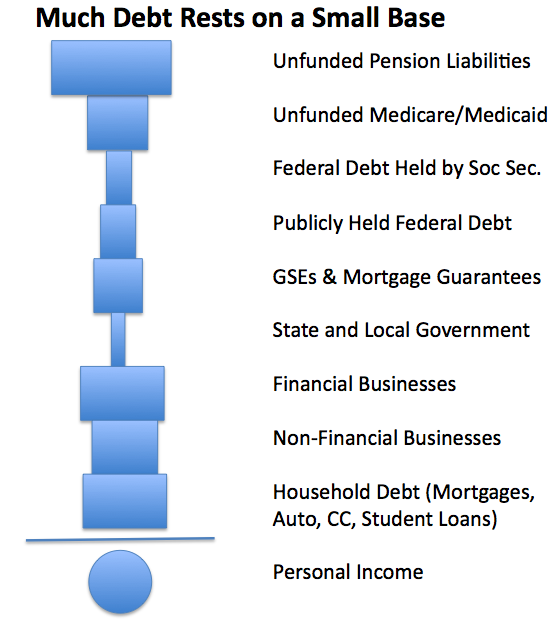
Many asset classes are correlated in time of stress, the tower of debt (Figure 1) has many feedback loops, and tends to magnify the economy's reaction to events, both favorable and unfavorable.


(FIGURE 1) (click on figure to read)

When consumer debt is rising it tends to make the economy look very, very good. When there are layoffs, the interrelationships tend to magnify the impact, making the economic impact much worse. One wonders whether there are tipping points, beyond which it is not really possible for the system to recover--particularly now that the US seems to be at the point of "peak energy" (Section 3), energy is required for growth (Section 3), and growth is required to allow debt to continue (Section 2).

The tower of debt is in some ways deceptive. It can make the economy look mostly OK to the casual observer, until all too quickly, things start to fall apart.

So far, the "fixes" that the US government has been attempting seem mostly counterproductive. Putting government guarantees behind more and more debt (thus stacking Figure 1 higher and higher, with a new TARP layer) just increases the likelihood that the US government will be drawn into the downward spiral. The financial services layer will be less and less needed in years ahead, as our need for debt-based products declines. Bailing it out does not help get additional income to ordinary workers (although it may temporarily protect them from losing their bank account balances).

All aspects of finances will be affected by the unwind of debt. A huge amount of debt will be defaulted on (or will be forgiven, so that an actual default does not need to occur). Regardless of whether the non-payment occurs because of default or forgiveness, the effect on financial institutions will be the same. Financial institutions such as banks, insurance companies, pension funds, and many hedge funds will find themselves in poor financial condition, because they were depending on the proceeds of this debt repayment to fund what they have promised--bank account balances; insurance policies; pension payments; or hedge fund returns. Institutions guaranteeing debt, such as monoline bond insurers will be particularly hard hit. The FDIC will likely be called on to rescue many failed banks, and will need to find funds from some source (printed money?) to do this.

As the year goes on, I expect each evaluation of where we are to be worse. Banks will report operating losses each quarter. Fannie and Freddie will need more funds than originally thought. TARP will need more funds than original planned. More and more businesses will enter bankruptcy, and more and more governments (states, cities, counties, and countries around the world) will find themselves unable to meet their obligations. There are a huge number of inter-relationships, and the bankruptcies and losses in one area will tend to cause more bankruptcies and losses in other areas, and act to destabilize the debt tower.

Debt of all forms will be very difficult to obtain, except through government sources. The interest rate the US government is currently paying is very low, mainly because of a "flight to quality". If the US government keeps issuing more and more debt, it seems likely that at some point this will change, because buyers will figure out that even if the US is the best of a bad lot, its risk of failure is significantly greater than 0%.

I do not expect a steep rise in the price of oil and natural gas in the next year, because the decline in demand is likely to outpace the decline in production in the short-term. If we look back at Figure 2, I expect that funds available to ordinary citizens will continue to decline in 2009, even considering any stimulus plan. This will happen because employee compensation will decline due to layoffs. Household debt outstanding will also decline (rather than just stay flat, as it has in the past year), because of the poor financial condition of lending institutions, and because with the poor economy, the risk of borrower default will be quite high, discouraging lending. A $300 billion stimulus program will be tiny in comparison to the boost the economy got in the past from increasing debt and greater refinancing (up to $2 trillion per year), as the prices of homes increased. With lower incomes, lower (actually net negative) cash flow from borrowing, and only a modest boost from a stimulus program, citizens will have less and less to spend on goods and services.

There is a distinct possibility that this could all end very badly. One possibility is that there will be more and more defaults, and the US government will not be able to prop up all of the institutions and will eventually default on its debt. While this seems to be the direction things are headed at the current time, the much more usual outcome is hyperinflation, caused by printing more and more money, wiping out the value of people's savings and pensions. Situations such as these are often accompanied by a new government (including a new constitution), and may even include different country boundaries (for example, Soviet Union after its fall).

Many people have started making preparation for the time when food needs to be produced locally and electricity is often not available. I would not discourage such preparations. While we do not know that the economy will collapse completely, I think such preparations are prudent, in the face of rising risk. Preparation for a major change takes many years, so starting earlier rather than later makes sense. Also, with the tower of debt (Figure 1) and the many feedback loops, the downward spiral can happen more quickly than our prior experience suggests is possible.

In conclusion, 2009 looks like a very challenging year for the new administration and for the world as a whole.

Series of Posts on the Economy: Peak Oil Planning for 2009

To better plan for Peak Oil impacts, we must understand the how we arrived at the current economic downturn and then forecast what lies ahead for 2009 and the future.

Over the next two days, I will post several articles and comments which explain the current economy and make forecasts for 2009 and the years ahead. To move toward an objective analysis, I will provide a variety of views on the economy.

Readers are welcome to make comments or email me their own assessment which I will post.

Subsequently, I will add a post that relates the economic assessments to oil production forecasts. This analysis will provide a base for making recommendations about planning for Peak Oil impacts.

Monday, January 19, 2009

Peak Oil and the Century of Famine, by Peter Goodchild

From Countercurrents.org, January 5, 2009

Around the beginning of the twenty-first century, there began a clash of two gigantic forces: overpopulation and oil depletion. The event went unnoticed by all but a few people, but it was quite real. As a result of that clash, the number of human beings on Earth must one day decline in order to match the decline in oil production.

Unfortunately, there seems to be no way to get those two giant forces into equilibrium in any gentle fashion, because in every year that has gone by for the last few thousand years — and every year that will arrive — the human population of Earth is automatically adjusted so that it is roughly equal to the planet’s carrying capacity. Like so many other animals, human beings always push themselves to the limits of that carrying capacity. The Age of Petroleum made us no wiser in that respect, and in fact dependence on fossil fuels has led us to a crisis far greater than any in the past.

(Continued here)

Tuesday, December 30, 2008

Top Story of the Year: Global Oil Production Peaked in 2008

The top story of the year is that global crude oil production peaked in 2008.

The media, governments, world leaders, and public should focus on this issue.

Global crude oil production had been rising briskly until 2004, then plateaued for four years. Because oil producers were extracting at maximum effort to profit from high oil prices, this plateau is a clear indication of Peak Oil.

Then in July and August of 2008 while oil prices were still very high, global crude oil production fell nearly one million barrels per day, clear evidence of Peak Oil (See Rembrandt Koppelaar, Editor of "Oil Watch Monthly," page 1). Peak Oil is now.

Credit for accurate Peak Oil predictions (within a few years) goes to the following (projected year for peak given in parentheses):

* Association for the Study of Peak Oil (2007)

* Rembrandt Koppelaar, Editor of “Oil Watch Monthly” (2008)

* Tony Eriksen, Oil stock analyst and Samuel Foucher, oil analyst (2008)

* Matthew Simmons, Energy investment banker, (2007)

* T. Boone Pickens, Oil and gas investor (2007)

* U.S. Army Corps of Engineers (2005)

* Kenneth S. Deffeyes, Princeton professor and retired shell geologist (2005)

* Sam Sam Bakhtiari, Retired Iranian National Oil Company geologist (2005)

* Chris Skrebowski, Editor of “Petroleum Review” (2010)

* Sadad Al Husseini, former head of production and exploration, Saudi Aramco (2008)

* Energy Watch Group in Germany (2006)

* Fredrik Robelius, Oil analyst and author of "Giant Oil Fields" (2008 to 2018)

Oil production will now begin to decline terminally.

Within a year or two, it is likely that oil prices will skyrocket as supply falls below demand. OPEC cuts could exacerbate the gap between supply and demand and drive prices even higher.

Independent studies indicate that global crude oil production will now decline from 74 million barrels per day to 60 million barrels per day by 2015. During the same time, demand will increase. Oil supplies will be even tighter for the U.S. As oil producing nations consume more and more oil domestically they will export less and less. Because demand is high in China, India, the Middle East, and other oil producing nations, once global oil production begins to decline, demand will always be higher than supply. And since the U.S. represents one fourth of global oil demand, whatever oil we conserve will be consumed elsewhere. Thus, conservation in the U.S. will not slow oil depletion rates significantly.

Alternatives will not even begin to fill the gap. There is no plan nor capital for a so-called electric economy. And most alternatives yield electric power, but we need liquid fuels for tractors/combines, 18 wheel trucks, trains, ships, and mining equipment. The independent scientists of the Energy Watch Group conclude in a 2007 report titled: “Peak Oil Could Trigger Meltdown of Society:”

"By 2020, and even more by 2030, global oil supply will be dramatically lower. This will create a supply gap which can hardly be closed by growing contributions from other fossil, nuclear or alternative energy sources in this time frame."

With increasing costs for gasoline and diesel, along with declining taxes and declining gasoline tax revenues, states and local governments will eventually have to cut staff and curtail highway maintenance. Eventually, gasoline stations will close, and state and local highway workers won’t be able to get to work. We are facing the collapse of the highways that depend on diesel and gasoline powered trucks for bridge maintenance, culvert cleaning to avoid road washouts, snow plowing, and roadbed and surface repair. When the highways fail, so will the power grid, as highways carry the parts, large transformers, steel for pylons, and high tension cables from great distances. With the highways out, there will be no food coming from far away, and without the power grid virtually nothing modern works, including home heating, pumping of gasoline and diesel, airports, communications, and automated building systems.

It is time to focus on Peak Oil preparation and surviving Peak Oil.

Sunday, December 21, 2008

From The Oil Drum: Peak Oil in 2008

Rembrandt Koppelaar, Editor of "Oil Watch Monthly," (page 1) concludes that global Peak Oil production occurred in 2008.

Global crude oil production has been on a plateau since 2004. Because oil producers were producing at maximum effort to take advantage of high oil prices, this is a clear indication of Peak Oil.

Accordingly, oil production will now begin to decline terminally.

Within a year, it is likely that oil prices will skyrocket as supply falls below demand. OPEC cuts would exacerbate the gap between supply and demand and drive prices higher.

There is discussion of Koppelaar's research at The Oil Drum.

Saturday, December 20, 2008

A Response to the IEA Forecast of a Peak in 2020

Independent studies conclude that Peak Oil production will occur (or has occurred) between 2005 to 2010 (projected year for peak in parentheses), as follows:

* Association for the Study of Peak Oil (2007)

* Rembrandt Koppelaar, Editor of “Oil Watch Monthly” (2008 to 2010)

* Tony Eriksen, Oil stock analyst (2008)

* Matthew Simmons, Energy investment banker, (2007)

* T. Boone Pickens, Oil and gas investor (2007)

* U.S. Army Corps of Engineers (2005)

* Kenneth S. Deffeyes, Princeton professor and retired shell Geologist (2005)

* Sam Sam Bakhtiari, Retired Iranian National Oil Company geologist (2005)

* Chris Skrebowski, Editor of “Petroleum Review” (2010)

* Sadad Al Husseini, former head of production and exploration, Saudi Aramco (2008)

* Energy Watch Group in Germany (2006)

* Fredrik Robelius, Oil analyst and author of "Giant Oil Fields" (2008 to 2018)


Independent studies indicate that global crude oil production will now decline from 74 million barrels per day to 60 million barrels per day by 2015. During the same time, demand will increase. Oil supplies will be even tighter for the U.S. As oil producing nations consume more and more oil domestically they will export less and less. Because demand is high in China, India, the Middle East, and other oil producing nations, once global oil production begins to decline, demand will always be higher than supply. And since the U.S. represents one fourth of global oil demand, whatever oil we conserve will be consumed elsewhere. Thus, conservation in the U.S. will not slow oil depletion rates significantly.

Alternatives will not even begin to fill the gap. And most alternatives yield electric power, but we need liquid fuels for tractors/combines, 18 wheel trucks, trains, ships, and mining equipment. The independent scientists of the Energy Watch Group conclude in a 2007 report titled: “Peak Oil Could Trigger Meltdown of Society:”

"By 2020, and even more by 2030, global oil supply will be dramatically lower. This will create a supply gap which can hardly be closed by growing contributions from other fossil, nuclear or alternative energy sources in this time frame."

With increasing costs for gasoline and diesel, along with declining taxes and declining gasoline tax revenues, states and local governments will eventually have to cut staff and curtail highway maintenance. Eventually, gasoline stations will close, and state and local highway workers won’t be able to get to work. We are facing the collapse of the highways that depend on diesel and gasoline powered trucks for bridge maintenance, culvert cleaning to avoid road washouts, snow plowing, and roadbed and surface repair. When the highways fail, so will the power grid, as highways carry the parts, large transformers, steel for pylons, and high tension cables from great distances. With the highways out, there will be no food coming from far away, and without the power grid virtually nothing modern works, including home heating, pumping of gasoline and diesel, airports, communications, and automated building systems.

This is documented in a free 48 page Peak Oil report that can be downloaded, website posted, distributed, and emailed.

I used to live in NH-USA, but moved to a more sustainable place. Anyone interested in relocating to a nice, pretty, sustainable area with a good climate and good soil? Email: clifford dot wirth at yahoo dot com or give me a phone call which operates here as my old USA-NH number 603-668-4207.

Friday, December 19, 2008

Matthew Simmons: No Way did oil demand plunge

Matthew Simmons does not think oil demand has dropped much, despite the current low prices.

And he sees problems ahead as oil and gas companies cut back on production efforts.

This could lead to a supply shortfall and a skyrocketing of oil prices in the near future.

Fortune Interview with Matthew Simmons