Friday, January 30, 2009

Economy's New Plunge is Worst in Quarter-Century, by Jeannine Aversa

January 30, 2009
Washington, D.C.
Associated Press


Economy has worst slide since `82 -- and tailspin is accelerating as Americans ax spending

Battered by layoffs, debts and dread of worse to come, shoppers clutched ever tighter to their wallets in the final three months of 2008 and thrust the economy into its worst downhill slide in a quarter-century. Americans cut spending on everything from cars to computers, and it's only getting worse so far in the new year. (Continued here)

Thursday, January 29, 2009

Mass Layoffs Continue at Rapid Pace, by Christopher S. Rugaber

January 28, 2009
Washington, D.C.
Associated Press

Mass layoffs involving 50 or more workers increased sharply last year, and large job cuts appear to be accelerating in 2009 at a furious pace.

Boeing, Pfizer, Home Depot and other U.S. corporate titans have announced tens of thousands of job cuts this week alone.

The economy is likely to continue to shed jobs for the rest of this year, even if an economic stimulus bill pushed by President Barack Obama is approved, economists said. (Continued here)

The Wall Street Journal: "Be Prepared for More Cutbacks," by Anna Prior

January 26, 2009

The Wall Street Journal notes that "Unemployment is hitting numbers we haven't seen in over a decade," and that many companies are cutting costs through layoffs and salary reductions and freezes. The Journal offers advice for cutting family expenses and securing your job.

Friday, January 23, 2009

Gerald Celente: Economic Trends for 2009

Gerald Celente is Editor and Publisher of "The Trends Journal"
Interivew MP3 January 17, 2009

Summary of the Interview: (not quotations)

The trend for 2008 was panic, a crashing stock market, some major retail store closings, and the loss of 2 million jobs in the last quarter of 2008.

The global economy will collapse in 2009, resulting in the worst recession in the post WW II period. The commercial real estate sector is highly leveraged and will collapse beginning in late February and March as major retailers and financial institutions fail, leaving vacant rental space that will not be filled. This will lead to further failures in the finance and banking sectors and higher unemployment.

Real unemployment is 13% and growing.

Some two-thirds of the economy is based on consumerism, which is declining rapidly due to increasing unemployment. Declining personal income means a shrinking tax base and a need to raise state, local, and federal taxes and user fees.

This will lead to the "Greatest Depression," increased street crime, more corporate fraud, taxpayer revolts, rioting, and "revolution." Survival is now a real concept as people lose investments and jobs. A return to frugality and self-sufficiency will characterize the economy in years to come.

Wednesday, January 21, 2009

ASPO Examines the Economy and Peak Oil: December 2008

Excerpts from the Association for the Study of Peak Oil and Gas (ASPO-Ireland) December 2008 Newsletter. The full article is available here.

In years ahead, analysts may look back on the current crisis and identify its causes. They may conclude that oil demand had begun to outpace supply around 2005, when the production of Regular Conventional Oil passed its peak. The shortfall was however relatively small and was partly met without undue difficulty by a modest reduction in consumption.

But as prices began to firm, oil traders and other speculative financial institutions began to take a position in the market, which had the effect of driving up the price. Gradually the process built momentum as huge notional profits were reaped from the appreciating asset. In a conventional market such movements would soon be countered by increased production, but in the case of oil, there was no spare capacity to release, and the speculative surge fed on itself leading to an extreme escalation in price which reached about $150 a barrel by July 2008. However as this peak [in prices] was approached, the traders began to conclude that a limit was close and began to buy future options at lower prices, which began to undermine the price in a self-fulfilling process. In parallel the high prices began to undermine many other aspects of the economy with for example airlines and automobile manufacturers facing difficulties. They themselves relied heavily on debt, which itself was traded between banks without adequate genuine collateral, and were forced to unload their speculative oil positions in order to try to shore up their failing businesses. Gradually the whole edifice collapsed, and oil prices fell to around $50 a barrel, although nothing particular had changed in the actual supply/demand relationship.

The flaw in the system was to treat a finite resource whose production was largely controlled by the immutable physics of the reservoir as if it were a normal commodity capable of responding to ordinary market pressures. If the price of potatoes increases, farmers can grow more and the market responds, but oil is different.

Governments responded to the crash by pouring yet more money, itself lacking genuine collateral, into the system in the mistaken belief that this would restore the position of assumed eternal growth, and quite possibly the stock market will respond positively as traders sense a new upward direction. They have no real interest in reality: their job being to try to reap rewards from short term movements.

But if there is an economic recovery, that would serve to increase the demand for oil, which is in a sense the lifeblood of the modern world, and oil prices would again begin to surge. Probably, it will take several such vicious circles before governments and, more important, people at large at last come to grasp the reality of the situation, which will likely prompt radical changes in the human condition.

The election of Mr Barrack Obama seems to have been greeted with rapture in the United States and around the world. Certainly he projects an attractive personality and speaks fluently and well, but the main enthusiasm seems to lie in his mixed racial background. Part of his family emanates from Kenya, possibly having some Arab blood, and the Irish stake claim to other antecedents. Some observers hope that his election will spell regime change and the end of the so-called War on Terror, which seems to have failed to extend global economic hegemony. On the other hand, his election, which required massive funding, suggests that he relied on more than the simple ballot box. Indeed, the financier, Rahm Emanuel, who has apparently served in the Israeli Army and is the son of a former member of the Irgun Zvai Leumi terrorist movement, has been appointed as Chief of Staff, suggesting that the established influences will remain in power. But by all means, most people welcome the change, and look forward with enthusiasm to new policies with which to face the unfolding situation, imposed ultimately by dwindling oil-based energy.

The new Presidency will certainly have to work a radically new situation for which no one is truly prepared. Even the leading American intelligence organisation, the National Intelligence Council (NIC) has issued a report entitled Global Trends 2025: A World Transformed which concludes that the days of US global economic and military power are over, foreseeing an end to the western model of economic liberalism, as the State is forced to take a more active role.

Meanwhile, desperate efforts are being made around the world to shore up the crumbling financial system. For example, the Bank of England has radically reduced interest rates in a country facing a severe recession, effectively taking money from savers to give to spenders.

The Government has evidently failed to grasp the underlying causes of recession and hopes that pumping a bit of money into the system will restore it to its previous condition. That was premised on eternal economic growth, which is a somewhat unrealistic proposition for a Planet of finite dimensions, but Governments subject to re-election are by nature short-term in their thinking.

The reporting of economic parameters: the official US numbers are apparently also highly suspect. The US Bureau of Labor Statistics (BLS) reports that US Consumer Price Inflation (CPI) is running at 5%, having changed the procedure for doing so in 1990. According to shadowstats.com, a more realistic estimate would be 13%. The Federal Reserve Bank no longer reports the so-called M3 for the creation of new money, but the same source suggests it is currently running at 13%, contributing to inflation. Officially, Gross Domestic Production (GDP) has increased by 2%, whereas the alternative source suggests that it is declining at 3%. Likewise, official estimates of unemployment at 6% contrast with the alternative estimate of 15%. Added credibility for the alternative assessment comes from no less than General Motors, which reports that global passenger car sales fell by 6% during the Third Quarter of this year. Apparently, various hidden agencies related to the Federal Reserve Bank may be manipulating gold and silver prices, which have fallen since the financial crisis broke. The fall does not seem a natural response, given that gold is the traditional safe haven in times of stress and growing inflation. Indeed according to the August issue of the Bank Participation Report, Bear Stearns had a large short position on COMEX silver at the time of its forced merger with JP Morgan in March. The transfer was undertaken by the US Treasury under somewhat dubious procedures. No doubt gold holdings are also involved in the labyrinthine dealings.

One is led to conclude that the entire Stock Market, including especially the oil market, has become a thoroughly debased speculative institution. In earlier years, investors clubbed together to build a specific project, such as a canal or railway, with the resulting dividend being the prime motivation. Things seemed to have gone wrong when such investments were traded on markets by financial institutions which naturally can have no serious knowledge of the underlying business or the true value to be placed upon it.

The Wharton School: Global Economic Forecast for 2009

Knowledge@Wharton

January 7, 2009

After a year of financial shock and sharp economic loss, 2009 is likely to be extremely difficult for the global economy, with investors, business leaders and policymakers struggling to find signs of recovery, according to Wharton faculty and academic partners around the world.

"It's all pretty negative," says Wharton finance professor Franklin Allen. "The economy is going into a recession and my own view is that it will be deep and quite long-lasting. There doesn't seem to be anything on the horizon that is a bright spot."

In the wake of crumbling stock markets, mounting bad debt and rising unemployment, policymakers are scrambling to devise strategies to restore stability and lay the groundwork for new growth. "There's no country in the world that's doing well," Allen continues. "Everybody is doing badly, with large amounts of debt and heading toward deflation," plus "unemployment and a rush by companies to fire people."

The collapse in the United States is different than in other industrialized countries around the world because the problems began in the financial sector and spread out into the broader economy, says Wharton management professor Mauro Guillén. In the rest of the world, problems in the real economy -- created largely by trouble in the United States -- led to weakness in financial markets. "In the United States, the key in 2009 is, 'Can we clear up the mess in the financial sector?' Unfortunately, I'm not very optimistic," says Guillén.

Wharton finance professor Richard Marston says he is shocked by the impact of the crisis on U.S. financial firms and markets. "To see Wachovia, Wash Mutual, Citi all gravely wounded. It's extraordinary." Marston contends that while the banks have been shored up, they are unlikely to lend for a long time. On top of that, he adds, the inability to securitize will constrain credit more than if banks alone had cut back on lending. (Continued here)

The World Bank: Global Economic Prospects 2009

Outlook Summary, December 9, 2008

The stresses in the financial markets of the United States that first emerged in the summer of 2007 transformed themselves into a full-blown global financial crisis in the fall of 2008: credit markets froze; stock markets crashed; and a sequence of insolvencies threatened the entire international financial system.

Massive liquidity injections by central banks and a variety of stopgap measures by governments proved inadequate to contain the crisis at first.

The initially hesitant policy response has become increasingly robust.
The United States government introduced a $700 billion rescue package and has taken equity positions in nine major banks and several large regional banks.

Various debt and deposit guarantees have also been introduced.
At the same time, European governments have announced plans for equity injections and purchases of bank assets worth some $460 billion, along with up to almost $2 trillion in guarantees of bank debt.

At the time of this writing, November 20, 2008, markets remain volatile despite the forcefulness of these measures and signs that credit conditions are improving somewhat in high-income countries.
Both private-sector and sovereign interest rate spreads for developing countries have spiked even higher, and a growing list of countries have been forced to seek assistance from the International Monetary Fund (IMF).

During the initial phases of this financial crisis in 2007, the effects of the financial turmoil on developing countries were relatively modest.
However, as the crisis intensified in 2008 and especially since mid-September, risk aversion (the absence of which had been the hallmark of the preceding boom) has increased, and capital flows to developing countries have seized up.

As a result, the currencies of a wide range of developing countries depreciated sharply, and developing-market equity prices have given up almost all of their gains since the beginning of 2008.
Initial public equity offerings have disappeared, and risk premiums have increased to more than 700 basis points on sovereign bonds and to more than 1,000 basis points on the debt of developing- country firms.

Very recent data on bank lending and foreign direct investment inflows are not available, but indications are that these inflows have also declined, but less dramatically.

Virtually no country, developing or high- income, has escaped the impact of the widening crisis, although those countries with stronger fundamentals going into the crisis have been less affected.
The deterioration in financing conditions has been most severe in countries with large current account deficits, and in those that showed signs of overheating and unsustainably rapid credit creation before the financial crisis intensified.

Of the 20 developing countries whose economies have reacted most sharply to the deterioration in conditions (as measured by exchange rate depreciation, increase in spreads, and equity market declines), 6 come from Europe and Central Asia, and 8 from Latin America and the Caribbean.

In this climate, growth prospects for both high-income and developing countries have deteriorated substantially, and the possibility of a serious global recession cannot be ruled out.
Even if the waves of panic that have inundated credit and equity markets across the world are soon brought under control, the crisis is likely to cause a sharp slowdown in activity stemming from the deleveraging in financial markets that has already occurred and that is expected to continue.

In the baseline forecast presented in this chapter, much tighter credit conditions, weaker capital inflows to middle-income countries, and a sharp reduction in global import demand are expected to be the main factors driving the slowdown in developing countries.
Import demand is projected to decline by 3.4 percent in high-income countries during 2009, while net private debt and equity flows to developing countries are projected to decline from $1 trillion in 2007 to about $530 billion in 2009, or from 7.7 to 3 percent of developing-country GDP.

As a result, investment growth in developing countries is projected to slow dramatically, rising only 3.5 percent in middle-income countries, compared with a 13.2 percent increase in 2007.

A pronounced recession is believed to have begun in mid-2008 in Europe, Japan, and most recently, the United States.
This recession is projected to extend into 2009, yielding a decline in high-income country GDP of 0.1 percent that year (see Forecast summary table).

In developing countries, growth is projected to slow to 4.5 percent in 2009, down from 7.9 and 6.3 percent in 2007 and 2008.
Overall, global GDP is projected to expand only 0.9 percent in 2009 (figure 1.1)— below the rate recorded in 2001 and 1991 and indeed, the weakest since records became available beginning in 1970.

Because low-income countries have less access to international capital markets, the slowdown will affect them mainly through indirect mechanisms, including reduced demand for their exports, lower commodity prices, and reduced remittance inflows.
International trade is projected to decelerate sharply, with global export volumes falling by 2.1 percent in 2009—the first time they have declined since 1982 and eclipsing the 1.9 percent falloff that occurred in 1975.

Export opportunities for developing countries will fade rapidly because of the recession in high-income countries and because export credits are drying up and export insurance has become more expensive.

Slower growth in high-income countries is estimated to have reduced remittance flows into developing countries from 2 to 1.8 percent of recipient country GDP between 2007 and 2008. At the country level, the extent of further slowdown will depend critically on exchange rate developments, with recent swings in bilateral exchange rates dwarfing the expected changes in remittances denominated in host-country currencies.

The global growth recession is projected to cause both commodity prices and inflation to ease further, with oil prices averaging about $75 a barrel (bbl) in 2009, and food and metal prices projected to decline by about 23 and 26 percent, respectively, compared with their average levels in 2008.
Nevertheless, commodity prices will remain well above the very low levels of the 1990s. Lower commodity prices should reduce the burden on some segments of the poor (notably urban dwellers), whose purchasing power has declined because of high food and fuel prices (see chapter 3 of Global Economic Prospects 2009).

Lower prices should also help dampen headline inflation.
Indeed, the rapid rise of food and energy prices over the course of 2007 and the first half of 2008, coupled with tight capacity in many countries (following years of very fast growth fueled by ample liquidity) caused headline and core inflation to pick up throughout the world.

Headline inflation increased by 5 percentage points or more in most developing countries, and more than half of developing countries had an inflation rate in excess of 10 percent by the middle of 2008.
This financial crisis and the expected abrupt slowing of global growth comes at a moment when developing countries considered as a whole are more vulnerable than they have been in the recent past.

Higher commodity prices have widened current account deficits of many oil-importing countries to worrisome levels (they exceed 10 percent of GDP in about one-third of developing countries), and after having increased substantially, the international reserves of oil-exporting developing countries are now declining as a share of their imports. Moreover, inflation is high, and fiscal positions have deteriorated both for cyclical reasons and because government spending has increased to alleviate some of the burden of higher commodity prices.

Although the global recession is likely to be protracted, some elements of an eventual recovery can already be discerned.
These include early movement toward stabilization in the housing sector in the United States; continued progress on debt workouts and a strengthening of balance sheets among both banks and households; a gradual easing of credit conditions as government rescue packages take hold and investors begin to return to heavily discounted equity markets; increases in real incomes (stemming from lower food and fuel prices) among individuals with relatively high marginal propensities to consume; and increased space for fiscal and monetary policies as inflationary pressures ease and government outlays on food and fuel subsidies decline in tandem.

Although this sober outlook represents a likely outcome, the situation remains unstable, and a wide range of outcomes are possible, including a scenario where the rebound of growth in 2010 is weaker, held back by continuing banking sector restructuring, and negative wealth effects resulting from lower housing and stock market prices.
An even sharper recession is also possible. If the freeze in credit markets does not thaw as anticipated in the baseline, the consequences for developing countries could be catastrophic.

Financing conditions would deteriorate rapidly, and apparently sound domestic financial sectors could find themselves unable to borrow or unwilling to lend—in both international and domestic markets.
Such a scenario would be characterized by a long and profound recession in high-income countries and substantial disruption and turmoil, including bank failures and currency crises, in a wide range of developing countries.

Sharply negative growth in a number of developing countries with all of the attendant repercussions, including increased poverty and unemployment, would be inevitable.

Although it is a receding concern, high inflation in developing countries remains a problem, especially if the impact from the current crisis on developing-country investment demand is less pronounced, and the stimulus provided by various rescue and fiscal packages in high- income and developing countries feeds a rapid expansion in demand.
Under such a scenario, global growth would still slow in 2009, which would tend to dampen inflationary pressures initially, but growth could be expected to snap back much more sharply in 2010.

Countries that now have large current account deficits and high inflation could suffer from a renewed overheating of their economies.
Policies would have to be very prudent in these circumstances, because the currencies of these countries are likely to remain sensitive to changing market perceptions and increased risk aversion.

The challenge for policy makers is not only to prevent an escalation of the crisis and to mitigate the downturn but also to ensure a good starting position once the rebound sets in.
For developing countries, this means responding rapidly and forcefully to signs of weakness in domestic banking sectors, including resorting to international assistance where necessary.

It also means pursuing a prudent countercyclical policy, relying on automatic stabilizers, social safety nets, and infrastructure investment that addresses bottlenecks that have become binding constraints on long-term sustainable growth in many countries.

In the current circumstances of heightened risk aversion and investor skittishness, policy makers need to be especially wary of taking on excessive levels of debt or creating the conditions for an inflationary bubble by reacting too aggressively to the global slowdown.
Although it is important for policy makers to react quickly to emerging problems, it is also essential that steps and conditions attached to assistance be well focused on overcoming some of the fundamental sources of weakness.

Otherwise there is a risk that governments lose the support of markets and taxpayers in their efforts to limit the extent of near-term disruptions.

TCH on the Economy (TCH is an economist with a Wharton School MBA)

THC Email to Clifford Wirth, January 1, 2009

One way or another we are all in a fine mess. The world economy is close to cratering and the US is headed for a period of hyper-inflation and stagflation while government issued debt crowds out the private sector from the credit markets.

Oil is the other shoe in the mess. The current credit crunch has lowered demand and oil prices. Can oil companies explore and produce remaining expensive oil with prices below $50 per barrel?

Tuesday, January 20, 2009

Financial Forecast for 2009, by Gail Tverberg

Excerpts from Theoildrum.com, January 6, 2009 (the full article includes much data and is followed by a discussion).

We are due for a debt unwind, and with it a rapid decline in the US standard of living. Exactly what form it will take, and what the timing will be (for example, sudden one month from now or sudden three years from now, or gradual over a longer period), isn't certain. I would expect that many (or most) other economies in the world will be dragged along in this debt unwind and will experience a decline in their standards of living.

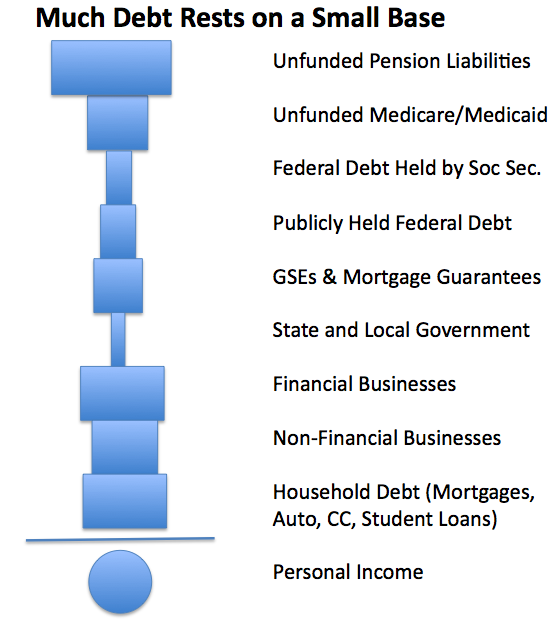
Many asset classes are correlated in time of stress, the tower of debt (Figure 1) has many feedback loops, and tends to magnify the economy's reaction to events, both favorable and unfavorable.


(FIGURE 1) (click on figure to read)

When consumer debt is rising it tends to make the economy look very, very good. When there are layoffs, the interrelationships tend to magnify the impact, making the economic impact much worse. One wonders whether there are tipping points, beyond which it is not really possible for the system to recover--particularly now that the US seems to be at the point of "peak energy" (Section 3), energy is required for growth (Section 3), and growth is required to allow debt to continue (Section 2).

The tower of debt is in some ways deceptive. It can make the economy look mostly OK to the casual observer, until all too quickly, things start to fall apart.

So far, the "fixes" that the US government has been attempting seem mostly counterproductive. Putting government guarantees behind more and more debt (thus stacking Figure 1 higher and higher, with a new TARP layer) just increases the likelihood that the US government will be drawn into the downward spiral. The financial services layer will be less and less needed in years ahead, as our need for debt-based products declines. Bailing it out does not help get additional income to ordinary workers (although it may temporarily protect them from losing their bank account balances).

All aspects of finances will be affected by the unwind of debt. A huge amount of debt will be defaulted on (or will be forgiven, so that an actual default does not need to occur). Regardless of whether the non-payment occurs because of default or forgiveness, the effect on financial institutions will be the same. Financial institutions such as banks, insurance companies, pension funds, and many hedge funds will find themselves in poor financial condition, because they were depending on the proceeds of this debt repayment to fund what they have promised--bank account balances; insurance policies; pension payments; or hedge fund returns. Institutions guaranteeing debt, such as monoline bond insurers will be particularly hard hit. The FDIC will likely be called on to rescue many failed banks, and will need to find funds from some source (printed money?) to do this.

As the year goes on, I expect each evaluation of where we are to be worse. Banks will report operating losses each quarter. Fannie and Freddie will need more funds than originally thought. TARP will need more funds than original planned. More and more businesses will enter bankruptcy, and more and more governments (states, cities, counties, and countries around the world) will find themselves unable to meet their obligations. There are a huge number of inter-relationships, and the bankruptcies and losses in one area will tend to cause more bankruptcies and losses in other areas, and act to destabilize the debt tower.

Debt of all forms will be very difficult to obtain, except through government sources. The interest rate the US government is currently paying is very low, mainly because of a "flight to quality". If the US government keeps issuing more and more debt, it seems likely that at some point this will change, because buyers will figure out that even if the US is the best of a bad lot, its risk of failure is significantly greater than 0%.

I do not expect a steep rise in the price of oil and natural gas in the next year, because the decline in demand is likely to outpace the decline in production in the short-term. If we look back at Figure 2, I expect that funds available to ordinary citizens will continue to decline in 2009, even considering any stimulus plan. This will happen because employee compensation will decline due to layoffs. Household debt outstanding will also decline (rather than just stay flat, as it has in the past year), because of the poor financial condition of lending institutions, and because with the poor economy, the risk of borrower default will be quite high, discouraging lending. A $300 billion stimulus program will be tiny in comparison to the boost the economy got in the past from increasing debt and greater refinancing (up to $2 trillion per year), as the prices of homes increased. With lower incomes, lower (actually net negative) cash flow from borrowing, and only a modest boost from a stimulus program, citizens will have less and less to spend on goods and services.

There is a distinct possibility that this could all end very badly. One possibility is that there will be more and more defaults, and the US government will not be able to prop up all of the institutions and will eventually default on its debt. While this seems to be the direction things are headed at the current time, the much more usual outcome is hyperinflation, caused by printing more and more money, wiping out the value of people's savings and pensions. Situations such as these are often accompanied by a new government (including a new constitution), and may even include different country boundaries (for example, Soviet Union after its fall).

Many people have started making preparation for the time when food needs to be produced locally and electricity is often not available. I would not discourage such preparations. While we do not know that the economy will collapse completely, I think such preparations are prudent, in the face of rising risk. Preparation for a major change takes many years, so starting earlier rather than later makes sense. Also, with the tower of debt (Figure 1) and the many feedback loops, the downward spiral can happen more quickly than our prior experience suggests is possible.

In conclusion, 2009 looks like a very challenging year for the new administration and for the world as a whole.

Series of Posts on the Economy: Peak Oil Planning for 2009

To better plan for Peak Oil impacts, we must understand the how we arrived at the current economic downturn and then forecast what lies ahead for 2009 and the future.

Over the next two days, I will post several articles and comments which explain the current economy and make forecasts for 2009 and the years ahead. To move toward an objective analysis, I will provide a variety of views on the economy.

Readers are welcome to make comments or email me their own assessment which I will post.

Subsequently, I will add a post that relates the economic assessments to oil production forecasts. This analysis will provide a base for making recommendations about planning for Peak Oil impacts.

Monday, January 19, 2009

Peak Oil and the Century of Famine, by Peter Goodchild

From Countercurrents.org, January 5, 2009

Around the beginning of the twenty-first century, there began a clash of two gigantic forces: overpopulation and oil depletion. The event went unnoticed by all but a few people, but it was quite real. As a result of that clash, the number of human beings on Earth must one day decline in order to match the decline in oil production.

Unfortunately, there seems to be no way to get those two giant forces into equilibrium in any gentle fashion, because in every year that has gone by for the last few thousand years — and every year that will arrive — the human population of Earth is automatically adjusted so that it is roughly equal to the planet’s carrying capacity. Like so many other animals, human beings always push themselves to the limits of that carrying capacity. The Age of Petroleum made us no wiser in that respect, and in fact dependence on fossil fuels has led us to a crisis far greater than any in the past.

(Continued here)

Tuesday, December 30, 2008

Top Story of the Year: Global Oil Production Peaked in 2008

The top story of the year is that global crude oil production peaked in 2008.

The media, governments, world leaders, and public should focus on this issue.

Global crude oil production had been rising briskly until 2004, then plateaued for four years. Because oil producers were extracting at maximum effort to profit from high oil prices, this plateau is a clear indication of Peak Oil.

Then in July and August of 2008 while oil prices were still very high, global crude oil production fell nearly one million barrels per day, clear evidence of Peak Oil (See Rembrandt Koppelaar, Editor of "Oil Watch Monthly," page 1). Peak Oil is now.

Credit for accurate Peak Oil predictions (within a few years) goes to the following (projected year for peak given in parentheses):

* Association for the Study of Peak Oil (2007)

* Rembrandt Koppelaar, Editor of “Oil Watch Monthly” (2008)

* Tony Eriksen, Oil stock analyst and Samuel Foucher, oil analyst (2008)

* Matthew Simmons, Energy investment banker, (2007)

* T. Boone Pickens, Oil and gas investor (2007)

* U.S. Army Corps of Engineers (2005)

* Kenneth S. Deffeyes, Princeton professor and retired shell geologist (2005)

* Sam Sam Bakhtiari, Retired Iranian National Oil Company geologist (2005)

* Chris Skrebowski, Editor of “Petroleum Review” (2010)

* Sadad Al Husseini, former head of production and exploration, Saudi Aramco (2008)

* Energy Watch Group in Germany (2006)

* Fredrik Robelius, Oil analyst and author of "Giant Oil Fields" (2008 to 2018)

Oil production will now begin to decline terminally.

Within a year or two, it is likely that oil prices will skyrocket as supply falls below demand. OPEC cuts could exacerbate the gap between supply and demand and drive prices even higher.

Independent studies indicate that global crude oil production will now decline from 74 million barrels per day to 60 million barrels per day by 2015. During the same time, demand will increase. Oil supplies will be even tighter for the U.S. As oil producing nations consume more and more oil domestically they will export less and less. Because demand is high in China, India, the Middle East, and other oil producing nations, once global oil production begins to decline, demand will always be higher than supply. And since the U.S. represents one fourth of global oil demand, whatever oil we conserve will be consumed elsewhere. Thus, conservation in the U.S. will not slow oil depletion rates significantly.

Alternatives will not even begin to fill the gap. There is no plan nor capital for a so-called electric economy. And most alternatives yield electric power, but we need liquid fuels for tractors/combines, 18 wheel trucks, trains, ships, and mining equipment. The independent scientists of the Energy Watch Group conclude in a 2007 report titled: “Peak Oil Could Trigger Meltdown of Society:”

"By 2020, and even more by 2030, global oil supply will be dramatically lower. This will create a supply gap which can hardly be closed by growing contributions from other fossil, nuclear or alternative energy sources in this time frame."

With increasing costs for gasoline and diesel, along with declining taxes and declining gasoline tax revenues, states and local governments will eventually have to cut staff and curtail highway maintenance. Eventually, gasoline stations will close, and state and local highway workers won’t be able to get to work. We are facing the collapse of the highways that depend on diesel and gasoline powered trucks for bridge maintenance, culvert cleaning to avoid road washouts, snow plowing, and roadbed and surface repair. When the highways fail, so will the power grid, as highways carry the parts, large transformers, steel for pylons, and high tension cables from great distances. With the highways out, there will be no food coming from far away, and without the power grid virtually nothing modern works, including home heating, pumping of gasoline and diesel, airports, communications, and automated building systems.

It is time to focus on Peak Oil preparation and surviving Peak Oil.

Sunday, December 21, 2008

From The Oil Drum: Peak Oil in 2008

Rembrandt Koppelaar, Editor of "Oil Watch Monthly," (page 1) concludes that global Peak Oil production occurred in 2008.

Global crude oil production has been on a plateau since 2004. Because oil producers were producing at maximum effort to take advantage of high oil prices, this is a clear indication of Peak Oil.

Accordingly, oil production will now begin to decline terminally.

Within a year, it is likely that oil prices will skyrocket as supply falls below demand. OPEC cuts would exacerbate the gap between supply and demand and drive prices higher.

There is discussion of Koppelaar's research at The Oil Drum.

Saturday, December 20, 2008

A Response to the IEA Forecast of a Peak in 2020

Independent studies conclude that Peak Oil production will occur (or has occurred) between 2005 to 2010 (projected year for peak in parentheses), as follows:

* Association for the Study of Peak Oil (2007)

* Rembrandt Koppelaar, Editor of “Oil Watch Monthly” (2008 to 2010)

* Tony Eriksen, Oil stock analyst (2008)

* Matthew Simmons, Energy investment banker, (2007)

* T. Boone Pickens, Oil and gas investor (2007)

* U.S. Army Corps of Engineers (2005)

* Kenneth S. Deffeyes, Princeton professor and retired shell Geologist (2005)

* Sam Sam Bakhtiari, Retired Iranian National Oil Company geologist (2005)

* Chris Skrebowski, Editor of “Petroleum Review” (2010)

* Sadad Al Husseini, former head of production and exploration, Saudi Aramco (2008)

* Energy Watch Group in Germany (2006)

* Fredrik Robelius, Oil analyst and author of "Giant Oil Fields" (2008 to 2018)


Independent studies indicate that global crude oil production will now decline from 74 million barrels per day to 60 million barrels per day by 2015. During the same time, demand will increase. Oil supplies will be even tighter for the U.S. As oil producing nations consume more and more oil domestically they will export less and less. Because demand is high in China, India, the Middle East, and other oil producing nations, once global oil production begins to decline, demand will always be higher than supply. And since the U.S. represents one fourth of global oil demand, whatever oil we conserve will be consumed elsewhere. Thus, conservation in the U.S. will not slow oil depletion rates significantly.

Alternatives will not even begin to fill the gap. And most alternatives yield electric power, but we need liquid fuels for tractors/combines, 18 wheel trucks, trains, ships, and mining equipment. The independent scientists of the Energy Watch Group conclude in a 2007 report titled: “Peak Oil Could Trigger Meltdown of Society:”

"By 2020, and even more by 2030, global oil supply will be dramatically lower. This will create a supply gap which can hardly be closed by growing contributions from other fossil, nuclear or alternative energy sources in this time frame."

With increasing costs for gasoline and diesel, along with declining taxes and declining gasoline tax revenues, states and local governments will eventually have to cut staff and curtail highway maintenance. Eventually, gasoline stations will close, and state and local highway workers won’t be able to get to work. We are facing the collapse of the highways that depend on diesel and gasoline powered trucks for bridge maintenance, culvert cleaning to avoid road washouts, snow plowing, and roadbed and surface repair. When the highways fail, so will the power grid, as highways carry the parts, large transformers, steel for pylons, and high tension cables from great distances. With the highways out, there will be no food coming from far away, and without the power grid virtually nothing modern works, including home heating, pumping of gasoline and diesel, airports, communications, and automated building systems.

This is documented in a free 48 page Peak Oil report that can be downloaded, website posted, distributed, and emailed.

I used to live in NH-USA, but moved to a more sustainable place. Anyone interested in relocating to a nice, pretty, sustainable area with a good climate and good soil? Email: clifford dot wirth at yahoo dot com or give me a phone call which operates here as my old USA-NH number 603-668-4207.

Friday, December 19, 2008

Matthew Simmons: No Way did oil demand plunge

Matthew Simmons does not think oil demand has dropped much, despite the current low prices.

And he sees problems ahead as oil and gas companies cut back on production efforts.

This could lead to a supply shortfall and a skyrocketing of oil prices in the near future.

Fortune Interview with Matthew Simmons

Sunday, December 14, 2008

Towns and Cities Should Prepare for the Peak Oil Energy Crisis

Liquid Fuels and Heating Oil Crises

The U.S. is highly dependent on oil for transportation, food production, industry, manufacturing, and residential and institutional heating. Oil is unique in providing gasoline and diesel, which are relatively inexpensive and portable. Oil also provides heating for many of the nation’s homes, institutions, and businesses. Despite advances in battery technology, battery powered tractors/combines and trucks do not provide a range that is practical. The so-called electric economy is not even in a planning stage of development. There are no alternatives that will replace oil.

Peak Oil is the term given for the point of maximum global production of oil, after which oil production will decline over a period of years until all recoverable oil is depleted. Peak Oil is a geological reality that is recognized by the National Academy of Sciences, National Academy of Engineering, General Accountability Office, Congressional Research Service, Army Corps of Engineers, and the National Petroleum Council.

Future oil production from off shore locations, Brazil, the Arctic, and the Gulf of Mexico etc., as well as future oil discoveries, will not provide enough new production to offset declining production in the largest oil fields.

In 2005, the U.S. Department of Energy released a Peak Oil study, “Peaking of World Oil Production: Impacts, Mitigation and Risk Management.” This report warns that “as peaking is approached, liquid fuel prices and price volatility will increase dramatically, and, without timely mitigation, the economic, social, and political costs will be unprecedented. Viable mitigation options exist on both the supply and demand sides, but to have substantial impact, they must be initiated more than a decade in advance of peaking. Unfortunately nothing like the kind of efforts envisaged has yet begun.” The report concludes that “the world has never faced a problem like this. Without massive mitigation more than a decade before the fact, the problem will be pervasive and will not be temporary. Previous energy transitions were gradual and evolutionary. Oil peaking will be abrupt and revolutionary.”

In 2007, the Government Accountability Office (GAO), with the assistance of a panel of 13 scientists of the National Academy of Sciences, published a study on Peak Oil, “Crude Oil: Uncertainty about the Future Oil Supply Makes it Important to Develop a Strategy for Addressing a Peak and Decline in Oil Production.” The study concludes:

“Because development and widespread adoption of technologies to displace oil will take time and effort, an imminent peak and sharp decline in oil production could have severe consequences. The technologies we examined [ethanol, biodiesel, biomass gas-to-liquid, coal gas-to-liquid, and hydrogen] currently supply the equivalent of only about 1% of U.S. annual consumption of petroleum products, and DOE [Department of Energy] projects that even under optimistic scenarios, these technologies could displace only the equivalent of about 4% of annual projected U.S. consumption by around 2015. If the decline in oil production exceeded the ability of alternative technologies to displace oil, energy consumption would be constricted, and as consumers competed for increasingly scarce oil resources, oil prices would sharply increase. In this respect, the consequences could initially resemble those of past oil supply shocks, which have been associated with significant economic damage. For example, disruptions in oil supply associated with the Arab oil embargo of 1973-74 and the Iranian Revolution of 1978-79 caused unprecedented increases in oil prices and were associated with worldwide recessions. In addition, a number of studies we reviewed indicate that most of the U.S. recessions in the post-World War II era were preceded by oil supply shocks and the associated sudden rise in oil prices. Ultimately, however, the consequences of a peak and permanent decline in oil production could be even more prolonged and severe than those of past oil supply shocks. Because the decline would be neither temporary nor reversible, the effects would continue until alternative transportation technologies to displace oil became available in sufficient quantities at comparable costs. Furthermore, because oil production could decline even more each year following a peak, the amount that would have to be replaced by alternatives could also increase year by year.”

A 2007 study by the Congressional Research Service, “Ethanol and Biofuels: Agriculture, Infrastructure and Market Constraints Related to Expanded Production” concludes:

“While recent proposals have set the goal of significantly expanding biofuel supply in the coming decades, questions remain about the ability of the U.S. biofuel industry to meet rapidly increasing demand. Current U.S. biofuel supply relies almost exclusively on ethanol produced from Midwest corn. In 2006, 17% of the U.S. corn crop was used for ethanol production. To meet some of the higher ethanol production goals would require more corn than the United States currently produces, if all of the envisioned ethanol was made from corn. Due to the concerns with significant expansion in corn-based ethanol supply, interest has grown in expanding the market for biodiesel produced from soybeans and other oil crops. However, a significant increase in U.S. biofuels would likely require a movement away from food and grain crops. Other biofuel feedstock sources, including cellulosic biomass, are promising, but technological barriers make their future uncertain. Issues facing the U.S. biofuels industry include potential agricultural “feedstock” supplies, and the associated market and environmental effects of a major shift in U.S. agricultural production; the energy supply needed to grow feedstocks and process them into fuel; and barriers to expanded infrastructure needed to deliver more and more biofuels to the market. There are limits to the amount of biofuels that can be produced and questions about the net energy and environmental benefits they would provide. Further, rapid expansion of biofuel production may have many unintended and undesirable consequences for agricultural commodity costs, fossil energy use, and environmental degradation. As policies are implemented to promote ever-increasing use of biofuels, the goal of replacing petroleum use with agricultural products must be weighed against these other potential consequences.”

An independent scientific energy research organization, Energy Watch Group, concludes in a 2008 report, “Peak Oil Could Trigger Meltdown of Society:”

"By 2020, and even more by 2030, global oil supply will be dramatically lower. This will create a supply gap which can hardly be closed by growing contributions from other fossil [including natural gas and coal], nuclear, or alternative energy sources in this time frame."

Independent studies (reviewed in the Peak Oil Report by Clifford J. Wirth) conclude that Peak Oil production will occur (or has occurred) between 2005 to 2010 (projected year for peak in parentheses), as follows:

* Association for the Study of Peak Oil (2007)

* Rembrandt Koppelaar, Editor of “Oil Watch Monthly” (2008 to 2010)

* Tony Eriksen, Oil stock analyst (2008)

* Matthew Simmons, Energy investment banker, (2007)

* T. Boone Pickens, Oil and gas investor (2007)

* U.S. Army Corps of Engineers (2005)

* Kenneth S. Deffeyes, Princeton professor and retired shell Geologist (2005)

* Sam Sam Bakhtiari, Retired Iranian National Oil Company geologist (2005)

* Chris Skrebowski, Editor of “Petroleum Review” (2010)

* Sadad Al Husseini, former head of production and exploration, Saudi Aramco (2008)

* Energy Watch Group in Germany (2006)

Independent studies conclude that global crude oil production will now decline from 74 million barrels per day to 60 million barrels per day by 2015. During the same time, demand will increase. Oil supplies will be even tighter for the U.S. As oil producing nations consume more and more oil domestically they will export less and less. Because demand is high in China, India, the Middle East, and other oil producing nations, once global oil production begins to decline, demand will always be higher than supply. Because the U.S. represents one fourth of global oil demand, whatever oil we conserve will be consumed elsewhere. Thus, conservation in the U.S. will not slow oil depletion rates significantly.

With increasing costs for gasoline and diesel, along with declining taxes and declining gasoline tax revenues, state and local governments will eventually have to cut staff and curtail highway maintenance. Eventually, gasoline stations will close, and state and local highway workers won’t be able to get to work. We are facing the collapse of the highways that depend on diesel and gasoline powered trucks for bridge maintenance, culvert cleaning to avoid road washouts, snow plowing, and roadbed and surface repair. When the highways fail, so will the power grid, as highways carry the parts, large transformers, steel for pylons, and high tension cables from great distances. With the highways out, there will be no food coming from far away, and without the power grid virtually nothing modern works, including home heating, pumping of gasoline and diesel, airports, communications, and automated building systems.

Although the GAO recommended that the DOE provide a risk management study for Peak Oil, no such study has been published. No federal or state agency provides any planning for Peak Oil impacts.

Although Peak Oil has been discussed briefly in a few popular sources (such as Fortune Magazine, BusinessWeek, The Times (London), The Wall Street Journal, MoneyWeek, Scientific American, and the Wikipedia Encyclopedia), television and public radio have avoided coverage of Peak Oil. Consequently, the public and most leaders are not aware of Peak Oil.

Problems Facing the Towns and Cities

Local governments face the following problems from Peak Oil impacts: (1) declining revenues due to declining property values and declining family incomes; (2) increasing costs for gasoline, diesel, and heating oil; (3) inflation in the costs of equipment, materials, products, services, and electric power; (4) increasing unemployment and homelessness; (5) increasing crime; and (6) resource constraints in providing basic services, social services, and emergency services. As needs and problems expand the resources available to state and local governments will shrink.

What Can Towns and Cities Do?

Town and city managers should promptly inform elected and other appointed officials at the local level (including county boards and school boards) about the Peak Oil issue. Forwarding them this article would be one way to do this, and this article could be used to focus discussions on Peak Oil planning. All government officials should be informed so that they can begin planning and so that they are able to respond to questions from constituents and the press about what their government is doing to plan for Peak Oil impacts.

Local governments should establish a Peak Oil committee in their government to provide advice regarding Peak Oil risk management and contingency planning. This committee should concentrate on what the town or city can do to address the problems that the town or city faces. The Peak Oil committee should establish a state wide means of communicating with other local governments in the state. One suggestion is to establish a free Google blog for discussions and announcements, and every local government and citizen advisory committee can be authorized to add to this blog. Local libraries should be involved in this effort so that they can order relevant books and hold local community discussions.

Local government officials should also establish a Peak Oil citizen advisory committee that can advise the public and town/city government, as well as inform state government and congressional leaders. Because Peak Oil is a very controversial and emotional issue, it is wise that an independent blue ribbon committee of citizens advise the media, the public, and local and state governments about Peak Oil problems and plans. The selection of members to this committee is critical. People with general knowledge and community service experience are preferable to those who might want to work to solve national energy problems, instead of focusing on the problems facing the town, city, county, and state. There is also a tendency to focus on energy conservation to plan for Peak Oil. Conservation of individual and local government resources is important, especially if it saves town resources, but local conservation is not a solution to most problems that communities face. Similarly, there is a tendency to focus on ways of generating energy, such as purchasing expensive solar panels or wind turbines. In general, these are not solutions. When the power grid fails, local electric power is not very useful, and it will be useful only as long as storage batteries last. A focus on risk management and contingency planning must be maintained.

Some Ideas for Risk Management and Contingency Planning

1. Studying Peak Oil impacts carefully will enable sensible risk management and contingency planning. The Peak Oil Report provides an excellent review of Peak Oil impacts.

2. Develop contingency plans for a power grid failure, which can occur at anytime (the possibility of a power grid failure is discussed in the Peak Oil Report in the section “Multiple Crises and a Gridlock of Crises” toward the end of the report).

3. Plan for government revenue reductions.

4. Guard financial resources.

5. Review the capital budget for possible cuts. For example, some state and local governments are widening highways, although traffic on these highways will decline in the future.

6. Plan ahead for very expensive oil and natural gas in the future. For example, many town or city offices may have to reduce operations to 3 or 4 days a week to cut costs in heating and transportation. Public schools use much heating oil (or natural gas) and diesel for transportation. Should the school calendar be adjusted to avoid the most expensive months: December, January, and February? Should classes meet 3 or 4 days a week? These changes require action by state board of education and changes in union contracts, etc. This example shows that government officials and the public need to be informed about Peak Oil now so that they can plan ahead. The pressure for changes in the school calendar would have to come from the local level, as there are no signs that state governments are planning for Peak Oil impacts.

7. Plans should be made for reductions in the personnel budget, as choices will have to be made between reductions-in-force and across the board reductions-in-pay.

8. Develop an extensive library of books that will provide useful technology for after the time when the power grid has failed permanently. Although this time is years away, these books could be sold out quickly following a national energy related emergency, and then the books may not be available later. An example: penicillin is not difficult to make, if you know how; but if you don’t know, it would be very difficult to invent the process for making penicillin.

9. Certain hand tools should be purchased and stored in quantities. Today they are inexpensive and plentiful, but in the future, they won’t be available, for example: 2 man wood saws, bow saws, and axes.

Where to Go for More Information

There are very few good sources of information for governments concerning Peak Oil planning, but Surviving Peak Oil blog is a portal to relevant websites and blogs. Town and cities will have to create their own plans to prepare for Peak Oil impacts. A Peak Oil blog for town governments (mentioned above) is a good way to share information. Also, local and state governments across the nation can add their plans and ideas to the Wiki Site for “Peak Oil Preparation:”

Everyone is welcome to email or call me if they have questions or want comments on plans, free of charge. I also provide presentations on these topics. My email address and telephone number can be included in any web posting of this article.

Cliff Wirth
clifford dot wirth at yahoo dot com
Telephone USA: (603) 668-4207

References

Crude Oil: Uncertainty about the Future Oil Supply Makes it Important to Develop a Strategy for Addressing a Peak and Decline in Oil Production

Peak Oil Could Trigger Meltdown of Society

Peaking of World Oil Production: Impacts, Mitigation and Risk Management

Peak Oil Report

Peak Oil Preparation Wiki Site

Surviving Peak Oil blog

About the Author

Cliff Wirth holds a Master of Public Administration degree (MPA) and a Ph.D. in Policy Analysis. He taught in three MPA programs, including the MPA program at the University of New Hampshire from 1981 to 2008, where he directed the MPA program for many years and implemented the extension MPA program in Manchester, NH in 1999. He has worked closely with hundreds of local, state, and federal officials on many projects. A number of his former students are current town and city managers in New Hampshire, Vermont, Maine, and Massachusetts.

Saturday, November 1, 2008

Peak Oil Survival: Choosing Reality or Illusion

I observed much about Peak Oil while traveling in Spain for the month of October, mostly driving: Madrid, Alicante, Granada, Cordoba, Sevilla, Merida, Barcelona, Aranjuez, and Segovia. I talked with taxi drivers, hotel workers and owners, shop workers and owners, tourists from all over the world, and a business owner relative who knows the economy of Spain, Europe, and the world well. I learned much as I traveled, including much reading of the "International Herald Tribune," "El Pais," "Times of London," "Financial Times," and the "Wall Street Journal," as well as viewing CNBC, CNN, and the local TV news.

Building construction in Spain has almost ceased and construction cranes stand idle. Capital is scarce. No amount of government priming will change that. Few new solar panels and wind turbines will be added to the thousands in use. Commercial centers, factories, and offices are all slowing down and many will close in the months ahead. Spain will soon have spare electric power. The large number of tourists on the streets is a hold over from the pre-recession economy. Tourism is declining rapidly. This is like much of Europe and the U.S.

Global oil production has been plateaued since early 2005. So, the oil flow rate has been much the same, but now more oil is consumed by China, India, and the oil producing nations. Europe, the U.S., Japan, Australia, etc. are consuming less. Peak Oil is here, regardless of the most recent U.S. Energy Information Agency data which show some possible recent minor increase. When oil production is the same after 4 years of trying hard to increase it, we are at Peak Oil.

Very soon oil production will begin to decline, probably about right now (2012 at the latest, according to independent studies). Unless they are transported to the Middle East, China, or India, those idled construction cranes in the U.S. and Europe will remain idle.

Despite a media clamor in Spain for more wind and solar investment, it won't happen. Soon all of the capital will go to subsidizing unemployment (currently at about 15% and rising rapidly) and to public works in order to employ people. The manufacture of solar panels and wind turbines produces few jobs. As soon as oil production begins to decline, global recession will devastate the global economy and capital and government revenues will evaporate.

We need to examine solar and wind power. But no one has a real plan on how solar/wind will power tractors and combines, transport food and goods, or fertilize crops. Showing a photo of an electric powered tractor, truck, or train or saying we can do it is not a plan. What would the infrastructure for the electric economy look like? Where would the trillions of Euros in capital come from? How can governments pay for it when people are out of work and governments have little revenue? Where will the oil come from to manufacture, transport, and maintain the electric economy? Where will people get the money to buy electric vehicles when they are out of work and have little trade in value on their gasoline/diesel powered cars?

How can we maintain the power grid without diesel for trucks? When the highways fail from a lack of maintenance, there won't be replacement parts for the power grid, wind turbines, and solar panels. As I cruised the highways of Spain, I saw some huge transformers and gigantic wind turbine blades being transported by trucks. Everything depends on trucks moving on the highways. Most food, goods, and people in Europe move by trucks, not trains. But like the construction cranes, those trucks will be idle one day -- and there goes food distribution, the power grid and everything. Without electric power, almost nothing mechanical or modern functions -- lights, sanitation, water purification and distribution, refrigeration, heating and air conditioning, pumping of diesel and gasoline, building systems, elevators, communications, emergency services, etc. Without the power grid, wind turbines and solar panels are mostly useless. In the future, wind turbines and solar panels will sit idle, monuments to misdirected policies that wasted fossil energy to manufacture, transport and maintain devices to produce electric power, when we need liquid fuels. The same can be said for nuclear power.

Shall we plan and prepare for the real future: a world without oil and without electric power. Or, shall we continue to avoid reality, dream about what will never happen, and waste time, effort, and capital on illusions?

Friday, October 31, 2008

Personal Survival Skills, by University of Arizona Students

We are a small group of students with diverse backgrounds and life goals. We began this journey relatively uninformed about the impacts of peak oil and other end-of-the-world-as-we-know-it scenarios, and our opinions differ as to how accurate or biased those scenarios are. But we share a common interest in personal survival as the chance of civilization collapsing increases, and we wish to share our newly accumulated knowledge with others who are similarly concerned about their own futures.

This report is intended to serve as a guide along the path we have, thankfully, already trodden and worn down, along with several thousand scientists, conspiracy-theory crackpots, and average frustrated chumps as we have come up against a world in turmoil. Specifically, we face an ambiguous future in a world that grows increasingly dependent on oil even as global supplies fall.

We begin by briefly discussing the evidence behind peak oil and the importance of crude oil to civilization. Then we review various scenarios of a future that, perhaps thankfully, we cannot fully predict. We conclude by discussing several areas of human life that we wish to continue participating in after the fall of civilization: Water, Food, Shelter, Community, and Medicine. We identify opportunities to access these wonderful components of society even as the world as we know it is turned upside down.

This report is not a comprehensive guide to peak oil, nor is it meant to be anything but informative as it provides access to several articles, books, websites, opinions, and other resources you might not find elsewhere. Unlike other literature, though, ours is a personal account that describes possible pertinent actions we can take in light of a future that is likely to be quite different from the recent past.

This report represents the culmination of an exciting and fun-filled semester. We spent many hours in thoughtful conversation, appropriately intermixed with pleasant absurdities and occasional field trips. We hope the reader finds value in this effort, and recognize that, if nothing else, we are taking action to create a future that we want to live in. And that is what really inspired us to research this topic in the first place. (Continued here)

Saturday, September 27, 2008

Peak Oil Preparation: Educating Family, Loved Ones, and Friends

Peak Oil will soon generate problems for individuals and families around the globe: unemployment; bankruptcy; inability to pay for heating oil, higher education, mortgage, and rent etc; the need for family members to share residences and expenses; violent street crime even in previously safe neighborhoods; the separation of family members (due to high airfares, the high cost of gasoline, or gasoline rationing); and anxiety and depression.

Families that have a common understanding of Peak Oil problems can provide mutual support and group problem-solving, and they are more likely enjoy life and survive the Peak Oil catastrophe. Young people who understand Peak Oil are more likely to study what makes sense for the future. Informed people who are unemployed can work collectively for their future and use their resources for contingency planning, instead of looking to panaceas and technological fixes.

Educating family, loved ones, and friends about Peak Oil and its impacts is a formidable challenge. Most people believe strongly that a national commitment and technology will solve energy problems and support a stable economy. Denial concerning Peak Oil is pervasive at all levels of society. Frustration in educating family members about Peak Oil is common, as revealed on the Peak Oil Blues website.

It helps to remember that people avoid the reality of Peak Oil from weakness, not strength. Peak Oil is personally frightening and many fear for family and friends. Educating about Peak Oil is the right thing to do, so be patient. It sometimes takes weeks, months, or years to get through to people. Learn from the experiences of others on the Peak Oil Blues website. Here are some ideas to consider in educating family, love ones, and friends.

Studies by major independent government agencies and scientific organizations are the most credible sources for convincing many people that Peak Oil is real and will have serious impacts soon. I wrote a 48 page Peak Oil Impacts Report based on such sources, and the sources can be referenced directly from the report (which can be downloaded, website posted, distributed, and emailed). It is hard to deny studies by the National Academy of Sciences, U.S. General Accountability Office, U.S, Congressional Research Service, and major scientific institutions. Many governments have sponsored Peak Oil studies. Use these authority symbols to your advantage.

You can tell your family or friends that Peak Oil is a serious issue that you personally need to discuss with them, and that you want them to read the report for factual information in order to have a well-informed conversation.

The report was written by a recently retired professor of Political Science at the University of New Hampshire, where he was director of the Master of Public Administration program for many years. In that capacity he worked with hundreds of local, state, and federal officials on government planning. Based on this report, he gave a Peak Oil presentation to the New Hampshire Town Managers Association last January and a variety of audiences in Albany, NY in June.

If the report is too long or complex, start off with some articles in newspapers or magazines that you can print and ask them to read and discuss, for example: Fortune Magazine, BusinessWeek, The Times (London), The Wall Street Journal, MoneyWeek, Scientific American, and the Wikipedia Encyclopedia

If they read short convincing articles, you may then convince them to read the 48 page report. You can also ask them to read the first page summary of the report and the summaries of the report by the U.S. General Accountability Office, which is covered in my report.

Also convincing are the following websites: U.S. Representative Roscoe Bartlett, who is a respected conservative Republican Member of Congress; Simmons and Company International (see his speeches), Jim Kingsdale, Association for the Study of Peak Oil & Gas - USA, and Association for the Study of Peak Oil & Gas – Ireland (see the Newsletter) .

The September 2008 ASPO-USA Peak Oil Conference included a very credible group of speakers, including Neil King Jr., the international energy reporter for “The Wall Street Journal.”

An Internet search of the term “peak oil” yields some 4,400,000 hits.

Energy Bulletin” provides much scientific information and a Peak Oil primer.

The “Transition Movement” and Portland (Oregon) Peak Oil Task (and other cities’ efforts) show that some towns and cities are planning to prepare for Peak Oil.

There are many videos on Peak Oil on Google or Yahoo.

If anyone asks why more people don’t know about Peak Oil, the following explains this conspiracy of silence. Both private and national oil company executives and their allies in business and government have lied to the media and public about oil reserves in order to create an image of corporate financial growth. This has increased their salaries, stock investments, stock options for retirement, and large consulting fees to produce phony research. The media and government officials have believed the lies and have conveniently avoided giving the public bad news about the future. And most leaders and people across the globe believe that there must a new energy source for continued prosperity and economic development, so why worry about Peak Oil?

Patience is a virtue. It takes time for people to think about how vital oil is for the economy and what life will be like without oil in the future. Patience -- even many who are aware of Peak Oil are in denial about the future. They accept Peak Oil, but not its impacts. Patience -- belief systems that were developed over a lifetime are difficult to change. Patience.

In the comments option, please offer additional ideas for educating family, loved ones, and friends about Peak Oil.

Wednesday, September 3, 2008

Surviving Peak Oil: Obstacles to Relocation

Oil and natural gas depletion will soon begin to undermine the capacity of urban and metropolitan areas to sustain human life. Modern urban and metropolitan life depends on oil and natural gas for food production and distribution, residential heating, water purification and distribution, sanitation, and the power grid that delivers electricity for the pumping of gasoline and diesel, airports, communications, elevators, home heating controls, and automated building systems. As international food transport collapses, most oil rich nations face starvation too, regardless of how much oil they possess. Oil depletion means population decline for all urban areas.

The notion that urban and suburban dwellers will relocate to small villages in agricultural regions is unrealistic. In the ensuing Peak Oil generated global economic depression, the value of urban residential properties will plummet. Increasing unemployment will slow new house sales and accelerate mortgage and property tax foreclosures. With more and more urban homes up for sale, their prices will decline sharply.

And, as the price of urban property declines in value, rural property will increase in comparative value. Indeed, in the last few years, the prices of agricultural land have increased. Soon, to move to a rural area most urban home owners will have to sell at a low price and buy a rural property for a higher price. The financial loss in selling and buying property will stifle the relocation to rural regions for most people.

At the same time, the cost of building new homes in rural areas will increase with the increasing cost of oil and natural gas. Building materials (asphalt and fiberglass shingles, cement, plastic and aluminum siding, fiberglass insulation, glass, lumber, and bricks) are either made from oil or they are manufactured with the energy of oil, natural gas, and coal. All building materials and construction workers are transported using oil (diesel and gasoline).

Electricity that is used in the manufacture and construction of houses will also become more expensive. Coal (which is transported with diesel) and natural gas (which uses oil in exploration, drilling operations, and transport of workers) provide the energy for electric power generation. Thus coal and natural gas costs, as well as the cost of electricity, will increase with the increasing price of oil.

Similarly, the construction of residential water (wells and pumps) and sanitation systems (septic systems or outhouses in rural areas) will cost more and more as the price of oil increases.

Local governments would have to construct schools and some roads in rural areas with expanding populations in an era of declining local government revenues (due to declining property values and property taxes). Local governments would have to raise taxes for new infrastructure at a time when citizens will vociferously oppose tax increases.

In colder regions of the world, including most of Europe and the U.S., urban to rural relocation means people moving close to wood supplies for home heating, but many agricultural areas lack significant forest land.

Inertia and procrastination are powerful forces in determining human behavior. It is basic human nature to deal with non-routine problems when they become obvious, not before. Very few people will study the Peak Oil future carefully to determine how it will impact them. Denial is encouraged by pervasive public, media, government, and business ignorance of Peak Oil impacts. Indeed, those who become vocal about Peak Oil face ridicule by the vast majority of the ignorant.

The combination of these obstacles means that only those who have ample resources and knowledge of Peak Oil impacts will be able to relocate, if they act sooner rather than later. Relocation will thus resemble a trickle of the affluent, rather than a mass movement.

As the Peak Oil economic depression undermines the value of investments and urban property, most people will be stuck where they are. When the highways fail, the movement of people from urban to rural areas will cease. That time is years away, not decades.

Studies by scientific organizations and independent analysts indicate that global crude oil production will now begin to decline, from 74 million barrels per day to 60 million barrels per day by 2015. During the same time demand will increase 14%. This is equivalent to a 33% drop in 7 years. The price of oil will skyrocket like never before.

No one can reverse this trend, nor can we conserve our way out of this catastrophe. Because the demand for oil is so high, it will always exceed the level of production; thus oil depletion will proceed at the same rate until all recoverable oil is extracted.

Alternatives energies will not fill the gap. And most alternatives yield electric power, but we need liquid fuels for tractors/combines, 18 wheel trucks, trains, ships, and mining equipment. The proponents of the electric economy, the hydrogen economy, or an algal biodiesel economy ignore the obvious. There is little capital, time, energy, or public will for such trillion dollar infrastructure makeovers. The belief in alternative energies is so strong that most scientists avoid examining obvious questions – does the development of alternative energies consume more energy than they provide, and do alternative energies consume liquid fuels and give us electric power, which is not what we need?

The U.S. government provides no studies to advise the Congress and president on what to do with this catastrophe. Congress and the president are so inept they don’t even know that they should commission the National Academy of Sciences to study the energy crisis and the advise the nation on how to plan for Peak Oil impacts. The NAS is the only objective body that can develop policy with the best scientists from many fields to work together cooperatively to develop sound policy recommendations. And the NAS is the only authoritative source for making such policy recommendations to the nation. Thus Congress and the president grope around in the dark, relying on energy company lobbyists and well meaning “sages” who offer some plan to save the nation, but who know little about energy policy and Peak Oil impacts. FEMA has no Peak Oil risk management plans. Contingency planning for Peak Oil is an oxymoron.

We are facing the collapse of the highways that depend on diesel trucks for maintenance of bridges, cleaning culverts to avoid road washouts, snow plowing, roadbed and surface repair. When the highways fail, so will the power grid, as highways carry the parts, transformers, steel for pylons, and high tension cables, all from far away. With the highways out, there will be no food coming in from "outside," and without the power grid virtually nothing works, including home heating, pumping of gasoline and diesel, airports, communications, and automated systems.

After the last power black out, the people living in rural areas will find that surviving will become increasing difficult without all of the goods from the “outside” (food, canning jars, fencing, roofing, hay, straw, seed, animal feed, plastic tarps, fertilizer, clothes, fabric, medicine, hardware, saws, wood stoves, etc.). The survivors will be the very few who live in areas with good rain and soil and who prepared intelligently for a life without oil.

Wednesday, July 30, 2008

Surviving in the Northern USA after the Last Power Blackout

According to energy investment banker Matthew Simmons and other independent analysts, global oil production is now declining, from 74 million barrels per day to 60 million barrels per day by 2015. During the same time demand will increase 14%.

This is equivalent to a 33% drop in 7 years. No one can reverse this trend, nor can we conserve our way out of this catastrophe. Because the demand for oil is so high, it will always be higher than production; thus the depletion rate will continue until all recoverable oil is extracted.

Alternatives will not even begin to fill the gap. And most alternatives yield electric power, but we need liquid fuels for tractors/combines, 18 wheel trucks, trains, ships, and mining equipment.

We are facing the collapse of the highways that depend on diesel trucks for maintenance of bridges, cleaning culverts to avoid road washouts, snow plowing, roadbed and surface repair. When the highways fail, so will the power grid, as highways carry the parts, transformers, steel for pylons, and high tension cables, all from far away. With the highways out, there will be no food coming in from "outside," and without the power grid virtually nothing works, including home heating, pumping of gasoline and diesel, airports, communications, and automated systems.

This is documented in a free 48 page report that can be downloaded, website posted, distributed, and emailed: http://www.peakoilassociates.com/POAnalysis.html

In June I took a trip to Albany to talk to 3 audiences on Peak Oil impacts. In the group that invited me, the Capital Regional Energy Forum CREF), is a physicist who teaches solar energy at a major university, and who had served in the Peace Corps.

He has solar powered just about everything, including a solar powered canoe which we went for long ride in on a lake in the Adirondacks, and a PV solar powered house and pump for his well. He repairs about everything on his house himself and he heats much with passive solar. So the guy knows his stuff. He is no ivory tower academic.

We talked for hours about survival in the northeast after the last power blackout.

It looks "challenging."

Eventually batteries and even the solar panels deteriorate. He thinks that he could store dry batteries with the liquid stored in glass and thus make "new batteries" after they conk out. But eventually the batteries and solar panels give out.

Cutting and moving wood without trucks, horses, and wagons will be a major effort and very time consuming. There are not many horses around and it will take decades to breed enough horses to go around. Horses require food, care, vets, and medicine. No one is making wagons these days locally.

Wood stoves break, just like everything else. You could keep one or 2 extras, but eventually you have none and can't get more, because there is no transportation on the highways.

Asphalt roof shingles need to be replaced, and houses need to be painted and maintained.

Food must be grown in with a short growing season, and all of the farm stuff that used to be in a 1890 Sears catalog is no longer available. Last summer I took a tour of a farm and saw how dependent farming is on oil -- transportation and manufacture of plastic feeding bowls, containers to store grains/feeds, straw, roofs for animals and storage areas, wire, rope, wood boards, cement, fencing, antibiotics for animals, asphalt shingles etc. Seed and hardware used to be available at the local hardware store, no more.

Then there is clothing which is manufactured and transported from afar. Making cloth is a major operation from growing cotton to making cloth. I have studied the textile mills of Lowell National Historical Park in Lowell, MA for years, as I used it as an example of the confluence of capital, technology, and labor for a course I taught on Global Urban Politics at the University of New Hampshire. I know that the parts in those factories were manufactured in many places with a vast transportation network. After the last power blackout, those factories will not be built again. And there are not many sheep around, nor animals for making leather clothes. Eventually down coats and comforters wear out, as do blankets. It sounds like just keeping warm will be a major problem.

Potable water is another problem, and sanitation also.

And there will be no modern pharmacies or hospitals.

After auto and air transport end (which could be next week if there is some "untoward activity" in the Middle East), there will be no way of getting here, or from here to there. Bus and train reservations will be backed up for years. You know the old Maine joke, "can you get there from here?" Well this time the answer will be no you can't. I keep reading in the newspapers that some of the folks over there in the Middle East are tired of others getting most of that oil, and that they are trying to shut down the flow of oil to us (:

Wasn't it that guy Murphy who said that if something can go wrong it will.

When the music stops (that is when air and automobile transportation ends) where you are is important, because that is pretty much where you will stay.