The trustees who oversee Social Security are projecting there won't be a cost of living adjustment (COLA) for the next two years. That hasn't happened since automatic increases were adopted in 1975."
Showing posts with label economy. Show all posts
Showing posts with label economy. Show all posts
Sunday, August 23, 2009
Peak Oil Impacts: "Millions face shrinking Social Security payments," By Stephen Ohlemacher, Associated Press, August 23, 2009
"Millions of older people face shrinking Social Security checks next year, the first time in a generation that payments would not rise.


Monday, August 17, 2009
"Insiders Continue to Sell, Sell, Sell," Seeking Alpha, August 14, 2009
"We have to send a tip of the hat, to ultra popular finance blogger at Zerohedge.com for alerting us to the huge number of insiders who are selling off stock in their companies."
(VIEW FULL ARTICLE)
Blog Comment: Many Wall Streeters know about Peak Oil. Neil King Jr. at "The Wall Street Journal" gave a talk last year at the annual ASPO conference. Two years ago I sent him my Peak Oil impacts report. He wrote back and said he would read it. I wrote back and suggested that he forward the report to his editors, as it would make writing about Peak Oil easier for him. I have posted my Peak Oil impacts report in comments on financial blogs, including those at "The Wall Street Journal" and "Financial Times," and it has been posted on Engerybulletin.net. Bart Anderson at Engergybulletin.net informed me that this article on Peak Oil and the economy had 3,783 unique page views. Another article on Peak Oil and the economy was likely as popular and has been posed on many blogs. We can conclude that many insiders know about Peak Oil.
(VIEW FULL ARTICLE)
Blog Comment: Many Wall Streeters know about Peak Oil. Neil King Jr. at "The Wall Street Journal" gave a talk last year at the annual ASPO conference. Two years ago I sent him my Peak Oil impacts report. He wrote back and said he would read it. I wrote back and suggested that he forward the report to his editors, as it would make writing about Peak Oil easier for him. I have posted my Peak Oil impacts report in comments on financial blogs, including those at "The Wall Street Journal" and "Financial Times," and it has been posted on Engerybulletin.net. Bart Anderson at Engergybulletin.net informed me that this article on Peak Oil and the economy had 3,783 unique page views. Another article on Peak Oil and the economy was likely as popular and has been posed on many blogs. We can conclude that many insiders know about Peak Oil.
Sunday, July 26, 2009
"20 Ways to Waste Your Money," By Erin Burt, Kiplinger. com, July 23, 2009
"Whether a newbie or seasoned budgeter, nearly everyone has spending holes -- leaks in your budget that drain money with you hardly noticing.
These small drips can add up to big bucks. Once you find the holes and plug them, you'll keep more money in your pocket. That spare cash could be the ticket to finally being able to save, invest, or break your cycle of living paycheck to paycheck.
Here are 20 common ways people waste money. See if any of these sound familiar, and then look for ways to plug your own leaks."
Thursday, July 23, 2009
"Some Unemployed are Giving Up," By Liz Wolgemuth, U.S. News & World Report, July 22, 2009
"In some U.S. states, nearly half of the job seekers who have stopped looking for work have done so because they simply don't believe they'll find anything. Indeed, the number of discouraged workers nationwide has more than doubled in the past year. This trend won't be reflected in the widely publicized unemployment rate, as discouraged workers aren't included among the unemployed. Still, in states as diverse as Mississippi, South Dakota, and New York, the span of this often invisible slice of workers signals a population losing its hope."
(CONTINUED HERE)

(CONTINUED HERE)
Thursday, July 16, 2009
" Twenty Dollars Per Gallon: How the rising price of oil will change our lives.," By Christopher Steiner, Forbes.com, July 16, 2009
"We sit in a period that's popularly (and appropriately) known as "peak oil," meaning that global production of crude is at a zenith that will never again be realized."
"Middle-class life runs on oil. So we should pay rapt attention to things that could cause the price of oil to increase. As the price increases, our lives will indelibly change--and there are plenty of reasons to think that the price of oil will, in the long term, steadily increase."
(CONTINUED HERE)
"Middle-class life runs on oil. So we should pay rapt attention to things that could cause the price of oil to increase. As the price increases, our lives will indelibly change--and there are plenty of reasons to think that the price of oil will, in the long term, steadily increase."
(CONTINUED HERE)
"Nine Reasons the Economy is Not Getting Better," By Mortimer B. Zuckerman, US New & World Report, July 15, 2009
"We are now looking at unemployment numbers that undermine any confidence that we might be nearing the bottom of the recession. The appropriate metaphor is not the green shoots of new growth. A better image is to look at the true total of jobless people as a prudent navigator looks at an iceberg.
What we see on the surface is disconcerting enough. The estimate from the Bureau of Labor Statistics of job losses for June is 467,000. That increases by 7.2 million the number of unemployed since the start of the recession. The cumulative job losses over the past six months have been greater than for any other half-year period since World War II, including demobilization. What's more, the job losses are now equal to the net job gains over the previous nine years, making this the only recession since the Great Depression to wipe out all employment growth from the previous business cycle.
Next year, state budgets will have depleted their initial rescue dollars. Absent another rescue plan, they will have no choice but to slash spending or raise taxes, or both. The complete state and local government sector, which makes up about 15 percent of the economy, is beginning the worst contraction in postwar history in the face of a deficit gap of $166 billion for fiscal year 2010, according to the Center on Budget and Policy Priorities, and a cumulative gap of $350 billion in fiscal year 2011.That's bad enough. But here are nine reasons we are in even more trouble than the 9.5 percent unemployment rate indicates."
(CONTINUED HERE)
Blog Comment: Peak Oil is the reason for continued economic malaise. Eventually state and local governments will lack the resources to maintain the highways -- which support maintenance for the power grid. Federal assistance to states will decline as federal revenues decline. Some 70% of federal revenues come from income taxes. Read more HERE and HERE.
Wednesday, July 15, 2009
"Hundreds of Thousands of Workers Will Lose Unemployment Benefits Soon," By Marie Coco, Washington Post Writer's Group, July 10, 2009
"When a virulent disease is ravaging you like a cancer, you don't want a cacophony of voices promoting different or contradictory cures. Yet that is what we're starting to hear about the economic crisis, not only from a politically divided -- and pretty scared -- capital, but from within the Obama administration itself. In just the past few days, Vice President Joe Biden has said the young administration misread the depth of the recession -- an honest account, since most private economists did as well. Laura Tyson, an outside economic adviser to the White House, said it's wise to start preparing another stimulus package."
(CONTINUED HERE)
(CONTINUED HERE)
"The State of Homelessness in the U.S.," By M.J. Stephey, TimeCNN, July 13, 2009
"There are few economic indicators as grim as homelessness, as the Department of Department of Housing and Urban Development demonstrates in its 4th annual report on the topic, which found that some 1.6 million Americans stayed at homeless shelters from October 2007 to September 2008. The Department also noticed some troubling trends: more families seeking shelter — particularly in rural and suburban areas — and more people going to shelters from stable living arrangements (instead of jails, institutional settings or the military)."
(CONTINUED HERE)
(CONTINUED HERE)
Thursday, June 11, 2009
'Most banks still getting weaker, analysis shows," By Bill Dedman, MSNBC, June 11, 2009
"Bad loans on real estate continue to push harder on the nation's banks.
At the end of the first quarter, six out of every 10 banks in the U.S. were less well prepared to withstand their potential loan losses than they had been at the end of 2008, according to a new analysis by msnbc.com and the Investigative Reporting Workshop at American University in Washington. Overall, bad loans rose another 22 percent in the quarter as the recession continued." (CONTINUED HERE).
Sunday, May 31, 2009
Peak Oil Current Events, Kenneth S. Deffeyes, Beyond Oil, May 29, 2009
Click Here >>> Join us as we watch the crisis unfolding
Blog comment:Professor Kenneth S. Deffeyes correctly forecasted crude Peak Oil in May 2005. By hindsight we will come to understand the Peak as the plateau between 2004 and 2008.
There are many labels for Peak Oil impacts, such as "crisis" or "long emergency." But these terms suggest major problems for a brief period. Because oil depletion is terminal and viable alternatives are non-existent, we face a global catastrophe which has no parallel in all of human history.
Wednesday, May 27, 2009
"Social Security and Medicare Finances Worsen," by Martin Crutsinger, Associated Press, May 12, 2009
"Social Security and Medicare are fading even faster under the weight of the recession, heading for insolvency years sooner than previously expected, the government warned Tuesday. Social Security will start paying out more in benefits than it collects in taxes in 2016, a year sooner than projected last year, and the giant trust fund will be depleted by 2037, four years sooner, trustees reported.
Medicare is in even worse shape. The trustees said the program for hospital expenses will pay out more in benefits than it collects this year, just as it did for the first time in 2008. The trustees project that the Medicare fund will be depleted by 2017, two years earlier than the date projected in last year's report.:
(CONTINUED HERE)
Blog Comment:
These funds will collapse much sooner than indicated here. Most government revenues are derived from the individual income tax. Peak Oil means less employment and less income.
Wednesday, March 25, 2009
Peak Oil Financial Planning: Get Out of the U.S. Dollar Now
"Why you should get out of the US dollar now!" By Justice Litle in CommodityOnline.com
"Get out of the U.S. Dollar. NOW. Do not pass go, do not collect $200, do not stop to conduct an impromptu inventory of your unmentionables." (Continued here)
This article is based on concerns that "China wants the dollar replaced as reserve currency." But regardless of this, printing dollars means inflation, and Peak Oil inflation is just around the corner. All currencies, pensions, retirement plans, life insurance, health insurance, and long term care insurance are promises to be able to buy oil in the future (all depend on oil). As oil supplies diminish, these promises evaporate in inflation and bankruptcies.
Gold and silver are mentioned as possible safe havens, but are not. The prices of gold and silver have not been going up as the world economy collapses. Both are used in electronics and jewelry and therefore the demand for these metals is collapsing. Gold and silver are a bubble waiting to burst.
"Get out of the U.S. Dollar. NOW. Do not pass go, do not collect $200, do not stop to conduct an impromptu inventory of your unmentionables." (Continued here)
This article is based on concerns that "China wants the dollar replaced as reserve currency." But regardless of this, printing dollars means inflation, and Peak Oil inflation is just around the corner. All currencies, pensions, retirement plans, life insurance, health insurance, and long term care insurance are promises to be able to buy oil in the future (all depend on oil). As oil supplies diminish, these promises evaporate in inflation and bankruptcies.
Gold and silver are mentioned as possible safe havens, but are not. The prices of gold and silver have not been going up as the world economy collapses. Both are used in electronics and jewelry and therefore the demand for these metals is collapsing. Gold and silver are a bubble waiting to burst.
Friday, March 6, 2009
The Peak Oil Economic Depression Has Arrived
A headline from Chicagotribune.com states: "Jobless rate bolts to 8.1 percent, 651K jobs lost in February."
"The net loss of 651,000 jobs in February came after even deeper payroll reductions in the prior two months, according to revised figures. The economy lost 681,000 jobs in December and another 655,000 in January," based on U.S. Department of Labor statistics."
But the real unemployment rate is now more like 12 or 13 percent, according to analyst Lee Adler, writing in "The Wall Street Examiner." Adler concludes that, "today’s deterioration is at least as rapid, and probably more rapid, than the beginning of the Great Depression."
Dow Jones concludes that today's stock market decline mimics the Great Depression.
Thus, both increasing unemployment and declining stock values indicate that we are entering an economic depression similar to the Great Depression.
Although it is difficult to determine how much of this economic depression is caused by Peak Oil impacts and how much stems from mismanagement of the economy as well as from business and government corruption, ASPO-Ireland explains that Peak Oil plays a major role.
But the current economic depression is permanent, due to declining global oil production, according to a recent post on EnergyBulletin.net.
We are entering the "Greatest Depression."
In the Great Depression of the 1930s, government programs and the build up for World War II stimulated the economy. The East Texas oil boom powered the factories, highways, trucks, tractors, trains, transportation, and infrastructure to make it possible.
Now, the problem is declining oil production, and there is no energy boom to help us pull ourselves up by the bootstraps.
There is no plan for developing energy alternatives that will power trucks, trains, ships, tractors, and combines, nor is there time or capital to develop alternatives. Capital is scarce due to declining oil production. Chris Shaw explains that energy is the source of capital, and hence, capital declines as oil production drops.
A review of government and scientific studies indicates that regardless of the time or capital available, no alternatives will begin to make up for declining global oil production.
Whatever alternative energy we attempt to develop will consume valuable oil (mining, manufacturing, and transportation) and not deliver the liquid fuels that we need. Chris Shaw call this the "quicksand effect."
The Congress and president will be at a loss of how to manage this ever-worsening economic collapse. They would be wise to commission the National Academy of Sciences (NAS) to provide the nation with advice. Chaos will result from the advice of contradictory interest groups, organizations, bloggers, and individuals. The NAS is the most credible source for such advice. The NAS and other scientific sources have already undertaken the basic research needed for a policy study to advise the nation. The NAS could provide an energy policy study within a year and could then provide advice on a continuing basis.
The best advice for individuals and organization is to prepare for Peak Oil impacts. No federal or state agencies are studying Peak Oil impacts and contingency planning. A few local governments and organizations are beginning to make plans.
This is what we must plan for. With increasing costs for gasoline and diesel, along with declining taxes and declining gasoline tax revenues, states and local governments will eventually have to cut staff and curtail highway maintenance. Eventually, gasoline stations will close, and state and local highway workers won’t be able to get to work. We are facing the collapse of the highways that depend on diesel and gasoline powered trucks for bridge maintenance, culvert cleaning to avoid road washouts, snow plowing, and roadbed and surface repair. When the highways fail, so will the power grid, as highways carry the parts, large transformers, steel for pylons, and high tension cables from great distances. With the highways out, there will be no food coming from far away, and without the power grid virtually nothing modern works, including home heating, pumping of gasoline and diesel, airports, communications, water distribution systems, waster water treatment, and automated building systems.
"The net loss of 651,000 jobs in February came after even deeper payroll reductions in the prior two months, according to revised figures. The economy lost 681,000 jobs in December and another 655,000 in January," based on U.S. Department of Labor statistics."
But the real unemployment rate is now more like 12 or 13 percent, according to analyst Lee Adler, writing in "The Wall Street Examiner." Adler concludes that, "today’s deterioration is at least as rapid, and probably more rapid, than the beginning of the Great Depression."
Dow Jones concludes that today's stock market decline mimics the Great Depression.
Thus, both increasing unemployment and declining stock values indicate that we are entering an economic depression similar to the Great Depression.
Although it is difficult to determine how much of this economic depression is caused by Peak Oil impacts and how much stems from mismanagement of the economy as well as from business and government corruption, ASPO-Ireland explains that Peak Oil plays a major role.
But the current economic depression is permanent, due to declining global oil production, according to a recent post on EnergyBulletin.net.
We are entering the "Greatest Depression."
In the Great Depression of the 1930s, government programs and the build up for World War II stimulated the economy. The East Texas oil boom powered the factories, highways, trucks, tractors, trains, transportation, and infrastructure to make it possible.
Now, the problem is declining oil production, and there is no energy boom to help us pull ourselves up by the bootstraps.
There is no plan for developing energy alternatives that will power trucks, trains, ships, tractors, and combines, nor is there time or capital to develop alternatives. Capital is scarce due to declining oil production. Chris Shaw explains that energy is the source of capital, and hence, capital declines as oil production drops.
A review of government and scientific studies indicates that regardless of the time or capital available, no alternatives will begin to make up for declining global oil production.
Whatever alternative energy we attempt to develop will consume valuable oil (mining, manufacturing, and transportation) and not deliver the liquid fuels that we need. Chris Shaw call this the "quicksand effect."
The Congress and president will be at a loss of how to manage this ever-worsening economic collapse. They would be wise to commission the National Academy of Sciences (NAS) to provide the nation with advice. Chaos will result from the advice of contradictory interest groups, organizations, bloggers, and individuals. The NAS is the most credible source for such advice. The NAS and other scientific sources have already undertaken the basic research needed for a policy study to advise the nation. The NAS could provide an energy policy study within a year and could then provide advice on a continuing basis.
The best advice for individuals and organization is to prepare for Peak Oil impacts. No federal or state agencies are studying Peak Oil impacts and contingency planning. A few local governments and organizations are beginning to make plans.
This is what we must plan for. With increasing costs for gasoline and diesel, along with declining taxes and declining gasoline tax revenues, states and local governments will eventually have to cut staff and curtail highway maintenance. Eventually, gasoline stations will close, and state and local highway workers won’t be able to get to work. We are facing the collapse of the highways that depend on diesel and gasoline powered trucks for bridge maintenance, culvert cleaning to avoid road washouts, snow plowing, and roadbed and surface repair. When the highways fail, so will the power grid, as highways carry the parts, large transformers, steel for pylons, and high tension cables from great distances. With the highways out, there will be no food coming from far away, and without the power grid virtually nothing modern works, including home heating, pumping of gasoline and diesel, airports, communications, water distribution systems, waster water treatment, and automated building systems.
Tuesday, March 3, 2009
Peak Oil Preparation: Protecting Your Financial Assets
From MONEY and MARKETS, "Beginning Now: The Panic Phase of the Collapse"
By Martin D. Weiss, Ph.D. February 3, 2009 (Excerpts)
The panic phase of this collapse is about to begin.
The panic phase is an acceleration in the economic decline … a chain reaction of debt explosions … a free-fall in the financial markets … and a series of rude awakenings that will accelerate the decline even further.
First and foremost, get your money to safety. (Continued here)
By Martin D. Weiss, Ph.D. February 3, 2009 (Excerpts)
The panic phase of this collapse is about to begin.
The panic phase is an acceleration in the economic decline … a chain reaction of debt explosions … a free-fall in the financial markets … and a series of rude awakenings that will accelerate the decline even further.
First and foremost, get your money to safety. (Continued here)
Sunday, February 1, 2009
Peak Oil and the Global Economy
Recent news headlines reveal that the U.S. economy is deteriorating rapidly: “Be Prepared for More Cutbacks,” “Mass Layoffs Continue at Rapid Pace,” and “Economy’s Plunge is Worst in Quarter-Century.”
The Work Bank forecasts that the recession of 2008 will extend into 2009 and probably to 2010:
“A pronounced recession is believed to have begun in mid-2008 in Europe, Japan, and most recently, the United States. This recession is projected to extend into 2009. The possibility of a serious global recession cannot be ruled out. Even if the waves of panic that have inundated credit and equity markets across the world are soon brought under control, the crisis is likely to cause a sharp slowdown in activity stemming from the deleveraging in financial markets that has already occurred and that is expected to continue.”
The World Bank sees some signs of optimism for 2010, but concludes that “global recession is likely to be protracted” and “an even sharper recession is likely.”
A variety of analysts of The Wharton School, forecast a deep recession extending through 2010 and possibly beyond.
Gerald Celente, Editor and Publisher of "The Trends Journal," forecasts a global economic collapse beginning in 2009 (interview summary, not quoted directly):
The global economy will collapse in 2009, resulting in the worst recession in the post WW II period. The commercial real estate sector is highly leveraged and will collapse beginning in late February or early March as major retailers fail, leaving vacant rental space that will not be filled. This will lead to further failures in the finance and banking sectors and higher unemployment which is at 13% and growing.
Some two-thirds of the U.S. economy is based on consumerism, which is declining rapidly due to increasing unemployment. Declining personal income means a shrinking tax base and a need to raise state, local, and federal taxes and user fees.
This economic collapse, Celente believes, will lead to the "Greatest Depression," more corporate fraud, increased street crime, taxpayer revolts, rioting, and revolution. Survival is now a real concept as people lose investments and jobs. A return to frugality and self-sufficiency will characterize the economy in years to come.
Financial analyst Gail Tverberg explains the economic crisis in terms of a “Tower of Debt.” Because most debt ultimately rests on personal income, as personal income declines most debts are at risk: unfunded pension liabilities, unfunded Medicare and Medicaid, Social Security debt, publicly held federal debt, government sponsored enterprises (such as Fannie Mae and Freddie Mac), state and local government debt, financial businesses, businesses, and household debt (mortgages, credit cards, and education loans). This supports Gerald Celente’s forecast. When personal income declines (due to increasing unemployment), consumerism declines, retails businesses fail, highly leveraged commercial centers fail and default on loans, causing banking and financial institutions to collapse.
ASPO-Ireland examines the economy in light of Peak Oil (excerpts from the ASPO Newsletter):
“Oil demand had begun to outpace supply around 2005, when the production of Regular Conventional Oil passed its peak. The shortfall was however relatively small and was partly met without undue difficulty by a modest reduction in consumption.
But as prices began to firm, oil traders and other speculative financial institutions began to take a position in the market, which had the effect of driving up the price. Gradually the process built momentum as huge notional profits were reaped from the appreciating asset. In a conventional market such movements would soon be countered by increased production, but in the case of oil, there was no spare capacity to release, and the speculative surge fed on itself leading to an extreme escalation in price which reached about $150 a barrel by July 2008. However as this peak [in prices] was approached, the traders began to conclude that a limit was close and began to buy future options at lower prices, which began to undermine the price in a self-fulfilling process. In parallel the high prices began to undermine many other aspects of the economy with for example airlines and automobile manufacturers facing difficulties. They themselves relied heavily on debt, which itself was traded between banks without adequate genuine collateral, and were forced to unload their speculative oil positions in order to try to shore up their failing businesses. Gradually the whole edifice collapsed, and oil prices fell to around $50 a barrel, although nothing particular had changed in the actual supply/demand relationship.
The flaw in the system was to treat a finite resource whose production was largely controlled by the immutable physics of the reservoir as if it were a normal commodity capable of responding to ordinary market pressures. If the price of potatoes increases, farmers can grow more and the market responds, but oil is different.
Governments responded to the crash by pouring yet more money, itself lacking genuine collateral, into the system in the mistaken belief that this would restore the position of assumed eternal growth, and quite possibly the stock market will respond positively as traders sense a new upward direction. They have no real interest in reality: their job being to try to reap rewards from short term movements.
But if there is an economic recovery, that would serve to increase the demand for oil, which is in a sense the lifeblood of the modern world, and oil prices would again begin to surge. Probably, it will take several such vicious circles before governments and, more important, people at large at last come to grasp the reality of the situation, which will likely prompt radical changes in the human condition.
Meanwhile, desperate efforts are being made around the world to shore up the crumbling financial system. For example, the Bank of England has radically reduced interest rates in a country facing a severe recession, effectively taking money from savers to give to spenders.
The Government has evidently failed to grasp the underlying causes of recession and hopes that pumping a bit of money into the system will restore it to its previous condition. That was premised on eternal economic growth, which is a somewhat unrealistic proposition for a Planet of finite dimensions, but Governments subject to re-election are by nature short-term in their thinking.
One is led to conclude that the entire Stock Market, including especially the oil market, has become a thoroughly debased speculative institution. In earlier years, investors clubbed together to build a specific project, such as a canal or railway, with the resulting dividend being the prime motivation. Things seemed to have gone wrong when such investments were traded on markets by financial institutions which naturally can have no serious knowledge of the underlying business or the true value to be placed upon it.”
Energy investment banker Matthew Simmons, like ASPO-Ireland, notes that today’s low oil prices and credit shortage will reduce investments needed for oil production, resulting in lower oil production in the future, followed by increasing oil prices as demand out strips supply, which will then cause another economic downturn in the future. Simmons also notes that the aging oil infrastructure of drilling rigs, rusting platforms, pipelines, and refineries must be renovated, requiring trillions of dollars in investments at a time when credit is tight..
Independent studies indicate that Peak Oil occurred between 2005 and 2008 and that global crude oil production will now decline from 74 million barrels per day to 60 million barrels per day by 2015. During the same time, demand will increase. Oil supplies will be even tighter for the U.S. As oil producing nations consume more and more oil domestically they will export less and less. Because demand is high in China, India, the Middle East, and other oil producing nations, once global oil production begins to decline, demand will always be higher than supply. And since the U.S. represents one fourth of global oil demand, whatever oil the U.S. conserves will be consumed elsewhere. Thus, conservation in the U.S. will not slow oil depletion rates significantly. More and more oil is expended in oil production and processing as lower grades of oil are extracted from an increasing number of smaller oil fields that are located in hard to access ocean depths. These factors will increase the oil production decline rate above the six percent that is forecasted in a few years
These Peak Oil factors suggest that there will be no economic recovery following the economic collapse of 2009 and that the recession will deteriorate into a permanent economic depression that will worsen over time.
In 2007, the U.S. General Accountability Office (advised by a panel of 13 scientists of the National Academy of Sciences) examined the potential of alternative energies for replacing liquid fuels (that are vital for transportation and food production):
“An imminent peak and sharp decline in oil production could have severe consequences. The technologies we examined [ethanol, biodiesel, biomass gas-to-liquid, coal gas-to-liquid, and hydrogen] currently supply the equivalent of only about 1% of U.S. annual consumption of petroleum products, and DOE [U.S. Department of Energy] projects that even under optimistic scenarios, these technologies could displace only the equivalent of about 4% of annual projected U.S. consumption by around 2015. If the decline in oil production exceeded the ability of alternative technologies to displace oil, energy consumption would be constricted, and as consumers competed for increasingly scarce oil resources, oil prices would sharply increase. In this respect, the consequences could initially resemble those of past oil supply shocks, which have been associated with significant economic damage. For example, disruptions in oil supply associated with the Arab oil embargo of 1973-74 and the Iranian Revolution of 1978-79 caused unprecedented increases in oil prices and were associated with worldwide recessions. In addition, a number of studies we reviewed indicate that most of the U.S. recessions in the post-World War II era were preceded by oil supply shocks and the associated sudden rise in oil prices. Ultimately, however, the consequences of a peak and permanent decline in oil production could be even more prolonged and severe than those of past oil supply shocks. Because the decline would be neither temporary nor reversible, the effects would continue until alternative transportation technologies to displace oil became available in sufficient quantities at comparable costs. Furthermore, because oil production could decline even more each year following a peak, the amount that would have to be replaced by alternatives could also increase year by year.”
There is no plan nor capital for a so-called electric economy. And most alternatives yield electric power, but we need liquid fuels for tractors/combines, 18 wheel trucks, trains, ships, and surface mining equipment.
The independent scientists of the Energy Watch Group conclude in a 2007 report titled: “Peak Oil Could Trigger Meltdown of Society:”
"By 2020, and even more by 2030, global oil supply will be dramatically lower. This will create a supply gap which can hardly be closed by growing contributions from other fossil, nuclear or alternative energy sources in this time frame."
With increasing costs for gasoline and diesel, along with declining taxes and declining gasoline tax revenues, states and local governments will eventually have to cut staff and curtail highway maintenance. Eventually, gasoline stations will close, and state and local highway workers won’t be able to get to work.
We are facing the collapse of the highways that depend on diesel and gasoline powered trucks for bridge maintenance, culvert cleaning to avoid road washouts, snow plowing, and roadbed and surface repair.
When the highways fail, so will the power grid, as highways carry the parts, large transformers, steel for pylons, and high tension cables from great distances.
With the highways out, there will be no food coming from far away, and without the power grid virtually nothing modern works, including home heating, pumping of gasoline and diesel, airports, communications, and automated building systems.
Governments, business and individuals should prepare for the impacts of Peak Oil.
The Work Bank forecasts that the recession of 2008 will extend into 2009 and probably to 2010:
“A pronounced recession is believed to have begun in mid-2008 in Europe, Japan, and most recently, the United States. This recession is projected to extend into 2009. The possibility of a serious global recession cannot be ruled out. Even if the waves of panic that have inundated credit and equity markets across the world are soon brought under control, the crisis is likely to cause a sharp slowdown in activity stemming from the deleveraging in financial markets that has already occurred and that is expected to continue.”
The World Bank sees some signs of optimism for 2010, but concludes that “global recession is likely to be protracted” and “an even sharper recession is likely.”
A variety of analysts of The Wharton School, forecast a deep recession extending through 2010 and possibly beyond.
Gerald Celente, Editor and Publisher of "The Trends Journal," forecasts a global economic collapse beginning in 2009 (interview summary, not quoted directly):
The global economy will collapse in 2009, resulting in the worst recession in the post WW II period. The commercial real estate sector is highly leveraged and will collapse beginning in late February or early March as major retailers fail, leaving vacant rental space that will not be filled. This will lead to further failures in the finance and banking sectors and higher unemployment which is at 13% and growing.
Some two-thirds of the U.S. economy is based on consumerism, which is declining rapidly due to increasing unemployment. Declining personal income means a shrinking tax base and a need to raise state, local, and federal taxes and user fees.
This economic collapse, Celente believes, will lead to the "Greatest Depression," more corporate fraud, increased street crime, taxpayer revolts, rioting, and revolution. Survival is now a real concept as people lose investments and jobs. A return to frugality and self-sufficiency will characterize the economy in years to come.
Financial analyst Gail Tverberg explains the economic crisis in terms of a “Tower of Debt.” Because most debt ultimately rests on personal income, as personal income declines most debts are at risk: unfunded pension liabilities, unfunded Medicare and Medicaid, Social Security debt, publicly held federal debt, government sponsored enterprises (such as Fannie Mae and Freddie Mac), state and local government debt, financial businesses, businesses, and household debt (mortgages, credit cards, and education loans). This supports Gerald Celente’s forecast. When personal income declines (due to increasing unemployment), consumerism declines, retails businesses fail, highly leveraged commercial centers fail and default on loans, causing banking and financial institutions to collapse.
ASPO-Ireland examines the economy in light of Peak Oil (excerpts from the ASPO Newsletter):
“Oil demand had begun to outpace supply around 2005, when the production of Regular Conventional Oil passed its peak. The shortfall was however relatively small and was partly met without undue difficulty by a modest reduction in consumption.
But as prices began to firm, oil traders and other speculative financial institutions began to take a position in the market, which had the effect of driving up the price. Gradually the process built momentum as huge notional profits were reaped from the appreciating asset. In a conventional market such movements would soon be countered by increased production, but in the case of oil, there was no spare capacity to release, and the speculative surge fed on itself leading to an extreme escalation in price which reached about $150 a barrel by July 2008. However as this peak [in prices] was approached, the traders began to conclude that a limit was close and began to buy future options at lower prices, which began to undermine the price in a self-fulfilling process. In parallel the high prices began to undermine many other aspects of the economy with for example airlines and automobile manufacturers facing difficulties. They themselves relied heavily on debt, which itself was traded between banks without adequate genuine collateral, and were forced to unload their speculative oil positions in order to try to shore up their failing businesses. Gradually the whole edifice collapsed, and oil prices fell to around $50 a barrel, although nothing particular had changed in the actual supply/demand relationship.
The flaw in the system was to treat a finite resource whose production was largely controlled by the immutable physics of the reservoir as if it were a normal commodity capable of responding to ordinary market pressures. If the price of potatoes increases, farmers can grow more and the market responds, but oil is different.
Governments responded to the crash by pouring yet more money, itself lacking genuine collateral, into the system in the mistaken belief that this would restore the position of assumed eternal growth, and quite possibly the stock market will respond positively as traders sense a new upward direction. They have no real interest in reality: their job being to try to reap rewards from short term movements.
But if there is an economic recovery, that would serve to increase the demand for oil, which is in a sense the lifeblood of the modern world, and oil prices would again begin to surge. Probably, it will take several such vicious circles before governments and, more important, people at large at last come to grasp the reality of the situation, which will likely prompt radical changes in the human condition.
Meanwhile, desperate efforts are being made around the world to shore up the crumbling financial system. For example, the Bank of England has radically reduced interest rates in a country facing a severe recession, effectively taking money from savers to give to spenders.
The Government has evidently failed to grasp the underlying causes of recession and hopes that pumping a bit of money into the system will restore it to its previous condition. That was premised on eternal economic growth, which is a somewhat unrealistic proposition for a Planet of finite dimensions, but Governments subject to re-election are by nature short-term in their thinking.
One is led to conclude that the entire Stock Market, including especially the oil market, has become a thoroughly debased speculative institution. In earlier years, investors clubbed together to build a specific project, such as a canal or railway, with the resulting dividend being the prime motivation. Things seemed to have gone wrong when such investments were traded on markets by financial institutions which naturally can have no serious knowledge of the underlying business or the true value to be placed upon it.”
Energy investment banker Matthew Simmons, like ASPO-Ireland, notes that today’s low oil prices and credit shortage will reduce investments needed for oil production, resulting in lower oil production in the future, followed by increasing oil prices as demand out strips supply, which will then cause another economic downturn in the future. Simmons also notes that the aging oil infrastructure of drilling rigs, rusting platforms, pipelines, and refineries must be renovated, requiring trillions of dollars in investments at a time when credit is tight..
Independent studies indicate that Peak Oil occurred between 2005 and 2008 and that global crude oil production will now decline from 74 million barrels per day to 60 million barrels per day by 2015. During the same time, demand will increase. Oil supplies will be even tighter for the U.S. As oil producing nations consume more and more oil domestically they will export less and less. Because demand is high in China, India, the Middle East, and other oil producing nations, once global oil production begins to decline, demand will always be higher than supply. And since the U.S. represents one fourth of global oil demand, whatever oil the U.S. conserves will be consumed elsewhere. Thus, conservation in the U.S. will not slow oil depletion rates significantly. More and more oil is expended in oil production and processing as lower grades of oil are extracted from an increasing number of smaller oil fields that are located in hard to access ocean depths. These factors will increase the oil production decline rate above the six percent that is forecasted in a few years
These Peak Oil factors suggest that there will be no economic recovery following the economic collapse of 2009 and that the recession will deteriorate into a permanent economic depression that will worsen over time.
In 2007, the U.S. General Accountability Office (advised by a panel of 13 scientists of the National Academy of Sciences) examined the potential of alternative energies for replacing liquid fuels (that are vital for transportation and food production):
“An imminent peak and sharp decline in oil production could have severe consequences. The technologies we examined [ethanol, biodiesel, biomass gas-to-liquid, coal gas-to-liquid, and hydrogen] currently supply the equivalent of only about 1% of U.S. annual consumption of petroleum products, and DOE [U.S. Department of Energy] projects that even under optimistic scenarios, these technologies could displace only the equivalent of about 4% of annual projected U.S. consumption by around 2015. If the decline in oil production exceeded the ability of alternative technologies to displace oil, energy consumption would be constricted, and as consumers competed for increasingly scarce oil resources, oil prices would sharply increase. In this respect, the consequences could initially resemble those of past oil supply shocks, which have been associated with significant economic damage. For example, disruptions in oil supply associated with the Arab oil embargo of 1973-74 and the Iranian Revolution of 1978-79 caused unprecedented increases in oil prices and were associated with worldwide recessions. In addition, a number of studies we reviewed indicate that most of the U.S. recessions in the post-World War II era were preceded by oil supply shocks and the associated sudden rise in oil prices. Ultimately, however, the consequences of a peak and permanent decline in oil production could be even more prolonged and severe than those of past oil supply shocks. Because the decline would be neither temporary nor reversible, the effects would continue until alternative transportation technologies to displace oil became available in sufficient quantities at comparable costs. Furthermore, because oil production could decline even more each year following a peak, the amount that would have to be replaced by alternatives could also increase year by year.”
There is no plan nor capital for a so-called electric economy. And most alternatives yield electric power, but we need liquid fuels for tractors/combines, 18 wheel trucks, trains, ships, and surface mining equipment.
The independent scientists of the Energy Watch Group conclude in a 2007 report titled: “Peak Oil Could Trigger Meltdown of Society:”
"By 2020, and even more by 2030, global oil supply will be dramatically lower. This will create a supply gap which can hardly be closed by growing contributions from other fossil, nuclear or alternative energy sources in this time frame."
With increasing costs for gasoline and diesel, along with declining taxes and declining gasoline tax revenues, states and local governments will eventually have to cut staff and curtail highway maintenance. Eventually, gasoline stations will close, and state and local highway workers won’t be able to get to work.
We are facing the collapse of the highways that depend on diesel and gasoline powered trucks for bridge maintenance, culvert cleaning to avoid road washouts, snow plowing, and roadbed and surface repair.
When the highways fail, so will the power grid, as highways carry the parts, large transformers, steel for pylons, and high tension cables from great distances.
With the highways out, there will be no food coming from far away, and without the power grid virtually nothing modern works, including home heating, pumping of gasoline and diesel, airports, communications, and automated building systems.
Governments, business and individuals should prepare for the impacts of Peak Oil.
Wednesday, January 21, 2009
ASPO Examines the Economy and Peak Oil: December 2008
Excerpts from the Association for the Study of Peak Oil and Gas (ASPO-Ireland) December 2008 Newsletter. The full article is available here.
In years ahead, analysts may look back on the current crisis and identify its causes. They may conclude that oil demand had begun to outpace supply around 2005, when the production of Regular Conventional Oil passed its peak. The shortfall was however relatively small and was partly met without undue difficulty by a modest reduction in consumption.
But as prices began to firm, oil traders and other speculative financial institutions began to take a position in the market, which had the effect of driving up the price. Gradually the process built momentum as huge notional profits were reaped from the appreciating asset. In a conventional market such movements would soon be countered by increased production, but in the case of oil, there was no spare capacity to release, and the speculative surge fed on itself leading to an extreme escalation in price which reached about $150 a barrel by July 2008. However as this peak [in prices] was approached, the traders began to conclude that a limit was close and began to buy future options at lower prices, which began to undermine the price in a self-fulfilling process. In parallel the high prices began to undermine many other aspects of the economy with for example airlines and automobile manufacturers facing difficulties. They themselves relied heavily on debt, which itself was traded between banks without adequate genuine collateral, and were forced to unload their speculative oil positions in order to try to shore up their failing businesses. Gradually the whole edifice collapsed, and oil prices fell to around $50 a barrel, although nothing particular had changed in the actual supply/demand relationship.
The flaw in the system was to treat a finite resource whose production was largely controlled by the immutable physics of the reservoir as if it were a normal commodity capable of responding to ordinary market pressures. If the price of potatoes increases, farmers can grow more and the market responds, but oil is different.
Governments responded to the crash by pouring yet more money, itself lacking genuine collateral, into the system in the mistaken belief that this would restore the position of assumed eternal growth, and quite possibly the stock market will respond positively as traders sense a new upward direction. They have no real interest in reality: their job being to try to reap rewards from short term movements.
But if there is an economic recovery, that would serve to increase the demand for oil, which is in a sense the lifeblood of the modern world, and oil prices would again begin to surge. Probably, it will take several such vicious circles before governments and, more important, people at large at last come to grasp the reality of the situation, which will likely prompt radical changes in the human condition.
The election of Mr Barrack Obama seems to have been greeted with rapture in the United States and around the world. Certainly he projects an attractive personality and speaks fluently and well, but the main enthusiasm seems to lie in his mixed racial background. Part of his family emanates from Kenya, possibly having some Arab blood, and the Irish stake claim to other antecedents. Some observers hope that his election will spell regime change and the end of the so-called War on Terror, which seems to have failed to extend global economic hegemony. On the other hand, his election, which required massive funding, suggests that he relied on more than the simple ballot box. Indeed, the financier, Rahm Emanuel, who has apparently served in the Israeli Army and is the son of a former member of the Irgun Zvai Leumi terrorist movement, has been appointed as Chief of Staff, suggesting that the established influences will remain in power. But by all means, most people welcome the change, and look forward with enthusiasm to new policies with which to face the unfolding situation, imposed ultimately by dwindling oil-based energy.
The new Presidency will certainly have to work a radically new situation for which no one is truly prepared. Even the leading American intelligence organisation, the National Intelligence Council (NIC) has issued a report entitled Global Trends 2025: A World Transformed which concludes that the days of US global economic and military power are over, foreseeing an end to the western model of economic liberalism, as the State is forced to take a more active role.
Meanwhile, desperate efforts are being made around the world to shore up the crumbling financial system. For example, the Bank of England has radically reduced interest rates in a country facing a severe recession, effectively taking money from savers to give to spenders.
The Government has evidently failed to grasp the underlying causes of recession and hopes that pumping a bit of money into the system will restore it to its previous condition. That was premised on eternal economic growth, which is a somewhat unrealistic proposition for a Planet of finite dimensions, but Governments subject to re-election are by nature short-term in their thinking.
The reporting of economic parameters: the official US numbers are apparently also highly suspect. The US Bureau of Labor Statistics (BLS) reports that US Consumer Price Inflation (CPI) is running at 5%, having changed the procedure for doing so in 1990. According to shadowstats.com, a more realistic estimate would be 13%. The Federal Reserve Bank no longer reports the so-called M3 for the creation of new money, but the same source suggests it is currently running at 13%, contributing to inflation. Officially, Gross Domestic Production (GDP) has increased by 2%, whereas the alternative source suggests that it is declining at 3%. Likewise, official estimates of unemployment at 6% contrast with the alternative estimate of 15%. Added credibility for the alternative assessment comes from no less than General Motors, which reports that global passenger car sales fell by 6% during the Third Quarter of this year. Apparently, various hidden agencies related to the Federal Reserve Bank may be manipulating gold and silver prices, which have fallen since the financial crisis broke. The fall does not seem a natural response, given that gold is the traditional safe haven in times of stress and growing inflation. Indeed according to the August issue of the Bank Participation Report, Bear Stearns had a large short position on COMEX silver at the time of its forced merger with JP Morgan in March. The transfer was undertaken by the US Treasury under somewhat dubious procedures. No doubt gold holdings are also involved in the labyrinthine dealings.
One is led to conclude that the entire Stock Market, including especially the oil market, has become a thoroughly debased speculative institution. In earlier years, investors clubbed together to build a specific project, such as a canal or railway, with the resulting dividend being the prime motivation. Things seemed to have gone wrong when such investments were traded on markets by financial institutions which naturally can have no serious knowledge of the underlying business or the true value to be placed upon it.
In years ahead, analysts may look back on the current crisis and identify its causes. They may conclude that oil demand had begun to outpace supply around 2005, when the production of Regular Conventional Oil passed its peak. The shortfall was however relatively small and was partly met without undue difficulty by a modest reduction in consumption.
But as prices began to firm, oil traders and other speculative financial institutions began to take a position in the market, which had the effect of driving up the price. Gradually the process built momentum as huge notional profits were reaped from the appreciating asset. In a conventional market such movements would soon be countered by increased production, but in the case of oil, there was no spare capacity to release, and the speculative surge fed on itself leading to an extreme escalation in price which reached about $150 a barrel by July 2008. However as this peak [in prices] was approached, the traders began to conclude that a limit was close and began to buy future options at lower prices, which began to undermine the price in a self-fulfilling process. In parallel the high prices began to undermine many other aspects of the economy with for example airlines and automobile manufacturers facing difficulties. They themselves relied heavily on debt, which itself was traded between banks without adequate genuine collateral, and were forced to unload their speculative oil positions in order to try to shore up their failing businesses. Gradually the whole edifice collapsed, and oil prices fell to around $50 a barrel, although nothing particular had changed in the actual supply/demand relationship.
The flaw in the system was to treat a finite resource whose production was largely controlled by the immutable physics of the reservoir as if it were a normal commodity capable of responding to ordinary market pressures. If the price of potatoes increases, farmers can grow more and the market responds, but oil is different.
Governments responded to the crash by pouring yet more money, itself lacking genuine collateral, into the system in the mistaken belief that this would restore the position of assumed eternal growth, and quite possibly the stock market will respond positively as traders sense a new upward direction. They have no real interest in reality: their job being to try to reap rewards from short term movements.
But if there is an economic recovery, that would serve to increase the demand for oil, which is in a sense the lifeblood of the modern world, and oil prices would again begin to surge. Probably, it will take several such vicious circles before governments and, more important, people at large at last come to grasp the reality of the situation, which will likely prompt radical changes in the human condition.
The election of Mr Barrack Obama seems to have been greeted with rapture in the United States and around the world. Certainly he projects an attractive personality and speaks fluently and well, but the main enthusiasm seems to lie in his mixed racial background. Part of his family emanates from Kenya, possibly having some Arab blood, and the Irish stake claim to other antecedents. Some observers hope that his election will spell regime change and the end of the so-called War on Terror, which seems to have failed to extend global economic hegemony. On the other hand, his election, which required massive funding, suggests that he relied on more than the simple ballot box. Indeed, the financier, Rahm Emanuel, who has apparently served in the Israeli Army and is the son of a former member of the Irgun Zvai Leumi terrorist movement, has been appointed as Chief of Staff, suggesting that the established influences will remain in power. But by all means, most people welcome the change, and look forward with enthusiasm to new policies with which to face the unfolding situation, imposed ultimately by dwindling oil-based energy.
The new Presidency will certainly have to work a radically new situation for which no one is truly prepared. Even the leading American intelligence organisation, the National Intelligence Council (NIC) has issued a report entitled Global Trends 2025: A World Transformed which concludes that the days of US global economic and military power are over, foreseeing an end to the western model of economic liberalism, as the State is forced to take a more active role.
Meanwhile, desperate efforts are being made around the world to shore up the crumbling financial system. For example, the Bank of England has radically reduced interest rates in a country facing a severe recession, effectively taking money from savers to give to spenders.
The Government has evidently failed to grasp the underlying causes of recession and hopes that pumping a bit of money into the system will restore it to its previous condition. That was premised on eternal economic growth, which is a somewhat unrealistic proposition for a Planet of finite dimensions, but Governments subject to re-election are by nature short-term in their thinking.
The reporting of economic parameters: the official US numbers are apparently also highly suspect. The US Bureau of Labor Statistics (BLS) reports that US Consumer Price Inflation (CPI) is running at 5%, having changed the procedure for doing so in 1990. According to shadowstats.com, a more realistic estimate would be 13%. The Federal Reserve Bank no longer reports the so-called M3 for the creation of new money, but the same source suggests it is currently running at 13%, contributing to inflation. Officially, Gross Domestic Production (GDP) has increased by 2%, whereas the alternative source suggests that it is declining at 3%. Likewise, official estimates of unemployment at 6% contrast with the alternative estimate of 15%. Added credibility for the alternative assessment comes from no less than General Motors, which reports that global passenger car sales fell by 6% during the Third Quarter of this year. Apparently, various hidden agencies related to the Federal Reserve Bank may be manipulating gold and silver prices, which have fallen since the financial crisis broke. The fall does not seem a natural response, given that gold is the traditional safe haven in times of stress and growing inflation. Indeed according to the August issue of the Bank Participation Report, Bear Stearns had a large short position on COMEX silver at the time of its forced merger with JP Morgan in March. The transfer was undertaken by the US Treasury under somewhat dubious procedures. No doubt gold holdings are also involved in the labyrinthine dealings.
One is led to conclude that the entire Stock Market, including especially the oil market, has become a thoroughly debased speculative institution. In earlier years, investors clubbed together to build a specific project, such as a canal or railway, with the resulting dividend being the prime motivation. Things seemed to have gone wrong when such investments were traded on markets by financial institutions which naturally can have no serious knowledge of the underlying business or the true value to be placed upon it.
The Wharton School: Global Economic Forecast for 2009
Knowledge@Wharton
January 7, 2009
After a year of financial shock and sharp economic loss, 2009 is likely to be extremely difficult for the global economy, with investors, business leaders and policymakers struggling to find signs of recovery, according to Wharton faculty and academic partners around the world.
"It's all pretty negative," says Wharton finance professor Franklin Allen. "The economy is going into a recession and my own view is that it will be deep and quite long-lasting. There doesn't seem to be anything on the horizon that is a bright spot."
In the wake of crumbling stock markets, mounting bad debt and rising unemployment, policymakers are scrambling to devise strategies to restore stability and lay the groundwork for new growth. "There's no country in the world that's doing well," Allen continues. "Everybody is doing badly, with large amounts of debt and heading toward deflation," plus "unemployment and a rush by companies to fire people."
The collapse in the United States is different than in other industrialized countries around the world because the problems began in the financial sector and spread out into the broader economy, says Wharton management professor Mauro Guillén. In the rest of the world, problems in the real economy -- created largely by trouble in the United States -- led to weakness in financial markets. "In the United States, the key in 2009 is, 'Can we clear up the mess in the financial sector?' Unfortunately, I'm not very optimistic," says Guillén.
Wharton finance professor Richard Marston says he is shocked by the impact of the crisis on U.S. financial firms and markets. "To see Wachovia, Wash Mutual, Citi all gravely wounded. It's extraordinary." Marston contends that while the banks have been shored up, they are unlikely to lend for a long time. On top of that, he adds, the inability to securitize will constrain credit more than if banks alone had cut back on lending. (Continued here)
January 7, 2009
After a year of financial shock and sharp economic loss, 2009 is likely to be extremely difficult for the global economy, with investors, business leaders and policymakers struggling to find signs of recovery, according to Wharton faculty and academic partners around the world.
"It's all pretty negative," says Wharton finance professor Franklin Allen. "The economy is going into a recession and my own view is that it will be deep and quite long-lasting. There doesn't seem to be anything on the horizon that is a bright spot."
In the wake of crumbling stock markets, mounting bad debt and rising unemployment, policymakers are scrambling to devise strategies to restore stability and lay the groundwork for new growth. "There's no country in the world that's doing well," Allen continues. "Everybody is doing badly, with large amounts of debt and heading toward deflation," plus "unemployment and a rush by companies to fire people."
The collapse in the United States is different than in other industrialized countries around the world because the problems began in the financial sector and spread out into the broader economy, says Wharton management professor Mauro Guillén. In the rest of the world, problems in the real economy -- created largely by trouble in the United States -- led to weakness in financial markets. "In the United States, the key in 2009 is, 'Can we clear up the mess in the financial sector?' Unfortunately, I'm not very optimistic," says Guillén.
Wharton finance professor Richard Marston says he is shocked by the impact of the crisis on U.S. financial firms and markets. "To see Wachovia, Wash Mutual, Citi all gravely wounded. It's extraordinary." Marston contends that while the banks have been shored up, they are unlikely to lend for a long time. On top of that, he adds, the inability to securitize will constrain credit more than if banks alone had cut back on lending. (Continued here)
TCH on the Economy (TCH is an economist with a Wharton School MBA)
THC Email to Clifford Wirth, January 1, 2009
One way or another we are all in a fine mess. The world economy is close to cratering and the US is headed for a period of hyper-inflation and stagflation while government issued debt crowds out the private sector from the credit markets.
Oil is the other shoe in the mess. The current credit crunch has lowered demand and oil prices. Can oil companies explore and produce remaining expensive oil with prices below $50 per barrel?
One way or another we are all in a fine mess. The world economy is close to cratering and the US is headed for a period of hyper-inflation and stagflation while government issued debt crowds out the private sector from the credit markets.
Oil is the other shoe in the mess. The current credit crunch has lowered demand and oil prices. Can oil companies explore and produce remaining expensive oil with prices below $50 per barrel?
Tuesday, January 20, 2009
Financial Forecast for 2009, by Gail Tverberg
Excerpts from Theoildrum.com, January 6, 2009 (the full article includes much data and is followed by a discussion).
We are due for a debt unwind, and with it a rapid decline in the US standard of living. Exactly what form it will take, and what the timing will be (for example, sudden one month from now or sudden three years from now, or gradual over a longer period), isn't certain. I would expect that many (or most) other economies in the world will be dragged along in this debt unwind and will experience a decline in their standards of living.
Many asset classes are correlated in time of stress, the tower of debt (Figure 1) has many feedback loops, and tends to magnify the economy's reaction to events, both favorable and unfavorable.
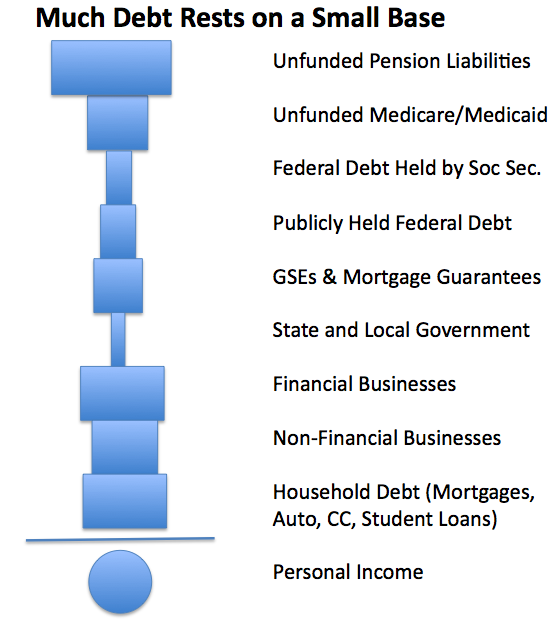
(FIGURE 1) (click on figure to read)
When consumer debt is rising it tends to make the economy look very, very good. When there are layoffs, the interrelationships tend to magnify the impact, making the economic impact much worse. One wonders whether there are tipping points, beyond which it is not really possible for the system to recover--particularly now that the US seems to be at the point of "peak energy" (Section 3), energy is required for growth (Section 3), and growth is required to allow debt to continue (Section 2).
The tower of debt is in some ways deceptive. It can make the economy look mostly OK to the casual observer, until all too quickly, things start to fall apart.
So far, the "fixes" that the US government has been attempting seem mostly counterproductive. Putting government guarantees behind more and more debt (thus stacking Figure 1 higher and higher, with a new TARP layer) just increases the likelihood that the US government will be drawn into the downward spiral. The financial services layer will be less and less needed in years ahead, as our need for debt-based products declines. Bailing it out does not help get additional income to ordinary workers (although it may temporarily protect them from losing their bank account balances).
All aspects of finances will be affected by the unwind of debt. A huge amount of debt will be defaulted on (or will be forgiven, so that an actual default does not need to occur). Regardless of whether the non-payment occurs because of default or forgiveness, the effect on financial institutions will be the same. Financial institutions such as banks, insurance companies, pension funds, and many hedge funds will find themselves in poor financial condition, because they were depending on the proceeds of this debt repayment to fund what they have promised--bank account balances; insurance policies; pension payments; or hedge fund returns. Institutions guaranteeing debt, such as monoline bond insurers will be particularly hard hit. The FDIC will likely be called on to rescue many failed banks, and will need to find funds from some source (printed money?) to do this.
As the year goes on, I expect each evaluation of where we are to be worse. Banks will report operating losses each quarter. Fannie and Freddie will need more funds than originally thought. TARP will need more funds than original planned. More and more businesses will enter bankruptcy, and more and more governments (states, cities, counties, and countries around the world) will find themselves unable to meet their obligations. There are a huge number of inter-relationships, and the bankruptcies and losses in one area will tend to cause more bankruptcies and losses in other areas, and act to destabilize the debt tower.
Debt of all forms will be very difficult to obtain, except through government sources. The interest rate the US government is currently paying is very low, mainly because of a "flight to quality". If the US government keeps issuing more and more debt, it seems likely that at some point this will change, because buyers will figure out that even if the US is the best of a bad lot, its risk of failure is significantly greater than 0%.
I do not expect a steep rise in the price of oil and natural gas in the next year, because the decline in demand is likely to outpace the decline in production in the short-term. If we look back at Figure 2, I expect that funds available to ordinary citizens will continue to decline in 2009, even considering any stimulus plan. This will happen because employee compensation will decline due to layoffs. Household debt outstanding will also decline (rather than just stay flat, as it has in the past year), because of the poor financial condition of lending institutions, and because with the poor economy, the risk of borrower default will be quite high, discouraging lending. A $300 billion stimulus program will be tiny in comparison to the boost the economy got in the past from increasing debt and greater refinancing (up to $2 trillion per year), as the prices of homes increased. With lower incomes, lower (actually net negative) cash flow from borrowing, and only a modest boost from a stimulus program, citizens will have less and less to spend on goods and services.
There is a distinct possibility that this could all end very badly. One possibility is that there will be more and more defaults, and the US government will not be able to prop up all of the institutions and will eventually default on its debt. While this seems to be the direction things are headed at the current time, the much more usual outcome is hyperinflation, caused by printing more and more money, wiping out the value of people's savings and pensions. Situations such as these are often accompanied by a new government (including a new constitution), and may even include different country boundaries (for example, Soviet Union after its fall).
Many people have started making preparation for the time when food needs to be produced locally and electricity is often not available. I would not discourage such preparations. While we do not know that the economy will collapse completely, I think such preparations are prudent, in the face of rising risk. Preparation for a major change takes many years, so starting earlier rather than later makes sense. Also, with the tower of debt (Figure 1) and the many feedback loops, the downward spiral can happen more quickly than our prior experience suggests is possible.
In conclusion, 2009 looks like a very challenging year for the new administration and for the world as a whole.
We are due for a debt unwind, and with it a rapid decline in the US standard of living. Exactly what form it will take, and what the timing will be (for example, sudden one month from now or sudden three years from now, or gradual over a longer period), isn't certain. I would expect that many (or most) other economies in the world will be dragged along in this debt unwind and will experience a decline in their standards of living.
Many asset classes are correlated in time of stress, the tower of debt (Figure 1) has many feedback loops, and tends to magnify the economy's reaction to events, both favorable and unfavorable.
(FIGURE 1) (click on figure to read)
When consumer debt is rising it tends to make the economy look very, very good. When there are layoffs, the interrelationships tend to magnify the impact, making the economic impact much worse. One wonders whether there are tipping points, beyond which it is not really possible for the system to recover--particularly now that the US seems to be at the point of "peak energy" (Section 3), energy is required for growth (Section 3), and growth is required to allow debt to continue (Section 2).
The tower of debt is in some ways deceptive. It can make the economy look mostly OK to the casual observer, until all too quickly, things start to fall apart.
So far, the "fixes" that the US government has been attempting seem mostly counterproductive. Putting government guarantees behind more and more debt (thus stacking Figure 1 higher and higher, with a new TARP layer) just increases the likelihood that the US government will be drawn into the downward spiral. The financial services layer will be less and less needed in years ahead, as our need for debt-based products declines. Bailing it out does not help get additional income to ordinary workers (although it may temporarily protect them from losing their bank account balances).
All aspects of finances will be affected by the unwind of debt. A huge amount of debt will be defaulted on (or will be forgiven, so that an actual default does not need to occur). Regardless of whether the non-payment occurs because of default or forgiveness, the effect on financial institutions will be the same. Financial institutions such as banks, insurance companies, pension funds, and many hedge funds will find themselves in poor financial condition, because they were depending on the proceeds of this debt repayment to fund what they have promised--bank account balances; insurance policies; pension payments; or hedge fund returns. Institutions guaranteeing debt, such as monoline bond insurers will be particularly hard hit. The FDIC will likely be called on to rescue many failed banks, and will need to find funds from some source (printed money?) to do this.
As the year goes on, I expect each evaluation of where we are to be worse. Banks will report operating losses each quarter. Fannie and Freddie will need more funds than originally thought. TARP will need more funds than original planned. More and more businesses will enter bankruptcy, and more and more governments (states, cities, counties, and countries around the world) will find themselves unable to meet their obligations. There are a huge number of inter-relationships, and the bankruptcies and losses in one area will tend to cause more bankruptcies and losses in other areas, and act to destabilize the debt tower.
Debt of all forms will be very difficult to obtain, except through government sources. The interest rate the US government is currently paying is very low, mainly because of a "flight to quality". If the US government keeps issuing more and more debt, it seems likely that at some point this will change, because buyers will figure out that even if the US is the best of a bad lot, its risk of failure is significantly greater than 0%.
I do not expect a steep rise in the price of oil and natural gas in the next year, because the decline in demand is likely to outpace the decline in production in the short-term. If we look back at Figure 2, I expect that funds available to ordinary citizens will continue to decline in 2009, even considering any stimulus plan. This will happen because employee compensation will decline due to layoffs. Household debt outstanding will also decline (rather than just stay flat, as it has in the past year), because of the poor financial condition of lending institutions, and because with the poor economy, the risk of borrower default will be quite high, discouraging lending. A $300 billion stimulus program will be tiny in comparison to the boost the economy got in the past from increasing debt and greater refinancing (up to $2 trillion per year), as the prices of homes increased. With lower incomes, lower (actually net negative) cash flow from borrowing, and only a modest boost from a stimulus program, citizens will have less and less to spend on goods and services.
There is a distinct possibility that this could all end very badly. One possibility is that there will be more and more defaults, and the US government will not be able to prop up all of the institutions and will eventually default on its debt. While this seems to be the direction things are headed at the current time, the much more usual outcome is hyperinflation, caused by printing more and more money, wiping out the value of people's savings and pensions. Situations such as these are often accompanied by a new government (including a new constitution), and may even include different country boundaries (for example, Soviet Union after its fall).
Many people have started making preparation for the time when food needs to be produced locally and electricity is often not available. I would not discourage such preparations. While we do not know that the economy will collapse completely, I think such preparations are prudent, in the face of rising risk. Preparation for a major change takes many years, so starting earlier rather than later makes sense. Also, with the tower of debt (Figure 1) and the many feedback loops, the downward spiral can happen more quickly than our prior experience suggests is possible.
In conclusion, 2009 looks like a very challenging year for the new administration and for the world as a whole.
Series of Posts on the Economy: Peak Oil Planning for 2009
To better plan for Peak Oil impacts, we must understand the how we arrived at the current economic downturn and then forecast what lies ahead for 2009 and the future.
Over the next two days, I will post several articles and comments which explain the current economy and make forecasts for 2009 and the years ahead. To move toward an objective analysis, I will provide a variety of views on the economy.
Readers are welcome to make comments or email me their own assessment which I will post.
Subsequently, I will add a post that relates the economic assessments to oil production forecasts. This analysis will provide a base for making recommendations about planning for Peak Oil impacts.
Over the next two days, I will post several articles and comments which explain the current economy and make forecasts for 2009 and the years ahead. To move toward an objective analysis, I will provide a variety of views on the economy.
Readers are welcome to make comments or email me their own assessment which I will post.
Subsequently, I will add a post that relates the economic assessments to oil production forecasts. This analysis will provide a base for making recommendations about planning for Peak Oil impacts.
Subscribe to:
Posts (Atom)


 Posts
Posts

