Saturday, April 25, 2009

Peak Oil: London Guardian Photos of the Recession, on Flickr, April 25, 2009

See hundreds of photos here.

Peak Oil: Picturing the Recession, The New York Times, April 2, 2009

"NYTimes.com readers are sending in their photos from around the world. How do you see the recession playing out in your community? What signs of hardship or resilience stand out? How are you or your family personally affected? Creative ways of documenting the changes around you are encouraged." Hundreds of photos, arranged by most recent or by topic.

Friday, April 24, 2009

Peak Oil: "Slate's Shoot the Recession Project," Slate Magazine, Hundreds of Photos Posted on Flickr, March 30, 2009

"Slate is turning to our readers and to the Flickr community to find out—we want to know what the recession looks like to you. Please submit photos to this group that capture our perilous economic moment. "

See photos HERE, and look on the site for newly added photos. Periodically, Slate will publish a selection of striking photos from the group in a slide show on Slate."

Peak Oil: "Scenes from the recession," By Alan Taylor, The Boston Globe, March 18, 2009

"The state of our global economy: foreclosures, evictions, bankruptcies, layoffs, abandoned projects, and the people and industries caught in the middle. It can be difficult to capture financial pressures in photographs, but here a few recent glimpses into some of the places and lives affected by what some are calling the 'Great Recession'." (35 photos)

(Continued here).

Peak Oil: "Global recession worst since Great Depression, IMF says," By Jeannine Aversa, Associated Press, April 22, 2009

"WASHINGTON – The global economy is expected to lurch into reverse this year for the first time since World War II with appalling consequences for nations large and small — trillions of dollars in lost business, millions of people thrust into hunger and homelessness and crime on the rise.

And the pain won't stop this year, the International Monetary Fund declared Wednesday, for what it said was "by far the deepest global recession since the Great Depression." To cushion the blow and head off further damage next year, the IMF is calling for more stimulus projects from the word's governments, including major spending for public works projects."

(Continued here).

Peak Oil Financial Crisis: "Fed says gov't ready to save stress-tested banks," By Daniel Wagner, Associated Press, April 24, 2009

"WASHINGTON – The government signaled Friday that some distressed banks will need to raise more cash to meet stricter standards it has set for the 19 financial firms that took its "stress tests" and suggested it's ready to step in with more federal help."

(Continued here).

Peak Oil: "Growing Food When the Oil Runs Out," By Peter Goodchild, Posted on Speaking Truth to Power, December 14, 2007

This post provides a good introduction to the challenge of growing food after the last power blackout.

The challenge is greater when we include the absence of all of readily available seeds, tools, wire, shovels, hardware, string, food storage jars, and fertilizer -- to mention just a few of the items that will not be available after the highways and power grid collapse.

Those who are preparing will now store enough of these items to last as long as possible.

Peter Goodchild understands the need to provide both nutrition and sufficient calories. Many Peak Oil gardening websites forget that a minimum of 2,400 calories per person daily is required for 365 day per year for survival. And his post Peak Oil world examines the reality of growing food without the implements of the Oil Age.

Irrigation presents are more challenging obstacle than he indicates. For much of the world, global warming and drought present real challenges to survival. See Globalis (see there: "How to Use Globalis") where you can see how much of the world, including much of the U.S. and Europe receive less and less rainfall every year. Due to persistent droughts, mMost of the U.S. and Europe are not sustainable, that is to say they are not survivable.

Monday, April 20, 2009

Peak Oil Interview with Dr. Colin J. Campbell, Interviewed by Neil Jackson, Posted by Chris Vernon on The Oil Drum, April 20, 2009

Photojournalist Neil Jackson has recently conducted an interview with Dr. Colin J. Campbell, retired -- Texaco, British Petroleum, Amoco and founder and Honorary Chairman of the Association for the Study of Peak Oil and Gas (ASPO). The interview is reproduced here in full.

Blog comments follow the interview.

Neil Jackson: Why is peak oil important?

Colin Campbell: Peak Oil is a turning point for mankind. It is a big subject.

In short, the population only doubled over the first 17 centuries of the last millennium. But then came coal followed by oil and gas, and the population increased six-fold. These new energy sources, especially oil, the easiest, allowed the rapid expansion of industry, transport, trade and agriculture allowing the economy to expand greatly. It was accompanied by the growth of financial capital as banks lent more than they had on deposit, confident that Tomorrow's Expansion was collateral for Today's Debt.

But now we face the dawn of the Second Half of the Age of Oil when supply declines from natural depletion, meaning that debt goes bad (as is already happening) and the economy contracts. Today's oil supply support 6.7 billion people, but by 2050 the supply will be enough to support no more than about 2.5 billion in their present way of life. So the challenges of using less and finding other energy sources is great.

The transition threatens to be a time of great tension : there are already tribal wars in Africa, disturbances in many places including rioting in Greece. Urban conditions will become especially difficult.


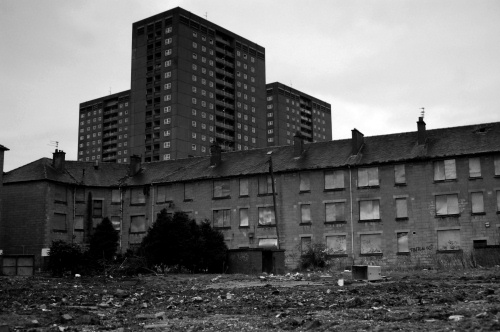
Looming lifestyle changes, derelict housing. Ibrox, Glasgow, UK

NJ: What has been your personal reaction to peak oil?

CC: I happened to have worked in the oil industry and I was not alone in being fully aware of depletion for a long time. But geologists are passive people, given to describing rather than changing things. We can describe the Cretaceous but not change it.

NJ: How are you or your family preparing?

CC: I am too old to do much, but live modestly in an Irish village. My wife however is actively trying to introduce allotments here by which people can feed themselves. We do have a solar panel on the roof, providing hot water from about May to October. If the sun doesn't shine I don't wash.

NJ: Do you think the media are playing the issue down? Has there been much coverage of the issue in the mainstream media? Any ideas as to why?

CC: The media is now taking a serious interest : a trail of journalists and TV crews have been here over the past few years. The BBC and no less than Korean TV was here recently. There are of course vested interests (BP for example) keen to suppress Peak Oil but I think the word is out.

NJ: How about governments? Are they playing the issue down, and if so, what examples can you give? Do you think any governments are approaching Peak Oil correctly? Who?

CC: The position of governments is changing. They are heavily influenced by classical economics and badly advised by such practitioners for whom finding oil is just a matter of investment.

The International Energy Agency is the OECD watchdog, although in practice more of a consumers lobby (not wanting OPEC to know its strength). Ten years ago internally it recognised that peak oil would arrive around 2010, but issued no more than a coded message. Now as Peak Oil arrives it changes its tune, for fear of losing credibility, and begins to admit to it under the slogan let's leave oil before it leaves us.

I happen to know the Irish Minister, who understands the position perfectly and is trying to prepare, but he tells me that the political obstacles are very great. It is promising that Obama has renewables high on his agenda and seems to recognise that the attempted conquest of Iraq's oil failed. Oil discovery in Britain peaked in the 1970s and should have alerted the government that the inevitable corresponding peak of production would follow, but Mrs Thatcher believed in the free market, and exploited the resources as fast as possible, which accelerated depletion.

Britain exported its surplus at low prices but now faces rising imports at high prices. Russia now seems to be aware of its power by controlling Europe's gas supply, and will likely try to conserve what is left for its own use rather than export, which makes sense. It is a big subject, and does not exactly give one much confidence in government.

NJ: It is sometimes said that there are billions of barrels of oil reserves locked up in Canada’s tar sands. Can you say anything about these reserves with respect to peak oil? What are the challenges faced when bringing this oil to market?

CC: The resource in the ground of tarsand in Canada and elsewhere is huge, but extraction is slow and costly, yielding a low or even negative net energy return. My guess is that oil prices in the future will range in the $50-100 range as higher prices would dampen demand by economic recession. If so this is a constraint on developing tarsands (some projects are said to be viable only at $90+) ... and indeed restrain the development of renewable energy).


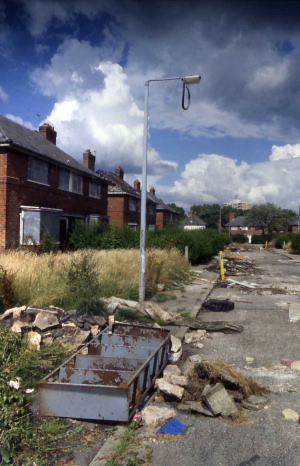
Poverty and the end of suburbia. Benchill, Manchester, UK

NJ: The discovery of oil peaked some 40 years ago – how much oil are we discovering now and what potential is there for further discoveries--new, significant discoveries? Does the Arctic represent another Saudi Arabia? How about the Antarctic?

CC: It is difficult to get good information on recent discovery, but my best estimate is that it is running in the 5-10 billion barrel a year range. The accessible world has now been thoroughly explored, such that all the major productive provinces and large fields within them have been found.

Attention now turns to the deepwater and Polar regions. I think that the main deepwater areas have also already been found : they depend on very exceptional geological conditions as most of the oceans are definitely non-prospective. I do not entertain great hopes for the Polar regions because I think they are generally deficient in effective source rock, and that seal integrity has been impaired by vertical movements of the crust due to the weight of fluctuating ice caps.

There are a few freak occurrences, such as Prudhoe Bay in Alaska, but generally Polar seems to be a gas-prone domain, with sniffs of encouragement that eventually disappoint. It is unlikely to have any material impact on Peak Oil.

NJ: How familiar do you think the senior staff of Western oil majors are with the concept of peak oil? Do they see it as a serious problem either for their business or the wider global economy?

CC: In earlier years, major oil companies did tend to be run by people with exploration experience, for whom peak oil has long been evident (Harry Warman once Exploration Manager of BP was one of the first to publish on it), but now most are run by financiers and engineers, who lack the deeper resource insights. But generally I think they understand.

The Seven major companies are now reduced to four by merger, which is a sign of contraction, and they are selling off subsidiary refineries and marketing chains, evidently recognising that falling supply will give downstream over-capacity.

But remember that the job of managers is to sing to the Stock Market to protect their shareholders' interests under the present system whereby the merits of a firm dividend have surrendered to speculative movements on the Market, which is largely a public relations exercise, as these brokers can have little real understanding of the businesses in which that take positions ("investment" is hardly the word). It is simply not the job of oil company managers to concern themselves with global issues. But that said they do begin to hint and half admit to the obvious truth : Total and Chevron are probably the most forthright, with BP being the least.

NJ: How does oil form, when did it form, where does it form - what does this tell us about the likelihood of finding significant new oil in the middle of the Atlantic... or in the Arctic?

CC: The bulk of the world's oil was formed under special conditions of global warming 90 and 150 million years ago.

Algae proliferated in warm sunlit tropical waters, and the hot surface water prevented normal circulation such that stagnant anoxic conditions occurred at depth. The algal organic remains were accordingly preserved in rifts. On burial to about 2000 meters, it was cooked enough to be converted into oil, which then began to move upwards. Much escaped or was dissipated, but some was trapped at the top of geological structures (arch-like anticlines or against faults).

In addition to these two main epochs there were other local occurrences of little global significance. Naturally, the older the source-rock the greater the chance of loss over geological time.


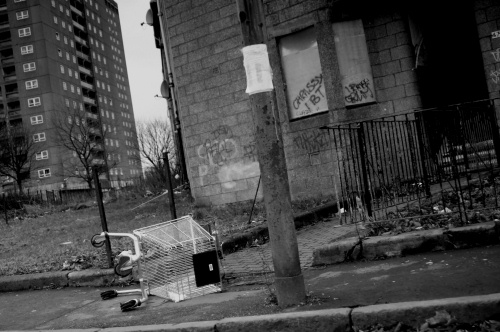
The crash of supermarket culture. Ibrox, Glasgow, UK

NJ: What is your opinion on reserve growth?"

CC: Assessing the size of an oilfield early in its life poses no particular scientific challenge, although it is naturally subject to a degree of uncertainty. Reporting its size is another matter.

The oil companies were subject to strict Stock Exchange rules designed to prevent fraudulent exaggeration while smiling on under-reporting as commercial prudence. Accordingly the major companies reported only as much as they needed to deliver a satisfactory financial outcome. The resulting upward revisions gave a comforting but misleading image of reserve growth.

Those days are however substantially over as the giant fields offering the main scope for upward revision mature. OPEC for its part greatly exaggerated in the 1980s when they were vying with each other for quota based on what they reported as reserves. The industry has developed various technologies (steam, nitrogen, CO2 injection and horizontal drilling plus sophisticated seismic to map the reservoirs in detail) which can increase the recovery, and hence give reserve growth. But the scope for doing so could easily have been foreseen early in the life of the field, even if it was not normal to report it.

NJ: At the ASPO meeting after the Barcelona conference you were talking about retiring from the newsletter at the end of 2008 - and after around 1000 items. The future plan was for individual national ASPO chapters to produce newsletters, or submit items for someone else to correlate. Is that still going ahead?

CC: Yes, I am a bit undecided about the future of the ASPO Newsletter. Obviously I can't keep doing it for ever, and also the main message has been delivered, so I find myself touching more and more on political subjects on which I lack any expertise.

ASPO has evolved as a loose organisation lacking any normal management or cohesion or rules, but that is a good thing as the different entities can do whatever is appropriate and possible in their own countries. I suppose in one sense the Newsletter does hold them together giving a certain common purpose.

One model might be to rotate the overall direction (including the newsletter), but in practice I doubt if that will happen. In one sense its mission has been accomplished as dealing with life in the Second Half of the Oil Age when everything is in decline calls for very different approaches.

NJ: Are we progressing towards implementing technologies to utilize alternative energy sources at a fast enough rate to prevent an economic collapse, or at least to minimize the impact the advent of Peak Oil is having/will have on the global economy?

CC: I doubt that renewable energies will ever replace oil and gas sufficiently to maintain the past order of things or still less allow economic growth to continue. They are of course greatly needed for the surviving communities.

My own preference is tidal energy to tap the massive regular lateral flows of water. Apparently they can build funnel-like walls on the sea bed forcing the tides to speed up through the constriction, and turn a rotor, generating electricity. But apparently such schemes did not compete with cheap oil and gas so far.

There is of course massive scope for using less energy : turning off all those loudspeakers and TV screens in public places would help.

NJ: What effect do the new technologies have on the projections for when production will peak?

CC: I don't think new technologies will have any impact on the date of peak, which I estimate to have been passed in 2008 ("all liquids"), but they can of course ameliorate the subsequent decline. I think most of the necessary technologies are already well known, so the issue is more about applying them than inventing a magic wand.

NJ: There is a lot of debate about why oil prices were so high during this summer, why they've dropped so quickly since then. What is the explanation for this? Were high prices due to "speculation" as many have argued or was it supply and demand, or both, or something else?

CC: I think that Regular Conventional oil peaked in 2005 and prices began to rise, although the shortfall was partly made up by costly tarsands and deepwater production. The rising price trend attracted the interest of the traders who started buying futures and so forth. It might also have made sense for the industry to keep the tanks full, watching them appreciate in value.

But eventually the rising price had an adverse impact on the real economy and the shrewd traders started to unload, selling short on the futures market. The industry too might have started draining its tanks.

But perhaps more important was the flood of petrodollars that the high prices delivered to the governments and royal families of the Middle East, where it still costs $10-15 to produce oil. They probably sent the surplus to western banks who promptly loaned it out on ever less sure collateral. The petrodollars were not really money in the sense of representing work or barter, but simply profiteering from shortage.

The whole flimsy financial edifice has now crashed, and some of the sillier governments are now pumping yet more fictional money into the system to encourage new consumption. Such policies may briefly succeed, but will only make the subsequent crash worse.

We enter a new world, as the principal energy that drove the anomalous past two centuries heads into decline from natural depletion. This is not necessarily a doomsday message. I have known many simple people in different parts of the world who smiled and laughed not being part of the consumer society.

There are encouraging signs. A BBC film crew who was here recently told me that they had become so convinced of the Peak Oil issue, which they had studied to make their programme, that they had decided to quit the BBC and buy a small farm in the west of England on which to build a simple sustainable future. That was most encouraging, I thought.


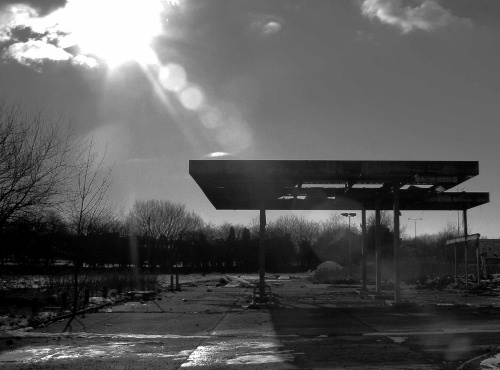
The end of the road for one petrol station. Near Derby, UK

---
Photojournalist Neil's slideshow, which looks in part at Peak Oil, can be viewed here.

Blog comments:

Dr. Campbell provides a valuable historical and global perspective on Peak Oil, geology, oil reserves, and the economy.

ASPO has been forecasting not only when Peak Oil and Gas would occur, but also how oil production will decline. ASPO could continue to conduct research on future oil production and net oil and gas production. As oil and natural gas production decline, more oil and natural gas energy is expended in extraction and refining processes, and less net oil and natural gas are actually produced. Because the net production curve toward depletion is steeper than the production curves that we see on most all charts, this is an important question. For much deep water oil and gas extraction, the point at which the amount of oil/gas expended equals the amount of oil/gas produced is reached quickly, especially when all of the oil/gas used for manufacturing all of the ships, pipelines, platforms, refineries, parts, their manufacture in factories that use energy, and all of the employee/stock owner salaries/dividends/pensions for all of the companies (salaries/dividends/pensions are spent and use oil/gas), and transportation for all of the above parts and employees.

Dr. Campbell concludes that alternative energies will not make up for much of the decline in fossil energies, and he favors developing tidal energy. My analysis indicates that alternatives and renewables will use up much fossil energy and liquid fuel in their development and yield electric energy, which is not the liquid fuel we need for tractors/combines, trucks, trains, and ships. And objective analysis indicates that tidal energy will not be developed due to siting limitations. And again, it yields electric energy, which is not needed as factories, commercial centers, and offices close.

Saturday, April 18, 2009

Peak Oil Recession: "IMF sees long and severe slowdown," BBC News, April 16, 2009

"The current global recession is likely to be 'unusually long and severe, and the recovery sluggish,' the International Monetary Fund has warned."

"Slowdowns linked with financial crises tend to be severe, while synchronised slowdowns last longer, it said.

The current global crisis has also been strongly felt in emerging economies, it said in its World Economic Outlook.

The global links between financial sectors have intensified the speed the downturn has spread across the world.

With the financial crisis intensifying, more countries are coming to the IMF for help and its supply of funds to loan may run out."

But...................no mention of oil production or Peak Oil.

(Article and video)

Friday, April 17, 2009

The Great (Peak Oil) Recession, Who's to Blame, and How People Adjust, TIME/CNN, April 17, 2009

Here you find lots on: who is to blame for the financial crisis; how some people in the U.S. are adjusting to the "Great Recession;" photos of failed retail stores; and a poll on attitudes; and how people are handling the "recession."

But there is not a photo display of how this impacts poor Americans or those in the economically less developed countries.

Missing on the blame list are those who issued fairy tales about future oil production and future oil prices -- the Energy Information Agency (EIA), International Energy Agency (IEA), U.S. Geological Survey (USGS), Cambridge Energy Research Associates, and private and national oil companies.

There is no mention of Peak Oil or high oil prices. No mention that last year economists quoted in "The Wall Street Journal" said that if oil goes above $125 per barrel we will go into recession. No mention that Dr. Colin Campbell, ASPO Ireland, ASPO International, Congressman Roscoe Bartlett, the U.S. General Accountability Office, the Hirsch report, Jim Puplava, James Kunstler, Chris Shaw, Gail the Actuary, Matt Savinar, Peter Goodchild, Kathy McMahon, me, and many others warned about a looming Peak Oil recession. And no mention that many voices now warn that the recession will grow into an ever worsening economic depression.

Thursday, April 16, 2009

Peak Oil Financial Crisis: "General Growth files largest U.S. real estate bankruptcy," By Ilaina Jonas and Emily Chasan, Reuters, April 16, 2009

NEW YORK (Reuters) - "General Growth Properties Inc, the second-largest U.S. mall owner, declared bankruptcy on Thursday in the biggest real estate failure in U.S. history.

Ending months of speculation, General Growth, along with 158 of its 200-plus U.S. malls, filed Chapter 11 while it tries to refinance its debts.

But the ongoing global financial crisis made it impossible for General Growth to restructure outside of bankruptcy and could signal further troubles for other financial institutions who are General Growth creditors."

(Continued here.)

Dr. Colin Campbell Predicted the Peak Oil Credit Crunch in 2005

Dr. Colin Campbell Predicted the Peak Oil Credit Crunch in 2005.

Dr. Samsam Bakhtiari (deceased), a former senior analyst for the National Iranian Oil Co. (NIOC) of Tehran, Iran warned of similar economic impacts in 2006.

Tuesday, April 14, 2009

"Preparing for a Post Peak Life Video," By Prepared for the Peak, 2009

"Preparing for a Post Peak Life Video: Why You Should Prepare and How You Should Get Started" provides good explanations of Peak Oil, the economy, and basic preparations.

But don't count on jobs in the renewable energy sector, as those jobs will be among the first to disappear.

Also, the authors do not focus on the reality of a final power blackout and a fast collapse at some point. Richard Heinberg appears to forecast this collapse between now and 2030. I guesstimate the collapse will occur before 2020. After this, things will get "challenging."

We are facing the collapse of the highways that depend on diesel trucks for maintenance of bridges, cleaning culverts to avoid road washouts, snow plowing, roadbed and surface repair. When the highways fail, so will the power grid, as highways carry the parts, transformers, steel for pylons, and high tension cables, all from far away. With the highways out, there will be no food coming in from "outside," and without the power grid virtually nothing works, including home heating, irrigation, water and waste water treatment, pumping of gasoline and diesel, airports, communications, and automated systems.

This is documented in a free 48 page report that can be downloaded, website posted, distributed, and emailed: http://www.peakoilassociates.com/POAnalysis.html

In June I took a trip to Albany to talk to 3 audiences on Peak Oil impacts. In the group that invited me, the Capital Regional Energy Forum CREF), is a physicist who teaches solar energy at a major university, and who had served in the Peace Corps.

He has solar powered just about everything, including a solar powered canoe which we went for long ride in on a lake in the Adirondacks, and a PV solar powered house and pump for his well. He repairs about everything on his house himself and he heats much with passive solar. So the guy knows his stuff. He is no ivory tower academic.

We talked for hours about survival in the northeast after the last power blackout.

It looks "challenging."

Eventually batteries and even the solar panels deteriorate. He thinks that he could store dry batteries with the liquid stored in glass and thus make "new batteries" after they conk out. But eventually the batteries and solar panels give out.

Cutting and moving wood without trucks, horses, and wagons will be a major effort and very time consuming. There are not many horses around and it will take decades to breed enough horses to go around. Horses require food, care, vets, and medicine. No one is making wagons these days locally.

Wood stoves break, just like everything else. You could keep one or 2 extras, but eventually you have none and can't get more, because there is no transportation on the highways.

Asphalt roof shingles need to be replaced, and houses need to be painted and maintained.

Food must be grown in with a short growing season, and all of the farm stuff that used to be in a 1890 Sears catalog is no longer available. Last summer I took a tour of a farm and saw how dependent farming is on oil -- transportation and manufacture of plastic feeding bowls, containers to store grains/feeds, straw, roofs for animals and storage areas, wire, rope, wood boards, cement, fencing, antibiotics for animals, asphalt shingles etc. Seed and hardware used to be available at the local hardware store, no more.

Then there is clothing which is manufactured and transported from afar. Making cloth is a major operation from growing cotton to making cloth. I have studied the textile mills of Lowell National Historical Park in Lowell, MA for years, as I used it as an example of the confluence of capital, technology, and labor for a course I taught on Global Urban Politics at the University of New Hampshire. I know that the parts in those factories were manufactured in many places with a vast transportation network. After the last power blackout, those factories will not be built again. And there are not many sheep around, nor animals for making leather clothes. Eventually down coats and comforters wear out, as do blankets. It sounds like just keeping warm will be a major problem.

Potable water is another problem, and sanitation also.

And there will be no modern pharmacies or hospitals.

After auto and air transport end (which could be next week if there is some "untoward activity" in the Middle East), there will be no way of getting here, or from here to there. Bus and train reservations will be backed up for years. You know the old Maine joke, "can you get there from here?" Well this time the answer will be no you can't. I keep reading in the newspapers that some of the folks over there in the Middle East are tired of others (including the elites in their own countries) getting most of that oil, and that they are trying to shut down the flow of oil to us.

Wasn't it that guy Murphy who said that if something can go wrong it will.

When the music stops (that is when air and automobile transportation ends) where you are is important, because that is pretty much where you will stay.

Monday, April 13, 2009

Peak Oil Financial Crisis: "Moody's Downgrades The Whole Country," By Joe Weisenthal, The Business Insider, April 8, 2009

"The Federal government is still AAA, but every municipal debt issuer is now suspect and shaky according to Moody's.

For the first time ever, the ratings agency placed all munis on negative outlook, a precursor to potential downgrades. Historically, the agency looked at munis individually and considered them to be too diverse to make blanket statements about."

(Continued here).

Peak Oil Homeless: "Homeless In Tent City, USA," By Kathy Sanborn, CounterPunch, April 3-5, 2009

"Homeless encampments around the country are mushrooming, much to the embarrassment of government officials, may of whom prefer to hear no evil, see no evil. In Fresno, California, a shantytown called “New Jack City” is host to newly poor, unemployed electricians and truck drivers, who share space with drug addicts and the mentally ill who have been homeless for years."

(Continued here).

Peak Oil Financial Crisis: "Best Places to Get a Part-Time Job," By Kate Klonick, SmartMoney.com, April 10, 2009

"Best Places to Get a Part-Time Job"

Saturday, April 11, 2009

Peak Oil Crime, Personal & Home Security: "Boom in Gun Sales Fueled by Politics and the Economy," By Sean Gregory, TIME.com, April 8, 2009

"Americans are afraid of this economy. As a result, they're getting locked and loaded. To wit: Jacquita Baker, a soft-spoken single mother from Kentwood, Mich., near Grand Rapids. She works as an administrative assistant at the Grand Rapids Urban League and is studying criminal justice at a local university. As of Monday, she's the proud owner of a shotgun. Why bear arms now? "The economy played a large part in my decision," says Baker, 27. 'When people don't have jobs, they might go breaking into people's homes. I want to be safe in my home.'"

(Continued here).

Peak Oil Crime, Personal & Home Security: "Equity and Guns," Airdale, April 11, 2009

One response in a recent blog discussion of equality after resource depletion:

Airdale on April 11, 2009 - 8:35pm

Perhaps I am not understanding the concept here.

If we are speaking post powerdown then with most communications lost then whose is to know who is where on the economic rung?

Right now let me make an observation that may tend to show what the future might hold.

I recently went to two guns shows. I also in the last week visited two sporting goods stores where one dealt solely with firearms.

What I saw was astounding and has happened just within a few months.

The gun shows first. One before Jan 2009. Moderate supplies of all items. Moderately full of purchasers and browsers .Trade was brisk with quite a few new firearms and quite a bit of ammunition. Prices were a bit above normal. This was around Nov 2008.

The next gun show was two weeks ago. The difference was amazing. First it was so crowded you had to stand behind someone to get to a table. There were over 500 tables/setups by those selling. The crowd was enormous and you had to shuffle slowly down the aisles.
There was few new firearms. Most all was used and rather used at that. Ammunition was almost non-existant and was very expensive. I saw really few firearms of real value. This was mostly older stuff that was used and dealers were making a killing at high prices.

I might add that the attendees were not your run of the mill gunowning types. Yes some collectors but what I saw was families. Women with their husbands and children. Buying,buying and buying. Walking out with lots and lots of purchases. The parking lot was overcrowded.

Then the two dealers. One used to have many shelves full of powder,bullets, brass and all the rest. Now all his shelves had been taken down and he had mere handfuls of ammo. Some very oxidized meaning very old. Nothing at all is the most desired calibers. He had zero reloading equipment. No restocking in a couple months and no more inventory on the way , he said. Shocking to me. I always stop by when in the neighborhood.

The next was just a firearms dealer. He had NOTHING. Maybe a rack of older used shotguns and a few rifles and almost no handguns. His shelves were totally bare. He said "Can't sell what I can't get."

I don't see how he was going to stay in business.

So it seems to me that firearms and defense is going to be a huge part of the 'equality' issues. Surely everyone is stocking for a couple reasons.

One. They finally have realized we are sinking fast. They are now on board and most will by weapons vs land and gardening. What they have they value I believe they are intent on defending.

Two. Obamas mutterings and House Bills that are out and out threats to make very big changes in the laws governing firearms. They see it as an assult on their freedoms to defend themselves and their property.

This to me is where the equality or lack of it wlll manifest itself.

Money might become meaningless to many shortly. We are seeing extreme weather changes. That storm that blew thru Arkansas and Tennessee came up here. I heard it roaring like 100 locomotives as it passed just to the north of me by 2 miles. Hail and hard hard rain.

So yesterday I saw the damage. A 75 ft radio tower toppled. A barn in the path totalled. A huge grain bin with an big kink in its side. Some hi tension twin leg power lines thrown on the ground like tinker toys. It was very localized. Only a mile wide and no circular movements. Just one very very strong wind. Never heard wind blow like that in all my years and I have been in several nearby tornadoes.

The times are achanging. We really can't see to what except it won't be BAU.

Airdale-perhaps OT but I wanted to make these observations. Folks are arming up rapidly and fully. If someone comes to take their weapons? Then hell will start immediately.

Peak Oil Financial Crisis: "It's Now a Renter's Market," by Prashant Gopal, Business Week, April 10, 2009

"Across the U.S., desperate landlords are coming up with novel ways to attract new tenants and retain old ones."

Peak Oil Financial Crisis: "Fox orders downsizing reality series," By James Hibberd, The Hollywood Reporter, April 8, 2009

""You're fired" -- but for real.

Fox has ordered a one-hour unscripted series that turns real-life company layoffs into a reality contest.

The show's working title is "Someone's Gotta Go." Employees are called to a meeting and informed there will be layoffs, but with a reality show twist: The staff will be allowed to determine who is fired.

The employees will have access to the company's internal information -- budgets, HR files, salaries, etc. -- to help make their decision."

(Continued here).

Peak Oil Financial Crisis: "Recession Anxiety Seeps Into Everyday Lives," By Pam Belluck, The New York Times, April 8, 2009

"Anne Hubbard has not lost her job, house or savings, and she and her husband have always been conservative with money. But a few months ago, Ms. Hubbard, a graphic designer in Cambridge, Mass., began having panic attacks over the economy, struggling to breathe and seeing vivid visions of “losing everything,” she said."

(Continued here).

Peak Oil Financial Crisis: "The American mood: Is the angst bottoming out?" By Ted Anthony, Associated Press, April 11, 2009

CLIFTON, NEW JERSEY -- "Want some economic angst? That's easy, too. Drive straight up Bloomfield Avenue into Glen Ridge, Montclair and Verona. Gaze at the empty Volvo and Jaguar dealerships and the deserted bank. Contemplate the thinned-out blocks of storefronts, defunct restaurants, abandoned shops and "For Lease" signs in one of the region's more affluent areas.

More doom on the horizon? Or will happy days soon be here again? Take your pick. The confusion is enough to play havoc on a person's mood — or an entire nation's. "Everybody is looking at it through their own personal lens," says Liza Dawson, a self-employed literary agent from Glen Ridge."

(Continued here).

Upcoming Teleseminar May 1st: Managing Peak Oil Blues, Kathy McMahon, Psy. D.

Friday, May 1st, 11:00 am -12:30 pm. Eastern Standard Time - “Emotional Realities in Managing the Big Three E’s (Energy, Environment, Economy): What Do We Know After Three Years of ‘Peak Oil Blues’?”with Dr. Kathy McMahon, the "Peak Shrink." Cost: $30.00. Register at: info@peakoilblues.com by April 27th, 2009.

(More information here)

"Pathways to Community Collapse: Can We Intervene?" By Kathy McMahon, Peak Oil Blues Blog, April 10, 2009

"As communities are facing high unemployment, economic hardship and deteriorating infrastructure, they will be left even more vulnerable when fossil fuel once again rises in price. In the early stages of distress, appeals to the “common good” or “cooperative engagement” may be met warmly and enthusiastically by townspeople.

However, there are predictable changes as hardship, deprivation and even violence escalates, which impacts on this spirit of altruism. One size does not fit all when working within a community setting. It is a skill to recognize the level of community functioning, or at what stage of collapse the system is functioning, and to work within these circumstances skillfully. Is an important skill for concerned citizens and community activists alike."

(Continued here).

Friday, April 10, 2009

Peak Oil Financial Crisis: "Job fair turnout creates gridlock," By Michael Cousineau & Pat Grossmith, The New Hampshire Union Leader, April 10, 2009

MANCHESTER, NH – "A massive turnout at the Project Economy Job Fair sponsored by WMUR triggered gridlock around the Mall of New Hampshire and traffic tie-ups elsewhere yesterday."

"About 10,000 people lobbied employers to obtain one of at least 1,500 available jobs."

(Continued here).

Note: Seasonally Adjusted Unemployment Rates - February 2009

United States 8.1%
New Hampshire 5.3%

Peak Oil Crime, Personal & Home Security: Auto GPS and Home Robbery, April 10, 2009

A security expert poses as a burglar to show the biggest safety mistakes homeowners make. (short video).

Peak Oil Financial Crisis: Regulatory "Stress Tests" for banks to determine their capital needs under more adverse economic conditions.

"Banks asked to keep quiet on stress tests"

By Karey Wutkowski, Reuters, April 10, 2009

WASHINGTON – "The U.S. Treasury Department is asking banks not to mention the regulatory 'stress tests' as part of their first-quarter earnings results, according to a source familiar with government discussions."

(Continued here).

Most readers won't understand this article. It appears that the U.S. Treasury Department is not as optimistic about the economy as public statements would indicate. This is a study to see how much more money the public will have to fork out to subsidize the banks and their friends as the economy implodes.

Some of the financial crisis is due to Peak Oil, but most is caused by years of corporate and government mismanagement and corruption. Who is paying for this? The poor and unemployed.

Rather than subsidizing the banks and affluent, the government could provide public works and public service employment. But that would mean "subsidies for the poor" and "make work" for millions of unemployed workers. Public works and public service employment could be directed to building a national rail system to prepare for Peak Oil impacts.

Thursday, April 9, 2009

Peak Oil Financial Crisis: "US home price drops set records in January," By Alan Zibel, Associated Press, March 31, 2009

"WASHINGTON – Home prices sank by the sharpest annual rate on record in January, and the pace continues to accelerate, but there were a handful of battered metro areas where price declines slowed, according to data released Tuesday."

(Continued here).

Peak Oil Preparation: "Save $50 a Day, How Three Super Savers Do It," By Kiplinger.com, March 31, 2009

"Take a look at how real people put cost-cutting ideas into action and watch their savings add up."

Peak Oil Preparation: "Suze Orman's New Ideas on Credit Card Debt," By Kimberly Palmer, U.S.News & World Report, April 3, 2009

"Top priority: build as much of an emergency cash fund as you can." "Consumers now need to make creating an emergency fund with eight months worth of expenses their top priority." Says the Queen of Personal Finance Suze Orman.

(Continued here).

Peak Oil Financial Crisis: "Homelessness up as families on the edge lose hold," By Wendy Koch, USA TODAY, Updated April 9, 2009

"Cities and counties are reporting a sharp increase in homeless families as the economic crisis leads to job loss and makes housing unaffordable."

(Continued here).

Peak Oil Financial Crisis: "New jobless claims fall more than expected to 654K," By Christopher S. Rugaber, Associated Press, April 9, 2009

WASHINGTON (AP) -- "New jobless claims fell more than expected last week but are stuck at elevated levels, while the number of people continuing to receive unemployment insurance approached 6 million, setting a record for the 10th straight week."

"The Fed expects the unemployment rate -- now at a quarter-century high of 8.5 percent -- will probably "rise more steeply into early next year before flattening out at a high level over the rest of the year," according to minutes from the central bank's March meeting released Wednesday. Many private economists expect the rate will hit 10 percent by year's end."

(Continued here).

This would put the total unemployment rate at some 18% by year's end.

Wednesday, April 8, 2009

Peak Oil Preparation:"The Wall Street Journal" Gives Advice for the Recession, April 1, 2009

"Five Financial Moves You Should Definitely Make -- and Five You Shouldn't."

Some of the advice is good: "Guard Against Inflation."

But some advice is questionable. Unless you really know where to invest, the stock market is probably not a good idea, as permanent economic depression will undermine stock values. Investing in retirement is always a good idea, but the stock market is not the way to go. Investing in what will benefit you before and after economic and societal collapse is best. Answering that question will take much thought and planning.

Tuesday, April 7, 2009

Peak Oil Financial Crisis: "Quarter of companies globally set to freeze pay," Reuters, April 7, 2009

"A quarter of the world's companies, and 40 percent in the United States, plan to freeze salaries this year, but employees in South America and India can look forward to robust rises, a global survey shows."

(Continued here).

Sunday, April 5, 2009

Peak Oil Financial Crisis: "One in 10 Americans gets help from U.S. to buy food," Reuters, April 2, 2009

WASHINGTON (Reuters) – "A record 32.2 million people -- one in every 10 Americans -- received food stamps at the latest count, the government said on Thursday, a reflection of the recession now in its 16th month."

Continued here)

Peak Oil Financial Crisis: "Shrinking airlines park more planes in the desert," By Joshua Freed, Associated Press, April 4, 2009

MARANA, Arizona – "Old jets come here, empty engine pods shrink-wrapped in white, tall red tails fading to pink in the desert sun. More will come soon. Some will never fly again."

"Eventually, some will be sold, some scrapped, some will sit at desert facilities in southern California, Arizona, and New Mexico. But at the moment, their number is growing faster than expected. The banking crisis has made it very difficult to get loans to buy aircraft, and the drop in commodity prices has gutted their scrap value."

(Continued here).

Friday, April 3, 2009

Peak Oil Planning: The G20 Global Plan for Economic Recovery Is an Illusion

In 2004, geologist Colin Campbell (retired -- Texaco, British Petroleum, Amoco) cautioned, "Throughout history, people have had difficulty in distinguishing reality from illusion. Reality is what happens, whereas illusion is what we would like to happen. Wishful thinking is a well-worn expression. Momentum is still another element: we tend to assume that things keep moving in the same direction. The world now faces a discontinuity of historic proportions, as nature shows her hand by imposing a new energy reality. There are vested interests on all sides hoping somehow to evade the iron grip of oil depletion, or at least to put it off until after the next election or until they can develop some strategy for their personal or corporate survival. As the moment of truth approaches, so does the heat, the deceptions, the half-truth and the flat lies." (Reality and Illusion source)

The 2009 G20 global recovery plan is an illusion, and ASPO President Kjell Aleklett explains why in detail:

"Not enough oil for the G20 package," originally published in the Swedish newspaper "Uppsala Nya Tidning," April 4, 2009 and translated into English on his blog here.

Peak Oil Financial Planning: "America's oil bust: setting ourselves up for another price spike, " By Steve Hargreaves, CNNMoney.com, April 3, 2009

"The collapse in oil prices from over $147 a barrel has caused many oil producers to pack up their rigs and stow their jacks. Some fear the drop in production activity will lead energy prices to spike once the economy recovers."

(Continued here).

High oil prices mean that inflation is just around the corner, as noted in a previous post.

Peak Oil Employment: "Hired! 5 successful job seekers share their secrets," CNNMoney.com Fortune Magazine, April 3, 2009

Read 5 Case Studies here.

Peak Oil Financial Crisis: "Small business lending drops 57%," By Emily Maltby, CNNMoney.com April 3, 2009

"President Barack Obama warned recently that small business lending had declined so sharply that the Small Business Administration was on track to back only half as many loans this year as it did last year. The SBA's lending data for the just-ended quarter bears out that bleak forecast: The number of loans the agency backed though its flagship program declined 57%."

(Continued here)

Peak Oil Financial Crisis: "Unemployment Rate Bolts to 8.5%, 663,000 Jobs Lost in March, " By Jeannnne Aversa, Associated Press, April 3, 2009

"If part-time and discouraged workers are factored in, the unemployment rate would have been 15.6 percent in March, the highest on records dating to 1994, according to Labor Department data released today."

"It's fresh evidence of the toll the recession has inflicted on America's workers, and economists say there's no relief in sight."

(Continued here)

Wednesday, April 1, 2009

Peak Oil Employment: "How to get a job," By Jia Lynn Yang, March 30, 2009 CNNMoney.com Fortune Magazine

"It's brutal out there. But the people getting hired aren't necessarily the most connected - they're the most creative. From food diarists to Twitter stalkers to candidates tapping the "hidden" job market, here's what's working now." (Continued here).

Tuesday, March 31, 2009

Peak Oil Employment: "How to Get a Job When No One's Hiring," By Jia Lynn Yang, March 30, 2009 (FortuneonCNNMoney.com)

"David Perry, a longtime headhunter, says you're wasting your time if you're looking for job postings online. And he should know: he's often the guy on the other side helping companies lure new talent. Perry, who's based in Ottawa, says that in the last 22 years he has accomplished 996 searches totaling $172 million in salary. And the bottom line in today's economy, he says, is you have to tap the 'hidden job market'."
(Contined here)

Monday, March 30, 2009

Sunday, March 29, 2009

Peak Oil Financial Planning: Living the Frugal Life

Introducing "Living the Frugal Life" a blog on "How we live well on less. Frugal recipes, practical tips, money confessions, and a dollop of modern homesteading technique," by Kate of Southeastern Pennsylvania.

See Kate's Most Popular Posts and Topical Topics

Thursday, March 26, 2009

Guest Post by Sebastian Ronin: “Post-Peak Oil and NAmerican Regional Secession”

In a web posted article, Sebastian Ronin concludes that national economic policies and Peak Oil mean that national governments will fail. A regional legal structure will be needed. Clearly, after the last power blackout national governments will not be able to govern. No communications and no transportation mean no national government.

Sebastin’s introduction to “Post-Peak Oil and NAmerican Regional Secession:”

I am an entropist. Being an entropist entails a meta-perspective upon this world that captures and stamps all natural, social, political and economic phenomena within its unique parameters of qualification. It applies equally from the build-up of clutter in a household, to global warming and climate chaos, to financial meltdown, to the implosion of the large industrial nation-state, as it does to the departure of a soul from the constraints of its body. It is a worldview, a Weltanschauung, a philosophical Babushka doll of many layers and complexities. It is my hope that one day the Laws of Thermodynamics will be taught at the grade school level, matching if not displacing, a false and jingoistic Pledge of Allegiance.

Albert Einstein is purported to have said about the Second Law of Thermodynamics, “It is likely the truest law in the physical universe.” The Second Law is the Entropy Law. It foreshadows and dictates that our world rushes towards a state of maximum disorder. Nowhere is this more evident than with the events we witness on a daily basis, events that signal the pinnacle and beginning collapse of industrial civilization. The only hypothetical antidote to the dictates of entropy is the creation of small pockets of negative entropy, the creation of small eco-states inclusive.

Industrial civilization has arrived at its apex, as is so clearly signaled by the ever-increasing acknowledgment of Peak Oil. It is all about energy, or lack thereof, as laid out by the Second Law: the ability to do work is dependent on access to energy; without energy, social institutions collapse/implode, the institution of the large industrial nation-state inclusive.

As an historical metaphor, I offer the following: we live in Copernican times. A new worldview, a true paradigm shift, is birthed from out of the cauldron of crisis. As the false notion of the earth being the center of the universe was rejected because it had to be rejected, I maintain that the false notion of the large industrial nation-state will in time be rejected because it also has to be rejected.

The rationale and motives for my being a secessionist revolve around my first of all being an entropist. Cultural and ethnic drivers towards secession, even the bourgeoning States’ Rights movement, are contained within the meta-conditions and meta-dictates of the Second Law. It is my hope that the paper, Post-Peak Oil and NAmerican Regional Secession, offers the reader an introductory glance, with the benefit of wearing entropic spectacles, at secessionist tendencies in play on the North American continent. It is my hope that one will perceive that our destiny as citizens lies in responsibly embracing a political philosophy of secession-by-default in order to seize the opportunity at hand, in order to begin the creation of new eco-states upon this continent, in order to extend social and political liberties and responsibilities beyond the cadaver of the industrial nation-state, and lastly, in order to survive and continue the human adventure.

The article is found here.

Peak Oil Financial Planning: High Oil Prices and Inflation Loom

"Financier sees oil shock from credit crunch," By Christopher Johnson
Reuters, March 26, 2009

"The global financial crisis and collapse in the oil market have stalled vital investment in oil exploration and production and are likely soon to lead to a sharp spike in prices," says energy investment banker Matthew Simmons. "We are three, six, maybe nine months away from a price shock. We are not talking about three to five years away -- it will be much sooner." (Continued here)

Thus, in addition to the dollar losing value from "printing dollars" to pay for bailouts the dollar will weaken from inflation brought on by high oil prices. This will bring about tighter credit and reduced investment in oil production and ageing/corroding oil production infrastructure.

Soon, governments will have to subsidize oil production and the unemployed, as well as heating oil and natural gas for heating their homes.

Wednesday, March 25, 2009

Peak Oil Financial Planning: Get Out of the U.S. Dollar Now

"Why you should get out of the US dollar now!" By Justice Litle in CommodityOnline.com

"Get out of the U.S. Dollar. NOW. Do not pass go, do not collect $200, do not stop to conduct an impromptu inventory of your unmentionables." (Continued here)

This article is based on concerns that "China wants the dollar replaced as reserve currency." But regardless of this, printing dollars means inflation, and Peak Oil inflation is just around the corner. All currencies, pensions, retirement plans, life insurance, health insurance, and long term care insurance are promises to be able to buy oil in the future (all depend on oil). As oil supplies diminish, these promises evaporate in inflation and bankruptcies.

Gold and silver are mentioned as possible safe havens, but are not. The prices of gold and silver have not been going up as the world economy collapses. Both are used in electronics and jewelry and therefore the demand for these metals is collapsing. Gold and silver are a bubble waiting to burst.

Friday, March 20, 2009

Peak Oil: Myth or Reality

Oil and stock analyst Tony Ericksen of the Oil Megaprojects Task Force concludes that global oil production peaked in 2008:

"World oil production peaked in 2008 at 81.73 million barrels/day (mbd). This oil definition includes crude oil, lease condensate, oil sands and natural gas plant liquids. If natural gas plant liquids are excluded, then the production peak remains in 2008 but at 73.79 million barrels per day. However, if oil sands are also excluded then crude oil and lease condensate production peaked in 2005 at 72.75 mbd.

The US Energy Information Administration (EIA) and the International Energy Agency (IEA) should make official statements about declining world oil production." (continued here).

Other sources have concluded much the same.

Friday, March 6, 2009

The Peak Oil Economic Depression Has Arrived

A headline from Chicagotribune.com states: "Jobless rate bolts to 8.1 percent, 651K jobs lost in February."

"The net loss of 651,000 jobs in February came after even deeper payroll reductions in the prior two months, according to revised figures. The economy lost 681,000 jobs in December and another 655,000 in January," based on U.S. Department of Labor statistics."

But the real unemployment rate is now more like 12 or 13 percent, according to analyst Lee Adler, writing in "The Wall Street Examiner." Adler concludes that, "today’s deterioration is at least as rapid, and probably more rapid, than the beginning of the Great Depression."

Dow Jones concludes that today's stock market decline mimics the Great Depression.

Thus, both increasing unemployment and declining stock values indicate that we are entering an economic depression similar to the Great Depression.

Although it is difficult to determine how much of this economic depression is caused by Peak Oil impacts and how much stems from mismanagement of the economy as well as from business and government corruption, ASPO-Ireland explains that Peak Oil plays a major role.

But the current economic depression is permanent, due to declining global oil production, according to a recent post on EnergyBulletin.net.

We are entering the "Greatest Depression."

In the Great Depression of the 1930s, government programs and the build up for World War II stimulated the economy. The East Texas oil boom powered the factories, highways, trucks, tractors, trains, transportation, and infrastructure to make it possible.

Now, the problem is declining oil production, and there is no energy boom to help us pull ourselves up by the bootstraps.

There is no plan for developing energy alternatives that will power trucks, trains, ships, tractors, and combines, nor is there time or capital to develop alternatives. Capital is scarce due to declining oil production. Chris Shaw explains that energy is the source of capital, and hence, capital declines as oil production drops.

A review of government and scientific studies indicates that regardless of the time or capital available, no alternatives will begin to make up for declining global oil production.

Whatever alternative energy we attempt to develop will consume valuable oil (mining, manufacturing, and transportation) and not deliver the liquid fuels that we need. Chris Shaw call this the "quicksand effect."

The Congress and president will be at a loss of how to manage this ever-worsening economic collapse. They would be wise to commission the National Academy of Sciences (NAS) to provide the nation with advice. Chaos will result from the advice of contradictory interest groups, organizations, bloggers, and individuals. The NAS is the most credible source for such advice. The NAS and other scientific sources have already undertaken the basic research needed for a policy study to advise the nation. The NAS could provide an energy policy study within a year and could then provide advice on a continuing basis.

The best advice for individuals and organization is to prepare for Peak Oil impacts. No federal or state agencies are studying Peak Oil impacts and contingency planning. A few local governments and organizations are beginning to make plans.

This is what we must plan for. With increasing costs for gasoline and diesel, along with declining taxes and declining gasoline tax revenues, states and local governments will eventually have to cut staff and curtail highway maintenance. Eventually, gasoline stations will close, and state and local highway workers won’t be able to get to work. We are facing the collapse of the highways that depend on diesel and gasoline powered trucks for bridge maintenance, culvert cleaning to avoid road washouts, snow plowing, and roadbed and surface repair. When the highways fail, so will the power grid, as highways carry the parts, large transformers, steel for pylons, and high tension cables from great distances. With the highways out, there will be no food coming from far away, and without the power grid virtually nothing modern works, including home heating, pumping of gasoline and diesel, airports, communications, water distribution systems, waster water treatment, and automated building systems.

Tuesday, March 3, 2009

Peak Oil Preparation: Dow Jones decline rate mimics Great Depression

By Dawn Kawamoto, March 2, 2009

With the Dow Jones Industrial Average falling below the psychological watermark of 7,000 on Monday, investors may be wondering how it all stacks up against the stock market crash of the Great Depression.

It's not looking good. (continued here)

Peak Oil Preparation: Protecting Your Financial Assets

From MONEY and MARKETS, "Beginning Now: The Panic Phase of the Collapse"

By Martin D. Weiss, Ph.D. February 3, 2009 (Excerpts)

The panic phase of this collapse is about to begin.

The panic phase is an acceleration in the economic decline … a chain reaction of debt explosions … a free-fall in the financial markets … and a series of rude awakenings that will accelerate the decline even further.

First and foremost, get your money to safety. (Continued here)

Sunday, February 1, 2009

Peak Oil and the Global Economy

Recent news headlines reveal that the U.S. economy is deteriorating rapidly: “Be Prepared for More Cutbacks,” “Mass Layoffs Continue at Rapid Pace,” and “Economy’s Plunge is Worst in Quarter-Century.”

The Work Bank forecasts that the recession of 2008 will extend into 2009 and probably to 2010:

“A pronounced recession is believed to have begun in mid-2008 in Europe, Japan, and most recently, the United States. This recession is projected to extend into 2009. The possibility of a serious global recession cannot be ruled out. Even if the waves of panic that have inundated credit and equity markets across the world are soon brought under control, the crisis is likely to cause a sharp slowdown in activity stemming from the deleveraging in financial markets that has already occurred and that is expected to continue.”

The World Bank sees some signs of optimism for 2010, but concludes that “global recession is likely to be protracted” and “an even sharper recession is likely.”

A variety of analysts of The Wharton School, forecast a deep recession extending through 2010 and possibly beyond.

Gerald Celente, Editor and Publisher of "The Trends Journal," forecasts a global economic collapse beginning in 2009 (interview summary, not quoted directly):

The global economy will collapse in 2009, resulting in the worst recession in the post WW II period. The commercial real estate sector is highly leveraged and will collapse beginning in late February or early March as major retailers fail, leaving vacant rental space that will not be filled. This will lead to further failures in the finance and banking sectors and higher unemployment which is at 13% and growing.

Some two-thirds of the U.S. economy is based on consumerism, which is declining rapidly due to increasing unemployment. Declining personal income means a shrinking tax base and a need to raise state, local, and federal taxes and user fees.

This economic collapse, Celente believes, will lead to the "Greatest Depression," more corporate fraud, increased street crime, taxpayer revolts, rioting, and revolution. Survival is now a real concept as people lose investments and jobs. A return to frugality and self-sufficiency will characterize the economy in years to come.

Financial analyst Gail Tverberg explains the economic crisis in terms of a “Tower of Debt.” Because most debt ultimately rests on personal income, as personal income declines most debts are at risk: unfunded pension liabilities, unfunded Medicare and Medicaid, Social Security debt, publicly held federal debt, government sponsored enterprises (such as Fannie Mae and Freddie Mac), state and local government debt, financial businesses, businesses, and household debt (mortgages, credit cards, and education loans). This supports Gerald Celente’s forecast. When personal income declines (due to increasing unemployment), consumerism declines, retails businesses fail, highly leveraged commercial centers fail and default on loans, causing banking and financial institutions to collapse.

ASPO-Ireland examines the economy in light of Peak Oil (excerpts from the ASPO Newsletter):

“Oil demand had begun to outpace supply around 2005, when the production of Regular Conventional Oil passed its peak. The shortfall was however relatively small and was partly met without undue difficulty by a modest reduction in consumption.

But as prices began to firm, oil traders and other speculative financial institutions began to take a position in the market, which had the effect of driving up the price. Gradually the process built momentum as huge notional profits were reaped from the appreciating asset. In a conventional market such movements would soon be countered by increased production, but in the case of oil, there was no spare capacity to release, and the speculative surge fed on itself leading to an extreme escalation in price which reached about $150 a barrel by July 2008. However as this peak [in prices] was approached, the traders began to conclude that a limit was close and began to buy future options at lower prices, which began to undermine the price in a self-fulfilling process. In parallel the high prices began to undermine many other aspects of the economy with for example airlines and automobile manufacturers facing difficulties. They themselves relied heavily on debt, which itself was traded between banks without adequate genuine collateral, and were forced to unload their speculative oil positions in order to try to shore up their failing businesses. Gradually the whole edifice collapsed, and oil prices fell to around $50 a barrel, although nothing particular had changed in the actual supply/demand relationship.

The flaw in the system was to treat a finite resource whose production was largely controlled by the immutable physics of the reservoir as if it were a normal commodity capable of responding to ordinary market pressures. If the price of potatoes increases, farmers can grow more and the market responds, but oil is different.

Governments responded to the crash by pouring yet more money, itself lacking genuine collateral, into the system in the mistaken belief that this would restore the position of assumed eternal growth, and quite possibly the stock market will respond positively as traders sense a new upward direction. They have no real interest in reality: their job being to try to reap rewards from short term movements.

But if there is an economic recovery, that would serve to increase the demand for oil, which is in a sense the lifeblood of the modern world, and oil prices would again begin to surge. Probably, it will take several such vicious circles before governments and, more important, people at large at last come to grasp the reality of the situation, which will likely prompt radical changes in the human condition.

Meanwhile, desperate efforts are being made around the world to shore up the crumbling financial system. For example, the Bank of England has radically reduced interest rates in a country facing a severe recession, effectively taking money from savers to give to spenders.

The Government has evidently failed to grasp the underlying causes of recession and hopes that pumping a bit of money into the system will restore it to its previous condition. That was premised on eternal economic growth, which is a somewhat unrealistic proposition for a Planet of finite dimensions, but Governments subject to re-election are by nature short-term in their thinking.

One is led to conclude that the entire Stock Market, including especially the oil market, has become a thoroughly debased speculative institution. In earlier years, investors clubbed together to build a specific project, such as a canal or railway, with the resulting dividend being the prime motivation. Things seemed to have gone wrong when such investments were traded on markets by financial institutions which naturally can have no serious knowledge of the underlying business or the true value to be placed upon it.”

Energy investment banker Matthew Simmons, like ASPO-Ireland, notes that today’s low oil prices and credit shortage will reduce investments needed for oil production, resulting in lower oil production in the future, followed by increasing oil prices as demand out strips supply, which will then cause another economic downturn in the future. Simmons also notes that the aging oil infrastructure of drilling rigs, rusting platforms, pipelines, and refineries must be renovated, requiring trillions of dollars in investments at a time when credit is tight..

Independent studies indicate that Peak Oil occurred between 2005 and 2008 and that global crude oil production will now decline from 74 million barrels per day to 60 million barrels per day by 2015. During the same time, demand will increase. Oil supplies will be even tighter for the U.S. As oil producing nations consume more and more oil domestically they will export less and less. Because demand is high in China, India, the Middle East, and other oil producing nations, once global oil production begins to decline, demand will always be higher than supply. And since the U.S. represents one fourth of global oil demand, whatever oil the U.S. conserves will be consumed elsewhere. Thus, conservation in the U.S. will not slow oil depletion rates significantly. More and more oil is expended in oil production and processing as lower grades of oil are extracted from an increasing number of smaller oil fields that are located in hard to access ocean depths. These factors will increase the oil production decline rate above the six percent that is forecasted in a few years

These Peak Oil factors suggest that there will be no economic recovery following the economic collapse of 2009 and that the recession will deteriorate into a permanent economic depression that will worsen over time.

In 2007, the U.S. General Accountability Office (advised by a panel of 13 scientists of the National Academy of Sciences) examined the potential of alternative energies for replacing liquid fuels (that are vital for transportation and food production):

“An imminent peak and sharp decline in oil production could have severe consequences. The technologies we examined [ethanol, biodiesel, biomass gas-to-liquid, coal gas-to-liquid, and hydrogen] currently supply the equivalent of only about 1% of U.S. annual consumption of petroleum products, and DOE [U.S. Department of Energy] projects that even under optimistic scenarios, these technologies could displace only the equivalent of about 4% of annual projected U.S. consumption by around 2015. If the decline in oil production exceeded the ability of alternative technologies to displace oil, energy consumption would be constricted, and as consumers competed for increasingly scarce oil resources, oil prices would sharply increase. In this respect, the consequences could initially resemble those of past oil supply shocks, which have been associated with significant economic damage. For example, disruptions in oil supply associated with the Arab oil embargo of 1973-74 and the Iranian Revolution of 1978-79 caused unprecedented increases in oil prices and were associated with worldwide recessions. In addition, a number of studies we reviewed indicate that most of the U.S. recessions in the post-World War II era were preceded by oil supply shocks and the associated sudden rise in oil prices. Ultimately, however, the consequences of a peak and permanent decline in oil production could be even more prolonged and severe than those of past oil supply shocks. Because the decline would be neither temporary nor reversible, the effects would continue until alternative transportation technologies to displace oil became available in sufficient quantities at comparable costs. Furthermore, because oil production could decline even more each year following a peak, the amount that would have to be replaced by alternatives could also increase year by year.”

There is no plan nor capital for a so-called electric economy. And most alternatives yield electric power, but we need liquid fuels for tractors/combines, 18 wheel trucks, trains, ships, and surface mining equipment.

The independent scientists of the Energy Watch Group conclude in a 2007 report titled: “Peak Oil Could Trigger Meltdown of Society:”

"By 2020, and even more by 2030, global oil supply will be dramatically lower. This will create a supply gap which can hardly be closed by growing contributions from other fossil, nuclear or alternative energy sources in this time frame."

With increasing costs for gasoline and diesel, along with declining taxes and declining gasoline tax revenues, states and local governments will eventually have to cut staff and curtail highway maintenance. Eventually, gasoline stations will close, and state and local highway workers won’t be able to get to work.

We are facing the collapse of the highways that depend on diesel and gasoline powered trucks for bridge maintenance, culvert cleaning to avoid road washouts, snow plowing, and roadbed and surface repair.

When the highways fail, so will the power grid, as highways carry the parts, large transformers, steel for pylons, and high tension cables from great distances.

With the highways out, there will be no food coming from far away, and without the power grid virtually nothing modern works, including home heating, pumping of gasoline and diesel, airports, communications, and automated building systems.

Governments, business and individuals should prepare for the impacts of Peak Oil.

Friday, January 30, 2009

Economy's New Plunge is Worst in Quarter-Century, by Jeannine Aversa

January 30, 2009
Washington, D.C.
Associated Press


Economy has worst slide since `82 -- and tailspin is accelerating as Americans ax spending

Battered by layoffs, debts and dread of worse to come, shoppers clutched ever tighter to their wallets in the final three months of 2008 and thrust the economy into its worst downhill slide in a quarter-century. Americans cut spending on everything from cars to computers, and it's only getting worse so far in the new year. (Continued here)

Thursday, January 29, 2009

Mass Layoffs Continue at Rapid Pace, by Christopher S. Rugaber

January 28, 2009
Washington, D.C.
Associated Press

Mass layoffs involving 50 or more workers increased sharply last year, and large job cuts appear to be accelerating in 2009 at a furious pace.

Boeing, Pfizer, Home Depot and other U.S. corporate titans have announced tens of thousands of job cuts this week alone.

The economy is likely to continue to shed jobs for the rest of this year, even if an economic stimulus bill pushed by President Barack Obama is approved, economists said. (Continued here)

The Wall Street Journal: "Be Prepared for More Cutbacks," by Anna Prior

January 26, 2009

The Wall Street Journal notes that "Unemployment is hitting numbers we haven't seen in over a decade," and that many companies are cutting costs through layoffs and salary reductions and freezes. The Journal offers advice for cutting family expenses and securing your job.

Friday, January 23, 2009

Gerald Celente: Economic Trends for 2009

Gerald Celente is Editor and Publisher of "The Trends Journal"
Interivew MP3 January 17, 2009

Summary of the Interview: (not quotations)

The trend for 2008 was panic, a crashing stock market, some major retail store closings, and the loss of 2 million jobs in the last quarter of 2008.

The global economy will collapse in 2009, resulting in the worst recession in the post WW II period. The commercial real estate sector is highly leveraged and will collapse beginning in late February and March as major retailers and financial institutions fail, leaving vacant rental space that will not be filled. This will lead to further failures in the finance and banking sectors and higher unemployment.

Real unemployment is 13% and growing.

Some two-thirds of the economy is based on consumerism, which is declining rapidly due to increasing unemployment. Declining personal income means a shrinking tax base and a need to raise state, local, and federal taxes and user fees.

This will lead to the "Greatest Depression," increased street crime, more corporate fraud, taxpayer revolts, rioting, and "revolution." Survival is now a real concept as people lose investments and jobs. A return to frugality and self-sufficiency will characterize the economy in years to come.

Wednesday, January 21, 2009

ASPO Examines the Economy and Peak Oil: December 2008

Excerpts from the Association for the Study of Peak Oil and Gas (ASPO-Ireland) December 2008 Newsletter. The full article is available here.

In years ahead, analysts may look back on the current crisis and identify its causes. They may conclude that oil demand had begun to outpace supply around 2005, when the production of Regular Conventional Oil passed its peak. The shortfall was however relatively small and was partly met without undue difficulty by a modest reduction in consumption.

But as prices began to firm, oil traders and other speculative financial institutions began to take a position in the market, which had the effect of driving up the price. Gradually the process built momentum as huge notional profits were reaped from the appreciating asset. In a conventional market such movements would soon be countered by increased production, but in the case of oil, there was no spare capacity to release, and the speculative surge fed on itself leading to an extreme escalation in price which reached about $150 a barrel by July 2008. However as this peak [in prices] was approached, the traders began to conclude that a limit was close and began to buy future options at lower prices, which began to undermine the price in a self-fulfilling process. In parallel the high prices began to undermine many other aspects of the economy with for example airlines and automobile manufacturers facing difficulties. They themselves relied heavily on debt, which itself was traded between banks without adequate genuine collateral, and were forced to unload their speculative oil positions in order to try to shore up their failing businesses. Gradually the whole edifice collapsed, and oil prices fell to around $50 a barrel, although nothing particular had changed in the actual supply/demand relationship.

The flaw in the system was to treat a finite resource whose production was largely controlled by the immutable physics of the reservoir as if it were a normal commodity capable of responding to ordinary market pressures. If the price of potatoes increases, farmers can grow more and the market responds, but oil is different.

Governments responded to the crash by pouring yet more money, itself lacking genuine collateral, into the system in the mistaken belief that this would restore the position of assumed eternal growth, and quite possibly the stock market will respond positively as traders sense a new upward direction. They have no real interest in reality: their job being to try to reap rewards from short term movements.

But if there is an economic recovery, that would serve to increase the demand for oil, which is in a sense the lifeblood of the modern world, and oil prices would again begin to surge. Probably, it will take several such vicious circles before governments and, more important, people at large at last come to grasp the reality of the situation, which will likely prompt radical changes in the human condition.

The election of Mr Barrack Obama seems to have been greeted with rapture in the United States and around the world. Certainly he projects an attractive personality and speaks fluently and well, but the main enthusiasm seems to lie in his mixed racial background. Part of his family emanates from Kenya, possibly having some Arab blood, and the Irish stake claim to other antecedents. Some observers hope that his election will spell regime change and the end of the so-called War on Terror, which seems to have failed to extend global economic hegemony. On the other hand, his election, which required massive funding, suggests that he relied on more than the simple ballot box. Indeed, the financier, Rahm Emanuel, who has apparently served in the Israeli Army and is the son of a former member of the Irgun Zvai Leumi terrorist movement, has been appointed as Chief of Staff, suggesting that the established influences will remain in power. But by all means, most people welcome the change, and look forward with enthusiasm to new policies with which to face the unfolding situation, imposed ultimately by dwindling oil-based energy.

The new Presidency will certainly have to work a radically new situation for which no one is truly prepared. Even the leading American intelligence organisation, the National Intelligence Council (NIC) has issued a report entitled Global Trends 2025: A World Transformed which concludes that the days of US global economic and military power are over, foreseeing an end to the western model of economic liberalism, as the State is forced to take a more active role.

Meanwhile, desperate efforts are being made around the world to shore up the crumbling financial system. For example, the Bank of England has radically reduced interest rates in a country facing a severe recession, effectively taking money from savers to give to spenders.

The Government has evidently failed to grasp the underlying causes of recession and hopes that pumping a bit of money into the system will restore it to its previous condition. That was premised on eternal economic growth, which is a somewhat unrealistic proposition for a Planet of finite dimensions, but Governments subject to re-election are by nature short-term in their thinking.

The reporting of economic parameters: the official US numbers are apparently also highly suspect. The US Bureau of Labor Statistics (BLS) reports that US Consumer Price Inflation (CPI) is running at 5%, having changed the procedure for doing so in 1990. According to shadowstats.com, a more realistic estimate would be 13%. The Federal Reserve Bank no longer reports the so-called M3 for the creation of new money, but the same source suggests it is currently running at 13%, contributing to inflation. Officially, Gross Domestic Production (GDP) has increased by 2%, whereas the alternative source suggests that it is declining at 3%. Likewise, official estimates of unemployment at 6% contrast with the alternative estimate of 15%. Added credibility for the alternative assessment comes from no less than General Motors, which reports that global passenger car sales fell by 6% during the Third Quarter of this year. Apparently, various hidden agencies related to the Federal Reserve Bank may be manipulating gold and silver prices, which have fallen since the financial crisis broke. The fall does not seem a natural response, given that gold is the traditional safe haven in times of stress and growing inflation. Indeed according to the August issue of the Bank Participation Report, Bear Stearns had a large short position on COMEX silver at the time of its forced merger with JP Morgan in March. The transfer was undertaken by the US Treasury under somewhat dubious procedures. No doubt gold holdings are also involved in the labyrinthine dealings.

One is led to conclude that the entire Stock Market, including especially the oil market, has become a thoroughly debased speculative institution. In earlier years, investors clubbed together to build a specific project, such as a canal or railway, with the resulting dividend being the prime motivation. Things seemed to have gone wrong when such investments were traded on markets by financial institutions which naturally can have no serious knowledge of the underlying business or the true value to be placed upon it.

The Wharton School: Global Economic Forecast for 2009

Knowledge@Wharton

January 7, 2009

After a year of financial shock and sharp economic loss, 2009 is likely to be extremely difficult for the global economy, with investors, business leaders and policymakers struggling to find signs of recovery, according to Wharton faculty and academic partners around the world.

"It's all pretty negative," says Wharton finance professor Franklin Allen. "The economy is going into a recession and my own view is that it will be deep and quite long-lasting. There doesn't seem to be anything on the horizon that is a bright spot."

In the wake of crumbling stock markets, mounting bad debt and rising unemployment, policymakers are scrambling to devise strategies to restore stability and lay the groundwork for new growth. "There's no country in the world that's doing well," Allen continues. "Everybody is doing badly, with large amounts of debt and heading toward deflation," plus "unemployment and a rush by companies to fire people."

The collapse in the United States is different than in other industrialized countries around the world because the problems began in the financial sector and spread out into the broader economy, says Wharton management professor Mauro Guillén. In the rest of the world, problems in the real economy -- created largely by trouble in the United States -- led to weakness in financial markets. "In the United States, the key in 2009 is, 'Can we clear up the mess in the financial sector?' Unfortunately, I'm not very optimistic," says Guillén.

Wharton finance professor Richard Marston says he is shocked by the impact of the crisis on U.S. financial firms and markets. "To see Wachovia, Wash Mutual, Citi all gravely wounded. It's extraordinary." Marston contends that while the banks have been shored up, they are unlikely to lend for a long time. On top of that, he adds, the inability to securitize will constrain credit more than if banks alone had cut back on lending. (Continued here)

The World Bank: Global Economic Prospects 2009

Outlook Summary, December 9, 2008

The stresses in the financial markets of the United States that first emerged in the summer of 2007 transformed themselves into a full-blown global financial crisis in the fall of 2008: credit markets froze; stock markets crashed; and a sequence of insolvencies threatened the entire international financial system.

Massive liquidity injections by central banks and a variety of stopgap measures by governments proved inadequate to contain the crisis at first.

The initially hesitant policy response has become increasingly robust.
The United States government introduced a $700 billion rescue package and has taken equity positions in nine major banks and several large regional banks.

Various debt and deposit guarantees have also been introduced.
At the same time, European governments have announced plans for equity injections and purchases of bank assets worth some $460 billion, along with up to almost $2 trillion in guarantees of bank debt.

At the time of this writing, November 20, 2008, markets remain volatile despite the forcefulness of these measures and signs that credit conditions are improving somewhat in high-income countries.
Both private-sector and sovereign interest rate spreads for developing countries have spiked even higher, and a growing list of countries have been forced to seek assistance from the International Monetary Fund (IMF).

During the initial phases of this financial crisis in 2007, the effects of the financial turmoil on developing countries were relatively modest.
However, as the crisis intensified in 2008 and especially since mid-September, risk aversion (the absence of which had been the hallmark of the preceding boom) has increased, and capital flows to developing countries have seized up.

As a result, the currencies of a wide range of developing countries depreciated sharply, and developing-market equity prices have given up almost all of their gains since the beginning of 2008.
Initial public equity offerings have disappeared, and risk premiums have increased to more than 700 basis points on sovereign bonds and to more than 1,000 basis points on the debt of developing- country firms.

Very recent data on bank lending and foreign direct investment inflows are not available, but indications are that these inflows have also declined, but less dramatically.

Virtually no country, developing or high- income, has escaped the impact of the widening crisis, although those countries with stronger fundamentals going into the crisis have been less affected.
The deterioration in financing conditions has been most severe in countries with large current account deficits, and in those that showed signs of overheating and unsustainably rapid credit creation before the financial crisis intensified.

Of the 20 developing countries whose economies have reacted most sharply to the deterioration in conditions (as measured by exchange rate depreciation, increase in spreads, and equity market declines), 6 come from Europe and Central Asia, and 8 from Latin America and the Caribbean.

In this climate, growth prospects for both high-income and developing countries have deteriorated substantially, and the possibility of a serious global recession cannot be ruled out.
Even if the waves of panic that have inundated credit and equity markets across the world are soon brought under control, the crisis is likely to cause a sharp slowdown in activity stemming from the deleveraging in financial markets that has already occurred and that is expected to continue.

In the baseline forecast presented in this chapter, much tighter credit conditions, weaker capital inflows to middle-income countries, and a sharp reduction in global import demand are expected to be the main factors driving the slowdown in developing countries.
Import demand is projected to decline by 3.4 percent in high-income countries during 2009, while net private debt and equity flows to developing countries are projected to decline from $1 trillion in 2007 to about $530 billion in 2009, or from 7.7 to 3 percent of developing-country GDP.

As a result, investment growth in developing countries is projected to slow dramatically, rising only 3.5 percent in middle-income countries, compared with a 13.2 percent increase in 2007.

A pronounced recession is believed to have begun in mid-2008 in Europe, Japan, and most recently, the United States.
This recession is projected to extend into 2009, yielding a decline in high-income country GDP of 0.1 percent that year (see Forecast summary table).

In developing countries, growth is projected to slow to 4.5 percent in 2009, down from 7.9 and 6.3 percent in 2007 and 2008.
Overall, global GDP is projected to expand only 0.9 percent in 2009 (figure 1.1)— below the rate recorded in 2001 and 1991 and indeed, the weakest since records became available beginning in 1970.

Because low-income countries have less access to international capital markets, the slowdown will affect them mainly through indirect mechanisms, including reduced demand for their exports, lower commodity prices, and reduced remittance inflows.
International trade is projected to decelerate sharply, with global export volumes falling by 2.1 percent in 2009—the first time they have declined since 1982 and eclipsing the 1.9 percent falloff that occurred in 1975.

Export opportunities for developing countries will fade rapidly because of the recession in high-income countries and because export credits are drying up and export insurance has become more expensive.

Slower growth in high-income countries is estimated to have reduced remittance flows into developing countries from 2 to 1.8 percent of recipient country GDP between 2007 and 2008. At the country level, the extent of further slowdown will depend critically on exchange rate developments, with recent swings in bilateral exchange rates dwarfing the expected changes in remittances denominated in host-country currencies.

The global growth recession is projected to cause both commodity prices and inflation to ease further, with oil prices averaging about $75 a barrel (bbl) in 2009, and food and metal prices projected to decline by about 23 and 26 percent, respectively, compared with their average levels in 2008.
Nevertheless, commodity prices will remain well above the very low levels of the 1990s. Lower commodity prices should reduce the burden on some segments of the poor (notably urban dwellers), whose purchasing power has declined because of high food and fuel prices (see chapter 3 of Global Economic Prospects 2009).

Lower prices should also help dampen headline inflation.
Indeed, the rapid rise of food and energy prices over the course of 2007 and the first half of 2008, coupled with tight capacity in many countries (following years of very fast growth fueled by ample liquidity) caused headline and core inflation to pick up throughout the world.

Headline inflation increased by 5 percentage points or more in most developing countries, and more than half of developing countries had an inflation rate in excess of 10 percent by the middle of 2008.
This financial crisis and the expected abrupt slowing of global growth comes at a moment when developing countries considered as a whole are more vulnerable than they have been in the recent past.

Higher commodity prices have widened current account deficits of many oil-importing countries to worrisome levels (they exceed 10 percent of GDP in about one-third of developing countries), and after having increased substantially, the international reserves of oil-exporting developing countries are now declining as a share of their imports. Moreover, inflation is high, and fiscal positions have deteriorated both for cyclical reasons and because government spending has increased to alleviate some of the burden of higher commodity prices.

Although the global recession is likely to be protracted, some elements of an eventual recovery can already be discerned.
These include early movement toward stabilization in the housing sector in the United States; continued progress on debt workouts and a strengthening of balance sheets among both banks and households; a gradual easing of credit conditions as government rescue packages take hold and investors begin to return to heavily discounted equity markets; increases in real incomes (stemming from lower food and fuel prices) among individuals with relatively high marginal propensities to consume; and increased space for fiscal and monetary policies as inflationary pressures ease and government outlays on food and fuel subsidies decline in tandem.

Although this sober outlook represents a likely outcome, the situation remains unstable, and a wide range of outcomes are possible, including a scenario where the rebound of growth in 2010 is weaker, held back by continuing banking sector restructuring, and negative wealth effects resulting from lower housing and stock market prices.
An even sharper recession is also possible. If the freeze in credit markets does not thaw as anticipated in the baseline, the consequences for developing countries could be catastrophic.

Financing conditions would deteriorate rapidly, and apparently sound domestic financial sectors could find themselves unable to borrow or unwilling to lend—in both international and domestic markets.
Such a scenario would be characterized by a long and profound recession in high-income countries and substantial disruption and turmoil, including bank failures and currency crises, in a wide range of developing countries.

Sharply negative growth in a number of developing countries with all of the attendant repercussions, including increased poverty and unemployment, would be inevitable.

Although it is a receding concern, high inflation in developing countries remains a problem, especially if the impact from the current crisis on developing-country investment demand is less pronounced, and the stimulus provided by various rescue and fiscal packages in high- income and developing countries feeds a rapid expansion in demand.
Under such a scenario, global growth would still slow in 2009, which would tend to dampen inflationary pressures initially, but growth could be expected to snap back much more sharply in 2010.

Countries that now have large current account deficits and high inflation could suffer from a renewed overheating of their economies.
Policies would have to be very prudent in these circumstances, because the currencies of these countries are likely to remain sensitive to changing market perceptions and increased risk aversion.

The challenge for policy makers is not only to prevent an escalation of the crisis and to mitigate the downturn but also to ensure a good starting position once the rebound sets in.
For developing countries, this means responding rapidly and forcefully to signs of weakness in domestic banking sectors, including resorting to international assistance where necessary.

It also means pursuing a prudent countercyclical policy, relying on automatic stabilizers, social safety nets, and infrastructure investment that addresses bottlenecks that have become binding constraints on long-term sustainable growth in many countries.

In the current circumstances of heightened risk aversion and investor skittishness, policy makers need to be especially wary of taking on excessive levels of debt or creating the conditions for an inflationary bubble by reacting too aggressively to the global slowdown.
Although it is important for policy makers to react quickly to emerging problems, it is also essential that steps and conditions attached to assistance be well focused on overcoming some of the fundamental sources of weakness.

Otherwise there is a risk that governments lose the support of markets and taxpayers in their efforts to limit the extent of near-term disruptions.